For day two of our 16 Days of Activism 2022, we return to the theme of sexual violence during Partition, rape as a weapon of war, displacement and forced migration that Butalia’s blog opened with. Pallavi Chakravarty’s piece on neglected experiences of violence adds further to Butalia’s opening piece.
Pallavi Chakravarty
The photo above (which is also the featured image for this post) is from Jugantor newspaper (1952). It reflects the dilemma of migrants in the wake of novel means of restricting influx on one side (passport in this context) and pushing out of minorities from the other side. Interestingly it is the body of the woman who is personifying all refugees here and men who are representing bureaucratic, political and social guardians.
Rape, abduction, and branding or mutilation of female genitals have been means often used as a ‘weapon of war’.
Looking at the South Asian context, it is in the violence accompanying the division of the Indian subcontinent in 1947 where this ‘weapon of war’ was mastered and used on an unprecedented scale. Hindu, Muslim and Sikh women seemed to have only two options before them: violation of their ‘honour’ at the hands of the ‘other’, which was considered a cause of shame and insult to the family, community and nation; and shockingly, ‘honour killing’ at the hands of their own family members, which was hailed as an act of martyrdom. Thus, ‘honour’ was interpreted as being embodied upon the unviolated body of the woman and the violation of the same supposedly brought dishonour to the family, community and nation. What being violated meant to the woman herself held much less significance.
Even today, oral testimonies show how stories of women jumping into the wells or ‘willingly’ offering to be slain by the knives of father, brother and other males of the same community are told and retold with pride by the male survivors of partition violence while the narratives of the women who were abducted and later restored by an arrangement between the two states (India and Pakistan)[1] are silenced or even forgotten.
Through the Recovery and Restoration Act (1949), both the states added further violence by making it compulsory for women to be ‘restored’ to their family of origin if found in the home of the other community, irrespective of their own will.
This caused dual displacement for the abducted women who may have been resigned to their fate or who knew that they would not be welcomed back home because they had been violated - that too by the other community.
Violence upon the bodies of the women was more commonplace in the western border of the subcontinent. But India was also divided on its eastern border and here the level of violence was ostensibly lower. This was largely due to the presence of Mahatma Gandhi here on the eve of partition thereafter it became possible for the two warring communities, Hindus and Muslims, to live together peacefully a little longer. Consequently, there was no large scale mass displacement here; rather, migration occurred in phases like the ebb and flow of the tide.
The violence at the eastern border was not always so explicit and direct. In fact, it was often dismissed as mere ‘psychological fear’, thereby denying it any degree of seriousness by the State and host community. Yet hereto, the threat to the honour of their women was the biggest concern for Hindu women coming from East Pakistan as refugees. Certain incidents narrated by them highlight this fear in clearer terms. To cite one example: one of them told Hiranmoy Bandyopadhyay, Rehabilitation Commissioner for West Bengal, that when the women went to take a bath in the pond, some Muslim men would often remark, ‘Pak Pak Pakistan, Hindur Bhatar Mussolman [This is Pakistan, the husband of a Hindu will be a Mussalman]’. Another refugee said that one of the Muslims called out to the ladies in the pond: ‘E bibi, bela je bede cholo. Aar deri keno? Ebar ghore cholo. [Oh Bibi, it is evening now, why delay any further, lets go home.]’[2]
Upon hearing such incidents, Bandyopadhyay noted that while fear was a genuine factor for migration, it was still all in the mind, i.e. psychological—‘manoshik nipiron’. However, what seemed ‘psychological’ to the distant government and the people of West Bengal, as well as the rest of India, was an everyday reality lived by Hindu women in East Pakistan.
Asoka Gupta and her husband Saibal Kumar Gupta [3]recorded testimonies of many East Bengal refugees on their own initiative for the purpose of submitting these eyewitness accounts to the enquiry commission set up by the Government of West Bengal in the aftermath of the 1964 Calcutta riots. These include a few testimonies of refugee women as well, who spoke of the gruesome violence they were either themselves exposed to, or which they had heard of. Bhatarani Ghosh stated that her parents, brother and sister were killed by the Muslims of their village (she names them as well) who later occupied their home. When her husband tried to oppose this forcible occupation of their home, he was threatened with dire consequences. In the face of such mounting pressure, they left their village and crossed over to India. Other accounts by refugee men and women identified abduction of women as one key factor that compelled migration to India. These accounts show how insecure the Hindus felt in East Pakistan, and yet their real fears were dismissed as a mere psychological construct.
It is my argument that when the State recognizes what it regards as ‘real’ violence, it also recognizes the victims of such violence as its direct responsibility. It then extends far-reaching help to these victims. The State recognized mass abductions, sexual violation and forcible conversion as ‘real’ violence. Only those women who were exposed to such violence became the immediate responsibility of the State. [4]Thus, many women coming from East Pakistan would have to face further hardships for they were not always seen as victims of ‘real’ violence.
Independence and Partition were marred by violence and women bore the major brunt of it. Undoubtedly, once they migrated to the host country (India or Pakistan), their immediate care and rehabilitation became a task of absolute importance. But in many ways, the distinction between ‘real’ and ‘psychological’ forms of violence left its mark on patterns of migration and final rehabilitation. Thus it can be argued that the impact of the differing experiences of violence on migration and consequently upon relief and rehabilitation measures for refugees coming into India through its eastern and western borders of India was profound. 
[1] The Recovery and Restoration of the Abducted Persons Act (1948): An act which allowed for an elaborate machinery to operate between the two States, India and Pakistan, to recover women of all age and boys upto age 16 if found in the homes of the other community and to restore them to their original family/community, whether willing or unwilling.
[3] Saibal Kumar Gupta, Civil Servant and officer in charge of rehabilitation of Bengali refugees in Dandakaranya (Chattisgarh, India) and his wife Asoka Gupta, a social worker who and looked specially into the rehabilitation of refugee women.
[4] She was a prominent Social Worker and was made the Head of the Women’s Section of the Ministry of Relief and Rehabilitation for the partition-refugees.
Author’s Bio
Pallavi Chakravarty is Assistant Professor at the School of Liberal Studies, Ambedkar University Delhi. She is currently Junior Fellow at the Nehru Memorial Museum and Library, New Delhi (July 2021-23).
She has obtained her doctoral degree from the Department of History, University of Delhi (2013) and her doctoral thesis made a comparison of the rehabilitation policies of the Indian state vis-à-vis the partition-refugees coming into the two cities: Delhi and Kolkata, from West and East Pakistan respectively. It is now published as a monograph, Boundaries and Belongings: Rehabilitation of the Partition Refugee in India, 1947-71, New Delhi: Primus Books (2022). Her main areas of research are: partition studies, refugee studies, oral history methodology.
Cover of Boundaries and Belongings: Rehabilitation of the Partition Refugee in India, 1947-71, New Delhi: Primus Books (2022).
Acclaimed feminist author and publisher Urvashi Butalia opens this year’s Blogathon with the hard truths we learn when we listen to survivors’ stories.
Urvashi Butalia
Featured image: ‘Carrying Home’ by artist Nilima Sheikh
People migrate for all sorts of reasons – political conflict, climate change, violent discrimination, poverty, in search of work, and so much more. Such ‘journeys’ (if one can call them that) are not always voluntary, and even when they seem ‘voluntary’ on the surface, behind that façade lies a set of circumstances that make it impossible for people to stay on in places which are settled.
Migrations differentially impact people – depending on their class, caste, location, gender, religion and so much more. And when people settle in new places, part of the struggle for survival is also a struggle to recreate a sense of home, the burden of which often falls on women.
So how do we begin to talk about this subject? And how measure, say, something like displacement in the lives of those – women – who have never really had a place to call their own? In this short piece, I cannot even attempt to answer these questions satisfactorily – in any case there are no ‘real’ or ‘comprehensive’ answers to them. But perhaps one way of understanding how these broader realities play out on the ground is to turn to people’s lives and experiences.
Years ago, I did some research on what I call the ‘hidden histories’ of the Partition of India – the experiences of ordinary people who lived through that time. Many of their stories have stayed with me. Here is one: several years ago, at a literature festival in Karachi, I met an 85-year old woman called Shehnaz who told her story in a halting, hesitant narrative, the gaps filled in by her children (now in their fifties and sixties).
Shehnaz had once been Gurbachan, a young sixteen-year old at the time of Partition. She and some of her friends were abducted at Partition (while trying to flee with their families) and ‘shared’ among the abductors – a fate that befell thousands of women. The story goes that her abductor then married her – again a common occurrence at the time – and like many women (on both sides of the border), she converted to his religion and became Shehnaz. By all accounts the marriage was a ‘happy’ one, although we do not really know what that means. She and her husband had five children – four daughters and a son. Many years later, they learnt that her parents had survived the attack and were somewhere near Amritsar in India. With her husband’s support, the family came to Amritsar to meet her parents.
Once there, though, the parents refused to let her return, and sent her husband back to Pakistan with their children. Shehnaz was forced to revert to being Gurbachan and was married to a widower, to whose young son she now became a mother. Meanwhile her first husband, now in Pakistan, remarried too and his wife became mother to the five children Shehnaz and he had had together.
At some point, both Gurbachan and her first husband lost their partners. She then moved to the United States with her foster son, and once there, began seeking out her family in Pakistan – she said that there hadn’t been a day in her life when she had not thought of her children. Her son helped; they advertised in Pakistani papers, and soon, miraculously, she found her children. Fifty years had passed; the youngest, who had been two and a half when they separated, was now fifty-two. When I met her, Gurbachan/Shehnaz had come to Lahore to meet her children and had decided that she now wanted to stay with them and not move back to the US.
She once again became Shehnaz. ‘This is my family,’ she said, ‘it is with them that I will live and die.’
Let me move now to another story. One of my most memorable encounters during my research was with another woman, Damyanti Sahgal, who spent many years working in the Gandhi Vanita Ashram in Jalandhar. She told a harrowing tale of travelling moneyless and alone, from Pakistan to India. Her wealthy father refused to leave his factory in Pakistan but told her she could go. But where was she to go? ‘Partition had started,’ she said, ‘I went alone, and there was rioting in Amritsar…I went alone…. Train, train. Everyone was full of fear…they kept saying put your windows up, put your windows up. Amritsar is coming and they are cutting people down there…’
Months later, after her constant search of a place to call her own, Damyanti finally found some solace in her work as part of the rescue teams sent out to find abducted women, and then in the Gandhi Vanita Ashram in Jalandhar where abducted women who had been rescued were housed, awaiting ‘rehabilitation’ or acceptance by their families. Such camps were set up in many cities, including Hoshiarpur and Karnal. Here is how Damyanti described her time:
‘The government had opened these camps, …and women like me were put in charge of the camps…. None of us was really qualified for this work; many of us were not educated. The government wanted to rehabilitate these women in every sense – our job was to make them forget their sorrow, to put new life into their veins, and to give them the means to be economically independent.’
Two stories of two different women, and so much to learn from them. Partition displaced them, pushed them into a mobility – sometimes travelling alone in uncertain and violent times – they had not known before. It exposed them to enormous violence including, in Damyanti’s case, a family who had no awareness of what she had lived through for the longest time. And yet, they survived, they made their lives. Damyanti worked with women who, like her, had been similarly uprooted and displaced – including thousands of abducted women, survivors of multiple sexual assaults. Gurbachan/Shehnaz did not belong to the same elite class as Damyanti, and she spent a lifetime searching for a place to belong, a home she could call her own, eventually finding it with her children but not knowing if she would ever be allowed to live with them in the long term.
Like these two women, there were millions of others who were similarly uprooted and displaced. Their stories lead us to the histories of the nearly hundred thousand women who were victims/survivors of sexual assault and for whom uprooting and displacement became an experience repeated multiple times: abducted, often sold from man to man, sometimes married to their abductors, sometimes ‘recovered’ from their abductors through a ‘rescue’ operation carried out by the Indian and Pakistani states who wanted to being ‘their’ women back to their ‘homes’.
The violence of Partition also contained in it – if one can say that – other forms of violence towards women and other gendered experiences that help us to understand what home, family, nation mean to women. For the millions who joined the long foot caravans (kafilas) which became people’s method of flight, the whole nature of public space changed (and therefore the notion of being settled). The street, the road, hitherto not a space they were allowed to own, suddenly became their home and all domestic tasks, hitherto carried out in the ‘safety’ of the home, now became part of this space. At another level, the desire of families to ‘protect’ their women from possible rape and conversion, meant killing them, and labelling those deaths as ‘honour’ killings, as ‘martyrdom’. The women were killed because their families felt they would not survive the long journey to escape, and yet, so many millions of women did walk those many miles to cross the border.
Even today, 75 years down the line, we know so little about the gendered dimensions of displacement and uprooting. I have mentioned only a few instances, and all of them relate to a history that is long gone. We have only just begun to scratch the surface of these stories. While we know a little about the experiences of elite and better off women, we know virtually nothing about lower caste and Dalit women – in the large kafilas for example, did caste play out as it does in everyday life? Did flight, desperation, hunger, a shared fear and insecurity, transform caste equations even if just for the moment? We need to continue to record, search and learn from our histories.
Author’s Bio
Urvashi Butalia is co-founder of Kali for Women, India’s first feminist publishing house, and Director of Zubaan, set up after Kali shut down in 2003. She writes widely on feminism and gender. Among her best-known publications is the award-winning oral history of Partition: The Other Side of Silence: Voices from the Partition of India.
This year’s annual blogathon brings together voices from academia, activism and the creative arts to raise awareness of this ongoing struggle. The blogathon marks a continuing collaboration between the University of Edinburgh, Dr B.R. Ambedkar University, Delhi, and the University of New South Wales.
Today is the International Day for the Elimination of Violence Against Women and the beginning of the 16 Days of Activism Against Gender-Based Violence which runs from 25 November to 10 December, Human Rights Day. This year’s annual blogathon brings together voices from academia, activism and the creative arts to raise awareness of this ongoing struggle. The blogathon marks a continuing collaboration between the University of Edinburgh, Dr B.R. Ambedkar University, Delhi, and the University of New South Wales.
Our theme this year is migration, mobilities, and displacement. This is an urgent theme, both historically and given the current moment. We are living through one of the largest and most rapid forced displacements of our times with some four million Ukrainians fleeing to neighbouring countries. This is not the only example of forced displacement: across the planet, populations are on the move in search of shelter from war, extreme climate change, and political instability. Historically, as our bloggers note, the foundational violence of settler colonialism and racialized labor regimes have violently separated people from their communities, rendering them vulnerable to harm.
Through an analysis of both violence and the reparative work of care, this year’s 16-day Blogathon explores how people endure and negotiate gender-based violence in contexts of voluntary and coerced movement.
Our blogathon follows in the tradition begun in 1991 by activists at the first Women’s Global Leadership Institute. That decade was marked by an emphasis on gender in global development initiatives. In 1995, the UN held the Fourth World Conference on Women that adopted the Beijing Declaration with an agenda for women’s empowerment and gender equality.
Where are the conversations today, thirty years later? As we curated the blogathon, we found that our interlocutors adopted a quite different approach to gender from the discourse of the 1990s.
One of our bloggers critically notes that “in the context of displacement, gender-based violence is often conceptualised as violence against women, meaning those who are cisgender and heterosexual.” Rather than considering women as the a priori subject of gender-based violence, our blogathon show how gender-based violence is produced in a range of institutional sites and contexts.
This year’s opening blog is by Urvashi Butalia, well-known historian and founder of the feminist publishing house, Kali for Women. She writes about India’s Partition, drawing on stories from the time to raise questions about what ‘displacement’ means when, really, you have no place at all to call your own. Gendered violence is enacted through separations of land and people.
Indeed, many of our bloggers show how forms of settler colonialism and war have displaced people from their land and their communities, thus fracturing kinship and intergenerational strength. Equally, borders act as technologies of violence, inviting certain laboring bodies and confining and isolating others—their spouses—whose labor of social reproduction is unrecognized. Moving bodies are also read as not “belonging” at certain times of day and night, as “foreign,” or “out-of-place” in certain spaces. We investigate a range of these spaces: refugee camps, crisis pregnancy centers, homes, and domestic shelters. Our bloggers draw on narratives – either from ethnographic research, personal testimonies, or literary accounts – of sexual violence in wars, and detail the racialized, sexualized, classed, and gendered dynamics of these forms of violence.
Our bloggers also show us how a gender analysis can expose the problematic construction of the “ideal” victim in international humanitarian and legal discourse. Such a figure is mobilized by normative ideas of gender and sexuality. Through queer and trans perspectives, the blogathon shows how homophobia and transphobia necessitate migration and the cobbling together of community-based “safe spaces.” The lived experience of violence in migrant life is thus not experienced through the individual alone but distributed through the communities that marginalized migrants belong to. Despite what some of our bloggers named as the “inevitability of rape and sexual abuse” in the refugee experience, there are now vibrant networks that situate refugee voices as leaders in international decision-making fora.
Even amidst the violence of war and border-making are forms of public and community art that enable survivors to bear witness and create art that gives form to experience and enables healing. We explore the feminist possibilities of witnessing and seeking justice through alternative courts and hear about the public installation of clothes of survivors of sexual violence. We explore the visual landscapes of art created in the aftermath of large-scale sexual violence during war. We hear the songs and read about the characters who have experienced gender-based violence during migration.
We hope that our curation of this year’s blogathon leaves you with a multi-lensed analysis of how gender-based violence works through patriarchy, colonialism, war, and racialized violence.
We also hope that we can give you a sense of the crucial forms of care and mutual aid through which communities stitch together the resources and kinship that are necessary to survive and thrive amidst both the violence and the possibilities of mobilities, movement, and displacement.
Content note: posts inevitably address distressing experiences and issues around sexual and gender-based violence. We hope they also provoke, energise and at times, serve to provide hope when it seems most bleak.
The 2022 curators:
University of Edinburgh: Dr Radhika Govinda (Director), Dr Hemangini Gupta (Assoc Director and 2022 Blogathon Co-Lead), Dr Zubin Mistry (Steering Group Member and 2022 Blogathon Co-Lead) and Aerin Lai (PhD web and editorial assistant) from GENDER.ED.
Dr B R Ambedkar University Delhi: Prof. Rukmini Sen (Director, Centre for Publishing), Dr Rachna Mehra (School of Global Affairs).
University of New South Wales: Prof. Jan Breckenridge (Co-Convenor), Mailin Suchting (Manager) and Georgia Lyons (Research Assistant) for the Gendered Violence Research Network.
It’s December 10, Human Rights Day, and we’ve reached the end of #16DaysBlogathon for the global #16DaysofActivism against Gender-based Violence for another year.
The 16 Days Blogathon Team
It’s December 10 – Human Rights Day – and the 16 Days of Activism against Gender-Based Violence comes to an end for another year. So, too, does our 2021 Blogathon. Over the last 16 days we have posted daily to raise awareness of gender-based violence as our way of supporting the global campaign.
This year, the theme has been Histories, Legacies, Myths and Memories.
We have explored the powerful undercurrents that connect past and present, highlighting the historical and longitudinal dimensions that have shaped narratives, experiences and activisms addressing gender-based violence today.
Through our remarkable contributors, we have surfaced the voices and perspectives of victims, survivors and activists from the recent past to antiquity, and across multiple geographies, and traced the legacies reverberating through the decades and centuries.
Over the last 16 Days we have travelled from Australia to India, Scotland to the Caribbean, and Mexico to England.
Through personal testimony, memoir, reportage, formal archive, immersive field experience and oral history as well as through literature and traditional music and storytelling we have reflected upon the lessons to be learned from the past.
Ultimately a focus on histories, legacies, myths and memories provides us with an important tool. It helps us to identify what is distinct and different about the moment and location we inhabit and what we share in common across time and space. In moving forward in the struggle to expose and address gender-based violence we argue that these histories are a rich resource to inspire and motivate today’s feminist practices and pedagogies.
The 16 Days Blogathon is a collaborative project co-hosted by genderED at University of Edinburgh, the Gendered Violence Research Network at the University of New South Wales, and the Centre for Publishing at Dr B R Ambedkar University Delhi.
The blog posts in a nutshell
Every #16DaysBlogathon is summarised below.
Content note: posts inevitably address distressing experiences and issues around sexual and gender-based violence. We hope they also provoke, energise, create solidarity, and sometimes uplift
Award-winning folk singer, songwriter and storyteller, Karine Polwart, reflects on a Scottish folk tradition of ballads about violence against women. She argues such archives and catalogues require critical intervention so that we can navigate and cherish traditional sources with a contemporary understanding of gender-based violence.
Almost 50 years on, Anne Summers writes about the opening of Elsie Women’s Refuge in 1974. This blog highlights the importance of the brave and selfless refuge workers who have devoted their lives to helping other women try and leave violence behind.
By Garima Singh, Assistant Professor at the Vivekananda Institute of Professional Studies
Garima Singh engages with the everyday resistance posed by women’s folk songs to the dominant social structure and their response to domestic violence in their own melody. She highlights that women have been conscious of their everyday struggle and, individually and in solidarity, pose a potent threat to the dominant.
By Lili Pâquet, Lecturer in Writing at the University of New England, Australia
Lili Pâquet discusses her research which aims to discover if true crime podcasts can offer informal justice to victim-survivors who feel dissatisfied with the formal police and court systems of Australia. She uses the examples of Trace and The Teacher’s Pet which discovered new witnesses in unsolved murder cases and led to arrests and coronial inquests.
By Balvinder Kaur Saund, Chair of the Sikh Women’s Alliance
This blog features a conversation with Balvinder Kaur Saund who has been at the frontline of activism within the UK’s Sikh community for over two decades. The London-based Sikh Women’s Alliance is an organisation which galvanizes women to tackle the deep-rooted attitudes and structures that fuel gender-based violence and constrain communities from tackling it.
By Maha Krayem Abdo (OAM), CEO of Muslim Women Australia
Maha Krayem Abdo writes about the history of Muslim Women Australia, who have led the way in centering the needs of culturally and linguistically diverse and faith-based communities. She highlights the healing and therapeutic nature of utilising faith as a tool for empowerment, with a client-centred focus to maintain a client’s dignity at every stage of support.
By Ulrike Roth, Ancient Historian at the University of Edinburgh
In this post, Ulrike Roth explores evidence from the ancient Roman world to raise questions about our preparedness to confront the issue of sexual violence against children, then and now. She discusses how acknowledging the ambiguities in the ancient evidence, and listening more carefully to the signs of abuse in it, helps to ingrain in our mindsets the kind of sensitivised attitude that is so essential in identifying and combating sexual violence today.
By Tanuja Kothiyal, Professor of History in the School of Liberal Studies, Dr. B. R. Ambedkar University Delhi
Tanuja Kothial discusses the portrayal of marginalised women and gendered violence in oral narratives and Hindu epic literature. While these narratives provide voice to marginal communities and groups, even within these traditions women’s locations remain marginal and mostly within respect to male figures.
In this blog, writer Hazel Atkinson explores ‘feminist’ reinterpretations and reclaiming of myths which historically have perpetuated violence against women. She asks the important question: Does repeatedly depicting the violence women face, even with the best of intentions, challenge or contribute to it?
Catherine Dwyer, writer and director of the film Brazen Hussies, reflects on the Women’s Liberation Movement and the work of Bessie Guthrie – a feminist and campaigner for child welfare reforms. Through her collaboration with the Women’s Liberation movement, she attracted media attention resulting in an exposé on the abuse of girls in state care and the barbaric act of forced virginity testing.
By Nancy Yadav, PhD candidate in Gender Studies at the School of Human Studies at Dr B R Ambedkar University Delhi
Nancy Yadav writes about stereotypes embedded in myth and colonial history that oppress the Bonda tribal women in India. While the recorded history of the Bonda community intersects with gender-based violence, Bonda women continue to bring rays of hope, interrogating negative stereotypes that they are born in to and repositioning their identity.
By Hannah McGlade, Noongar woman, Senior Indigenous Research Fellow at Curtin University and an Advisor to the Noongar Council for Family Safety and Wellbeing
In this blog, Hannah McGlade highlights how Aboriginal women have consistently voiced concern about state indifference and violence that contributes directly and indirectly to the violence that is blighting the lives of too many women and children. A standalone National Action Plan and recognition of the fundamental right of self-determination is needed to combat the systemic and structural discrimination that contributes to violence against Aboriginal women.
By Sarah Easy, human rights lawyer and research assistant for the Australian Human Rights Institute
Sarah Easy discusses the anti-gender based violence movement in Mexico and the practice of dismantling public monuments or ‘statue toppling’. She considers whether the dismantling of the old and rebuilding of new public monuments is merely symbolic, or whether it can engender genuine cultural change.
By Rachna Mera, Assistant Professor in the Urban Studies Program (SGA), Dr. B. R Ambedkar University Delhi
Rachna Mehra traces the legacies of Partition-era gender-based violence and abductions on community relations and consensual inter-faith marriages in contemporary India. She argues that whether it was 1947 or it is 2021, the honour of the Hindu family, community and nation is inextricably linked with a woman’s body.
By Janeille Zorina Matthews, multi-disciplinary criminal justice scholar, The University of the West Indies Cave Hill campus, Barbados
Janeille Matthews offers a critical perspective into the story of the ‘masked serial rapist’ in Antigua and how it frames gender-based violence. She argues that Antiguans need to hear a different story about crime and sexual violence, one that includes a historical understanding of the intra-racial sexual violence that existed during slavery and its post-emancipation aftermath and is grounded in 50 years of police data.
By Kristy M Stewart, New College Collections Curator and School of Scottish Studies Archivist, Centre for Research Collections, University of Edinburgh
This blog considers the role of the archivist and the problems of taking a neutral voice in curation when many stories are underpinned by gendered violence and silencing women’s voices. Kristy Stewart argues that the re-telling of such stories should give women and girls a voice that their history should have had all along.
By Mara Keire, Senior Research Fellow at the Rothermere American Institute, University of Oxford
Mara Keire discusses her research on rape in the 20th century and how the rhetoric of ‘it was different back then’ enables the justification of men’s sexually predatory behaviour. She argues that studying the history of sexual violence serves to obliterate the idea that rapists are solitary ‘bad apples’. Instead, researchers can uncover the networks of complicity that reinforce male power.
Building upon the previous blog, Mara Schmueckle discusses the medieval Scottish notarial record on Janet Lausoun, who was abducted and forced into marriage. The story highlights the burden placed on women where their credibility is measured against expectations of the behaviour of “real victims.”
By Ann Curthoys, Department of History at the University of Sydney, Catherine Kevin, College of Humanities, Arts and Social sciences at Flinders University and Zora Simic, Historian and Gender Studies scholar, Faculty of Arts, Design and Architecture at the University of New South Wales
In this blog, the contributors discuss their research which aims to capture the first national history of domestic violence against women in Australia. In doing so, they are working to understand the significant changes over time in public discourse, legal frameworks and activism to combat domestic violence, and to understand how and why domestic violence has wreaked such enormous damage on women, children and society as whole from the 19th century to present.
By Charlotte James Robinson, doctoral researcher at the University of Glasgow’s Centre for Gender History
Charlotte James Robinson reflects on the International Conference on Violence, Abuse and Women’s Citizenship, held in November 1996. The conference was considered a remarkable culmination of two decades of feminist activism against gender-based violence. She discusses the success of the conference in including the voices of all women working on gender-based violence.
By Monimalika Day, Associate Professor at the School of Education Studies, Dr B R Ambedkar University Delhi and Deputy Director, Centre for Publishing
Monimalika Day discusses how education students grapple with stories, memories and narratives of gender-based violence. A range of experiences are shared, with variations in the degree of violence, the relationship with the perpetrator, the nature of oppression, the site of the violence, each a powerful testimony of dehumanization. However, this approach often challenges the instructor to move beyond the well-defined space of a syllabus and explore uncharted waters.
Tereza Valny, Teaching Fellow at the University of Edinburgh, Department of History
In this blog, Tereza Valny discusses the challenges of teaching about historical case studies of sexual violence and how this may impact students and create feelings of anxiety, tension and distress. She asks the important question: what can we do as instructors to face these inevitable dilemmas that arise from teaching material which has the potential to traumatise and re-traumatise?
By Anubha Sinha, Alumni Dr B R Ambedkar University Delhi and Consultant at PRADAN
Anubha Sinha reflects on the immersive action research she conducted in Dokal in the state of Chhattisgarh, India, where she formed a collective of forty women who had experienced domestic violence. The blog highlights how these strong women are taking small steps every day to survive and bring attention to the injustice of gender-based violence.
By Claire E. Aubin, PhD candidate at the University of Edinburgh’s School of Divinity, and Emily Rose Hay, PhD scholar situated between the School of History, Classics and Archaeology and the School of Law at the University of Edinburgh
Co-convenors of the Emotionally Demanding Histories Group Claire E. Aubin and Emily Rose Hay discuss how researching sensitive topics, such as gender-based violence, can present ethical and methodological dilemmas and impact the person’s emotional health. They consider how we can engage with traumatic histories in a way that does not cause further harm to researchers, but which does justice to the stories we are telling.
By Jan Breckenridge, Professor and Head of School of Social Sciences and Co-Convenor of the Gendered Violence Research Network, UNSW Sydney and Mailin Suchting, Manager of the Gendered Violence Research Network, UNSW Sydney
This blog highlights that social action in the 1970s and 1980s meant that it was no longer possible to ignore domestic violence, rape and the sexual assault of children. The results of this work were tangible with a proliferation of women’s health and sexual assault services, survivor groups and government policy development. There is no doubt that these changes established child and adult sexual assault as a serious and prevalent issue. But is our world a safer place?
By Kyllie Cripps, Scientia Fellow and Associate Professor in the Faculty of Law and Justice and Co-Convenor of the Gendered Violence Research Network at UNSW, Sydney
It is widely understood that gender-based violence disproportionately impacts Indigenous populations compared to other population groups. And yet, why are their lives not honoured or mourned or valued in the same way? Kyllie Cripps discusses the silencing of Indigenous women and girls’ experiences of violence and how Indigenous women continue to speak up and speak back to the narratives constructed about their victimhood.
By Sumangala Damodaran, Professor of Economics, Development Studies and Popular Music Studies at Dr. B. R. Ambedkar University Delhi
Sumangala Damodaran discusses how songs about gender-based violence have been a significant element of wider struggles in India. They have been written spontaneously as part of various campaigns and social and political events that brought issues to the fore, including before the mass mobilisation of the women’s movement in the 1970s. Songs depicting the lives of women, and particularly focusing on the violence that is inflicted, have had to edge their way into larger repertoires around class, caste, racial and ethnic discrimination.
The 2021 curators:
University of Edinburgh: Prof. Fiona Mackay (Director) and Aerin Lai (PhD web and editorial assistant) for genderED; Dr. Zubin Mistry (Lead), Prof. Louise Jackson, Prof, Diana Paton, and Dr Hatice Yildiz, for the Histories of Gender and Sexualities Research Group
Dr B R Ambedkar University Delhi: Prof. Rukmini Sen (Director, Centre for Publishing), Dr Rachna Mehra (School of Global Affairs)
University of New South Wales: Prof. Jan Breckenridge (Co-convenor), Mailin Suchting (Manager), and Georgia Lyons (Research Assistant), Gendered Violence Research Network
Freedom from endless violence, freedom from helpless silence. Sumangala Damodaran discusses the place of songs about GBV in protest movements in India.
Sumangala Damodaran
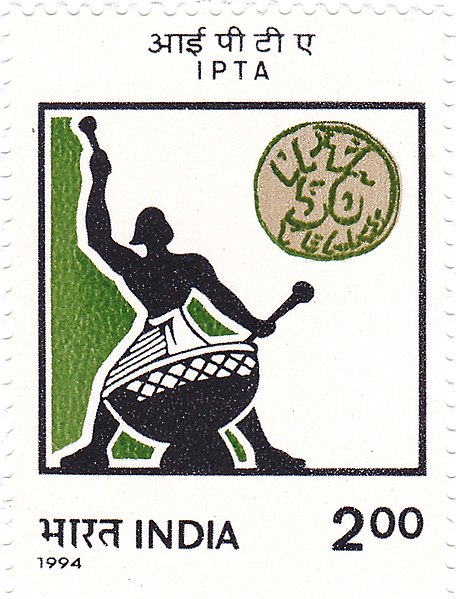
Featured image: Indian People’s Theatre Association commemorated on a postage stamp half a century after its founding. Source: Wikimedia Commons
‘Auratein utthi nahin to zulm badhta jayega
Zulm karne wala seena zor banta jayega
Auratein utthi nahin to zulm badhta jayega’
If women do not rise, oppression will multiply. This is the rough translation for the first two lines of a song written by Safdar Hashmi, theatre person and political activist. Hashmi was assassinated on New Year’s day, 1989, for performing a play in support of trade unions who were on strike for better conditions on the outskirts of Delhi in India. Hashmi’s song was written for a documentary film made in the wake of the horrific burning or ‘Sati’ of a young woman, Roop Kanwar, in Rajasthan, which shook the conscience of the entire country as an example of extreme gender-based violence that was being condoned in the name of ‘tradition’.
The film was made by a young women’s filmmakers’ collective called Media Storm and contained two songs, the one mentioned above and another one that described poignantly the various kinds of work that women do, at home and outside, and yet were subjected to the most horrific forms of violence.
Some lines of the second song are:
Sataati hai rulaati hai use zinda jalati hai
(She is harassed, made to weep, burnt alive)
Songs about gender-based violence have been a significant element of wider struggles in India, having been written spontaneously as part of various campaigns and social and political events that brought issues to the fore, including before the mass mobilisation of the women’s movement in the 1970s.
There are several examples of powerful songs written in the late colonial and early post-independence period. During the Tebhaga peasant movement in Bengal in 1946, where peasants were demanding two thirds of the share of the grain they produced, the brutal murder of a young, pregnant peasant woman called Ahalya produced spontaneous poetry and songs. Ahalya was killed by hired goons of landlords, as she, along with others from her village, stood guard over the grain produced and harvested by them.
Paying homage to Ahalya, a song called ‘Aar koto kaal, bolo koto kaal, shoibo ei mrityur aupoman’ (How much longer shall we have to bear the humiliation of death) was sung by singer Reba Roychowdhury and other young women as they campaigned for the peasants resisting the brutal landlord system in Bengal.
‘Auratein Utthi Nahi Toh Zulm Badhta Jayega’ (Song mentioned at the beginning of the post)
In the Telugu speaking Telangana region in Southern India, rape and murder of women from lower castes by landlords and their gangs formed the subject of several songs written and sung during the Telangana peasants’ movement soon after independence in 1948. Under the aegis of a political cultural organisation called the Indian People’s Theatre Association (IPTA) and of similar organisations at the regional level, the beginning of songs focussing on gender issues, and to some extent gender-based violence, can be found.
However, even if there were many across different languages and different genres, these songs were not created as part of consciously gender-politics-driven objectives. That happened later with the growth of the women’s movement of the 1970s and after. From the late 1970s, the women’s movement started focussing on specific kinds of gender-based violence like dowry, rape, domestic violence, sexual harassment and violence at the workplace and various parts of India saw extensive campaigns against such forms of violence and the outdated and patriarchal laws that governed them.
Street theater and songs became popular ways to reach out to people in the streets, workplaces and near homes. Kamla Bhasin, the fiery, humorous and inspirational feminist from Delhi wrote several songs in Hindi and Punjabi and also raised the famous Azaadi (Freedom) slogans that she heard first in Pakistan and made them popular in India. ‘Freedom from endless violence, freedom from helpless silence’ was one such electrifying slogan. Working with simple and popular folk melodies from North India, Kamla Bhasin wrote songs that not only addressed violence against women frontally but also spoke to the patriarchal structures that shackled both men and women into the system of dominance and dependence that patriarchy represents.
“Todh todh ke bandhanon ko dekho behane aati hai…Ayengi zulm mitaeingi…Yeh to naya zamana laayengi!”
Thus went a song that became a rallying call for the women’s movement, like “Auratein Utthi Nahin To” mentioned before. Several other songs that Kamla Bhasin wrote focussed on gender based violence as part of the 16 Days of Activism Against Gender Based Violence every year between 25 November and 10 December.
As awareness of gender based violence began to spread in the public consciousness, popular media also produced responses in the form of films, advertisements and songs. One such song is ‘Rupaiya’. Based on a folk tune from North India, it was written against dowry by popular songwriter Swanand Kirkire and sung by Sona Mohapatra. Appealing to the conscience and emotional bond of a daughter with her family, the woman protagonist in the song emphatically states ‘I will not be sold for rupees’.
Like in the struggle against patriarchy at the societal level and in individual contexts, cultural activists have had to struggle hard within their own movements to bring focus to gender issues and highlight gender based violence. Songs depicting the lives of women, inside and outside the home, in workplaces and society at large, and particularly focusing on the violence that is inflicted, have had to edge their way into larger repertoires around class, caste, racial and ethnic discrimination.
At the same time, these songs have played a very major role in mobilisation in not only movements that focus on gender-based issues but also go beyond to focus on various kinds of societal domination.
To go back to the Azaadi slogans popularised by Kamla Bhasin in India, they were first raised by Pakistani feminists as calls for emancipation from all kinds of bondage.
Prof Sumangala Damodaran singing ‘Aar Kotho Kal’
Author Bio Prof. Sumangala Damodaran is Professor of Economics, Development Studies and Popular Music Studies at Dr. B. R. Ambedkar University Delhi. As a development economist, her research and publications fall broadly within the rubric of Industrial and Labour studies and more specifically on Industrial Organisation, Global Value Chains, the Informal Sector, Labour and Migration. She is also a singer and composer. Her book “The Radical Impulse: Music in the Tradition of the IPTA” is a documentation of the musical tradition of the Indian People’s Theatre Association from the 1940s and 1950s. Her album titled ‘Songs of Protest’ and a collaborative project titled ‘Insurrections’ has resulted in four albums. She is currently engaged in researching the relationship between music and migration, particularly of women in slavery and servitude across centuries and across vast tracts of the globe that were linked through long distance trade in commodities and symbolic goods. This work is being done in collaboration with several universities in Africa and Asia.


 16 Days Blogathon