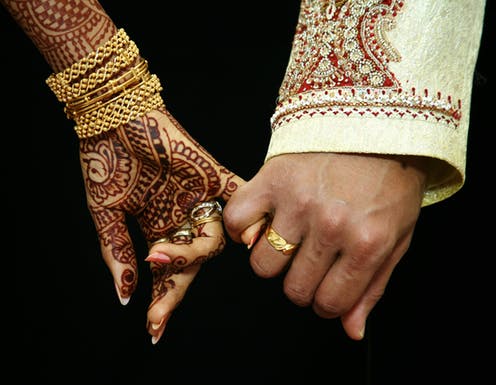
The practice of dowry usually involves the giving of money, property, goods or other gifts by one family to another before, during or any time after marriage. It is a universal practice. For example, Bombay Island – now called Mumbai – was a former Portuguese outpost which was gifted to England as dowry in the marriage of Catherine of Braganza to Charles II (and was later leased to the East India Company in 1668).
In its modern day avatar, dowry as a practice has different customary characteristics across different communities. Dowry exchange in South Asian communities is characterised by the woman’s family providing goods (including but not limited to money, jewellery, furniture and appliances) to the man and his family. In North African and Middle Eastern communities, dowry is characterised by the man’s family providing goods (predominantly in the form of money or cattle) to the female and her family.
Dowry is an ancient practice most frequently associated with India, but in reality, it is a cultural practice globally. This blog mostly addresses dowry in the South Asian context. Dowry in ancient times originated as a form of ante mortem inheritance, meant only for the bride. In modern times dowry gifts are expected by the family of the receiver as well and has become a practice that is a product of patriarchy reinforcing gender inequality. Women activists have campaigned against dowry practices in India since 1961, recognising the toxic impact of patriarchy combined with greed, and growing evidence of serious violence, murders and suicides associated with dowry in India.
The Australasian Centre of Human Rights and Health (ACHRH)has refined the definition of dowry as ‘substantial gifts’ in the context of a marriage, where the value of gifts is out of proportion to the income of either family and causes financial distress to the giver.
Strongmen across the globe are ascending to the position of president or prime minister. Sexist and racist rhetoric is part of their brand, which followers find authentic and even unifying. Male political leaders who use swaggering masculinity to cultivate support express the growing global backlash to diversity, inclusion, and multiculturalism. When powerful men use their platforms to abuse women, they send the message that abuse is okay. It also makes abusing women an integral part of a right-wing agenda.
Boris Johnson, the Prime Minister of the United Kingdom, has an impressive track record of demeaning women. He has called women Members of Parliament (MPs) by their husband’s names and described women journalists and athletes in terms of their bodies – he once described female volleyball players “glistening wet otters”, for instance.
Across the Atlantic, US President Donald Trump uses adjectives like “fat” and “ugly” to demean women who have spoken out against him. He rallies crowds to chant “lock her up” in reference to his former rival, Democratic presidential candidate Hillary Clinton. Brazilian president Jair Bolsonaro once told a congresswoman she was not “worth” raping, saying that she “didn’t deserve it”.
These leaders often reserve their most vitriolic comments for women of colour – attacks that often merge gender and race. Trump told four women Members of Congress – all of whom criticised his policies and his person – to “go back and help fix the totally broken and crime infested places from which they came”. Three of them were born in the United States, while the fourth – Somali refugee Ilhan Omar – was painted by Trump and other critics as a Jew-hater. Similarly, Johnson has spouted racialised descriptions of Muslim women, variously portraying them as objects and criminals.
These incidents are not isolated. When powerful men deliver abuse, the attacks receive media coverage. But many women with public profiles – from activists to athletes – receive hateful messages daily. The senders are not usually powerful men, but everyday people.
A study examining 152 leading British women in politics, business, entertainment, the media, and sports estimated that each received about 200 sexually-explicit tweets a day. In another study of nearly 600 women journalists, 63 percent reported being threatened and harassed on-line and 26 percent reported physical assaults. Amnesty International documents various quantitative and qualitative studies, all demonstrating that high-profile women on Twitter endure significant levels of abuse.
Abusive language as political violence against women
Abusive language is a form of violence against women. Much of it may happen online, but virtual harms cause actual damage. Hateful messages and death threats cause stress and trauma. Victims experience diminished self-esteem and an inability to focus and to complete their work. They fear for their safety and for their family’s safety, and they face disruption to their routines caused as a result of increased security. Many leave Twitter. In Britain, female MPs received such profane attacks that they received police protection.
But this language affects many more than just the immediate victims: it also tells the larger audience of women and girls to stay out of public life. Mona Lena Krook and Juliana Restrepo Sanín call these “message crimes.” Whether world leaders or everyday jerks, abusers want women in public life to shut up and go away.
Since abusive language aims to diminish women’s influence over politics, policy, and the public debate, these attacks are forms of political violence. In my research with Elin Bjarnegård and Gabrielle Bardall, we argue that political violence is gendered in three ways: in its motive, in its form, and in its impact. The abusive language aimed at women in public life has all three elements.
In terms of motive, attackers are driven by hate towards women in public, not hate towards public figures irrespective of gender. The rates at which women and men endure abuse are simply not the same: visible women receive disproportionate amounts of abuse when compared to visible men. In terms of form, attackers use gendered language, including threats of sexual harm and sexual assault.
In terms of impact, the victims extend beyond the women targeted. They signal to other women and girls the costs of a public profile. And women and girls have received this message. A respected U.S. survey firm found that 70 percent of women, and 83 percent of young women, identified online harassment as a major problem, compared to just 54 percent of men and 55 percent of young men. Indeed, programs that train women candidates now include lessons that prepare women to handle abuse. Their tips include immediately reporting the abuse to authorities, using humour to diffuse the situation, and writing op-eds to call attention to the problem.
Stopping abusive language
Documenting and denouncing abusive language have not stemmed the attacks against publicly-visible women. The anonymity of online platforms combined with social media companies’ commitment to free speech means that attackers behave with impunity. Abusers even become leaders of powerful countries.
The vicious and sexist abuse of women in public life has become so normalised that solutions focus not on holding perpetrators accountable, but on helping women cope. In the candidate training program, women politicians are told to be brave. A British MP, herself standing down because of online abuse, recommended that women MPs create circles of support.
The women and girls of the world deserve better solutions. When the #MeToo movement brought down prominent men like Harvey Weinstein, the effects reverberated across the globe. Sexual harassment suddenly bore real consequences, even for powerful men. Likewise, voters must reject male political leaders who bully those weaker than them, especially women and racial and ethnic minorities. In the current political climate, protecting women from abuse cannot be divorced from resisting the right-wing forces that reject diversity and inclusion more broadly.
Jennifer M. Piscopo(@Jennpiscopo) is an Associate Professor of Politics at Occidental College in Los Angeles, California. Her research on women’s political participation and representation has appeared in over 15 academic journals. With Susan Franceschet and Mona Lena Krook, she co-edited The Impact of Gender Quotas (Oxford University Press, 2012). An international speaker and consultant, she has collaborated with international organizations such as UN Women, the Inter-Parliamentary Union, and the Carter Center. Her op-eds have appeared in The Washington Post, The New York Times, and The Los Angeles Times, among other outlets.
When I was five years old my father began to sexually abuse me. This went on until I was ten, and then the daily physical battery and terror began. This life of endless brutality and invasion rearranged my chemistry, forced me out of my body, repressed my ability to think and made me terrified of love.
My father never told me why he did what he did. He never explained how he became a man capable of this kind of sadism and he died without apologizing.
In recent months, I have read the accounts of several men accused of sexual violence. Their words often focused on the pain and repercussions they had experienced after being accused rather than thinking of the pain of their victims or admitting what they had done and how they had worked on themselves to understand their own histories and behavior.
It then occurred to me that I had never heard a man make an honest, thorough, public accounting of his abuse. I had never heard a man openly apologize. I wondered what it would be like to hear an apology like this, what impact it might have on me and other survivors and how it might help end the scourge of violence altogether.
And so I decided to write the apology from my father that I always needed to hear; to find the words and the language, to outline the anatomy of an apology that could possibly set me free and act as a possible blueprint for other men seeking a pathway to atonement, accountability and reckoning.
As I wrote “The Apology” I felt as though I began to hear my father’s voice. He told me of his childhood, how he was adored rather than loved and how adoration forced him to live up to someone else’s idealized image of himself rather than being able to be his authentic, imperfect human self. He told me of the ways that patriarchy and toxic masculinity had forced him to push feelings of tenderness, vulnerability, tears, doubt, uncertainty and wonder underground, and how they later metastasized into another persona called “Shadow Man.”
This disassociated self was capable of sexually abusing a five-year-old girl and physically torturing and gaslighting her thereafter. He told me in ruthless detail everything he had done to me and why. He allowed himself to feel the pain, heartbreak and betrayal he had caused in me. He reflected deeply on his past in order to understand what had led him to these terrible actions. He explained his behavior rather than justifying it. And through his agonizing detailed admissions, he expressed deep sorrow, remorse, guilt and self-hatred. He took responsibility and he made amends.
In the book, my father also confessed to me that to apologize is to be a traitor to men. That there is an unwritten code of silence that is not to be broken without unraveling the whole story of patriarchy.
But he also told me that what he had done to me had poisoned his soul and consumed him in the next world. He was desperate to tell the truth, to make an apology so he could get free.
Until I wrote this book, both my father and I were caught for nearly 60 years in an ongoing vise of pain, rage, guilt and shame. We were consigned to a particular terrible time in our history. Me, defined as victim; him defined as perpetrator.
Because my father owned his actions and apologized in the book, my suffering was honored and made real. I experienced justice and respect. I heard the words I needed to hear that released the resentment, pain and hurt. I was able to have a deeper understanding of his history, wounds and motivation, and because of that the ongoing, haunting question of why was finally resolved. I was able fully let him go and move on.
Of course I wrote my father’s apology for him. But I must say it was a profoundly healing and liberating exercise. Because my father has lived inside me my whole life, I was able to move him in a new direction, from monolithic monster to apologist, from terrifying entity to broken, damaged little boy. In doing so, I gained agency and he lost his power over me.
In the process, I also discovered how central apologies are to the next stage of our human evolution. We must create pathways for men to do this critical work of atonement, and men must be brave now and willing to come forward — risking being called gender traitors — in order to free the suffering of their victims and themselves. The time of reckoning is here.
This piece was first published by NBC news and reproduced with permission.
Eve Ensleris a Tony Award-winning playwright, performer and activist best known for “The Vagina Monologues.” Her critically acclaimed memoir “In the Body of the World” was published by Metropolitan Books in 2013. Her most recent book is “The Apology.”
photo credit: IHSAAN HAFFEJEE/AL JAZEERA. Men from the Jeppestown hostel in Johannesburg make threatening gestures towards foreign-owned businesses
Written by Natasha Dyer
In 2015, I was back in South Africa, after two years living and working in the country. The newspapers were full of graphic pictures of men brandishing knives, hammers and clubs, with headlines blaring about the resurgence of xenophobic violence after 2008’s nationwide attacks against foreign nationals left 63 dead, hundreds injured, dozens raped and hundreds of thousands displaced.
I had so many questions. What and who exactly were behind these attacks? Which foreign nationals were being targeted? Why was violence flaring up again now? And why were only men in the pictures? What about the women affected by the violence?
Violence against women and girls in South Africa is an ever-present reality. The rates of female rape and sexual assault mostly against black women are some of the highest in the world. Over the last five years, the number of women murdered in the country has increased by 16%, while one in 13 adult women have experienced violence at home. Violence against women is generally under-reported, and LGBTI and gender non-conforming people face severe risk of violence and discrimination, including a pandemic of “corrective rape” violations against lesbian women. Both men and women were reported as victims in the xenophobic attacks of 2015; foreign nationals and South African wives of migrants.
This reality, coupled with the gruesome newspaper images, propelled me to ask questions of activists, scholars, politicians and civil society and scour debates online. Eventually, it led to starting a PhD at the University of Edinburgh this year. In May, I conducted preliminary research in Johannesburg, with South African women and African women of multiple nationalities. The project convinced me to broaden my doctoral study to compare critically with African female experiences in the UK, looking at the gendered manifestations of xenophobia in Johannesburg and London, two cities experiencing rising levels of anti-migrant abuse and gender disparities, while linked by histories of colonialism and complex patterns of migration. Gender-based violence is a phenomenon being increasingly understood and fought against, as the 16 days of activism against gender-based violence campaign shows.
Xenophobia and misogyny intertwined
Xenophobia is not new to either South Africa or the UK. Despite migrants constituting only 5% of South Africa’s population and 9% of Britain’s, foreign nationals are publicly blamed for almost every social issue. Since the start of South African democracy in 1994 and as recently as two weeks ago, politicians and the media have portrayed international migrants as “unwanted aliens”, negatively affecting businesses, acting in criminal ways and “stealing our jobs and our women”. In the UK, the wave of hostility leading up to the Brexit referendum result was propelled by divisive political rhetoric led by far-right figures such as Nigel Farage, warning that failure to deal effectively with immigration may lead to ‘cultural issues’, such as women being attacked by foreign nationals. These sentiments have built upon decades-long racism embedded in UK society and policy, most often expressed in debates over immigration controls and bolstered by a media narrative about migrants as ‘scroungers’.
Approximately half of migrants in both Johannesburg and London are women. Despite this, political and media debates often position women as silent victims, passive targets of spectacular xenophobic violence or vulnerable persons. Academic studies on xenophobia are mostly lacking in rigorous gender-based perspectives (see Morrice, 2016 and Sigsworth et al, 2008 for exceptions), despite the similarity between xenophobia and the battle for power inherent in misogyny, as noted by Helen de Cruz. In her new book DownGirl (2017), Kate Manne describes misogyny as “dependent on patriarchy – societal structures that demand that women cater primarily to men’s needs.” When women do not fit the demands of patriarchy – for example, by standing up for their rights or taking on leadership roles – backlash occurs in the form of verbal or physical abuse.
As de Cruz explains elsewhere, one can see a similar struggle for control in xenophobia worldwide. Instead of a representation of hatred between a country’s native population and its immigrants, xenophobia demonstrates a fight for control over identity, rights and resources. It is a manifestation of the institutionalised sense of entitlement generated in citizens born in a country. Immigrants are tolerated as long as they adhere to stringent political and legal rules, learn trivia about a country’s history to pass immigration tests and keep out of the way, even when they contribute to society or their safety is at risk. It occurs when immigrants fight against measures designed to control them or force them into positions of dependency and potential rejection. In African contexts, xenophobia is understood as the systematic construction of strangers as a threat to society, justifying their exclusion and sometimes their suppression.
My PhD compares how women of different socio-economic classes in London and Johannesburg experience ‘everyday’ forms of xenophobia and how this impacts upon their lives. More broadly, it looks at questions of access, race, identity and belonging in two countries where migrants and often women (and especially women of colour), are made to feel unwelcome. It creates a space to explore the multiple roles women play as would-be targets, observers, accomplices and instigators of xenophobia in day-to-day life.
Exploring conflict and violence through the arts
This work requires tools that can sensitively enable a multiplicity of voices to interact. They must facilitate the sharing of feelings and experiences, and challenge stereotypes associated with different identities. Creative, arts-based research approaches such as theatre, film, photography and walking can facilitate spaces for women’s stories to be told, shared and processed creatively, contributing to positive social change. Like the arts, conflict resolution is often approached experientially. The key to successful approaches is to create safe spaces that guarantee physical safety and a learning environment free from violence. In these forums, participants can communicate their fears, problems, feelings and frustrations.
Over a decade working on development projects across Africa, I have seen the usefulness of some of these methods first-hand. For example, in the Democratic Republic of Congo, I was introduced to peacebuilding NGO Search for Common Ground’s project using participatory theatre to help transform the way that people view conflict. In South Africa, I have met researchers and NGOs using the arts to work with marginalised women and their communities, such as Sonke Gender Justice’s community radio arts production to help educate women about surviving sexual assault. The African Centre for Migration and Society (ACMS) at the University of Witwatersrand in Johannesburg does excellent work on migration, identity and belonging, as well as supporting artists using multimedia to explore similar issues, such as Sydelle Willow Smith, whose most recent project investigates white South Africans exploring their past and present in the new post-apartheid society.
For research to have meaning and impact beyond the academy, cross-pollination between artists and academics exploring social issues is essential. It combines creative ways of learning and investigation with well-worn data-gathering tools, hopefully providing positive ways for those affected by conflict and violence to process their experiences, as well as new insights for academics, policy-makers and practitioners. Using a participatory approach in my research, I look to the female participants to lead the process, while learning from feminist scholars and experienced artists. My hope is that by enabling women of different socio-economic classes, races and nationalities to explore their feelings on identity and belonging through the arts, in two countries where debates on these issues have become so divided, it will generate new understandings of how to tackle xenophobia and its gendered dimensions. In places where migrants are at serious risk of deportation or violence and where gender-based violence or discrimination is ever-present, women need spaces to explore and share their thoughts and experiences creatively, helping them to make connections and generate answers to increasing social problems.
Natasha Dyer is a research and communications consultant in international development, currently pursuing a PhD at the Centre for African Studies, School of Social and Political Science at the University of Edinburgh. She has worked across Africa for over a decade, supporting organisations and governments to achieve gender equality, provide quality education and resolve conflict. Twitter handle: @nrlcadyer
On October 2017 – just after the first allegations of rape and sexual harassment were levied against Harvey Weinstein through the #MeToo social media campaign – an Indian student based in a US law school ‘published’ a crowd-sourced list on Facebook (FB) that named and accused more than 70 Indian professors (based in Indian universities or outside) as sexual harassers. This FB post by Raya Sarkar was shared, liked and commented on widely. In social media circles this list has since been referred to as LoSHA (List of Sexual Harassment Accused) and it also has its own Wikipedia page. LoSHA is seen as the catalyst for the #MeToo movement in India.
LoSHA provoked both support and resistance within feminist circles. Immediately after the FB post, a statement was released and signed by fourteen Delhi based feminists who critiqued the ‘naming and shaming’ of men, cautioned against making accusations of sexual harassment without ‘context or explanation’, and advocated ‘due process’. After the statement, many other feminists across India commented and reflected on this, raising concerns around the over-emphasis on the law. It became evident again that there is no monolithic feminism in India – or any single unified position on feminists engaging with the law. The last year or so has been an interesting ‘new’ moment in feminist politics in India, and amongst the accusations, counter accusations and closing down of conversations, we have also seen nuanced and thoughtful reflections trying to understand complexity and express solidarity. V Geetha, in an important essay, points out the need to initiate dialogue about sexual harassment, and the power politics in social relationships including in the Academy:
“Therefore, rather than fall back on the need to observe due process, which, indeed we do, when we engage with the justice system, we need to also think of how we enable speech about sexual harassment and violence that is not about law and justice alone, but about social relationships and the power invested in those who defined the terms of the latter, on account of their class, caste and authority as intellectuals.”
Whilst the media has characterised feminist conflict over LoSHA as that of ‘old’ and ‘new’ feminisms, of ‘ungrateful daughters’ and ‘tut-tutting mothers’, others, such as Srila Roy, have argued that a generational analysis is unhelpful and over-simplifying: “there has been both support for and condemnation of the list across different generations of feminists.” Meanwhile there have been provocative discussions on erotics in the Indian university classroom through pedagogic practices (Brinda Bose and Rahul Sen https://cafedissensusblog.com/2018/08/17/liberal-vertigo-eros-and-the-university/), projecting the interconnections of caste and patriarchy in University spaces in contexts of sexual harassment (Drishadwati Bargi https://www.epw.in/engage/article/misreading-dalit-critique-university-space) and hoping for a conversation on the modes and methods of speaking, complaining on sexual harassment by netizens (Gita Chadha and Rukmini Sen https://www.epw.in/engage/special-features/power-relationships-academia)
Since LoSha and then #MeToo in India, languages of both law and feminism have been questioned, subjected to reflection upon their own hegemony and boundaries respectively. The legal history around sexual harassment in India goes back to the 1997 Supreme Court Vishakha judgment recognizing unwelcome sexual behaviour in the workplace as harassment, which mandated workplaces to create gender sensitization and complaints committees. Twenty years post the judgment and four years since the 2013 Sexual Harassment of Women at Workplace (Prevention, Prohibition and Redressal) Act, it is important to understand that the LoSha and #MeToo campaigns have happened as a result of years of feminist politics and not despite them. Yet, this contemporary moment opened up new conversations about the meaning(s) of speech, silence, evidence, criminality, intimacy.
This is a crucial point at which it becomes necessary to acknowledge that the law would define and construct boundaries within which a violation has to be expressed. The limitation of what is intrinsic to law is the need to speak in the language of law—within definitions, through written/oral testimonies, evidence, or witness, especially in situations injury leading to punishment. The definition of sexual harassment includes and yet also leaves out many kinds of behaviour from the definition; it is hinged at a complicated understanding of ‘unwelcome behaviour’, where the definition of ‘unwelcome’ is be redefined in each new case. Interpretation of what is not exactly in the definition is always possible, yet it is important to recognise that quasi legal committees operate within the framework of the law and all (sexually unwanted) behaviour cannot find a name in the law. Speech therefore is an essential component of any legal process, when law is in action either in a courtroom or within an anti-sexual harassment complaints committee. It is relevant to remember here that feminist politics has encouraged and emphasised the need to use speech to bring experiences into the public realm. Breaking the silence or chuppi todo has been part of posters and campaign slogans since the 1980s when issues of rape and domestic violence were discussed publicly in unprecedented ways. Thus voicing and not silence has been a tool for any politics emanating from the margins and feminism has been no exception. Silence, hesitation, pausing, self-imposed caution are all part of the process of making sense of a sexual violation, and the definition of the law is not the only way through which this happens.
What is of critical importance in the post LoSha moment is to reaffirm that universities are sites of both possibilities and contradictions. They foster ideas and imaginations of new citizenship by removing boundaries about who can have access to higher education. On the other hand, universities also cultivate power in relationships while encouraging and sustaining relations – all of which are a complex web of multiple social locations and identities that individuals inhabit based on gender-sexuality, caste, class, religion, language, disability or place of origin. It is necessary to take cognisance of the co-existence of power and intimacy in teacher–student relationships in contemporary institutions of higher learning. As V Geetha notes: “ In the university context, indeed in any learning context, especially in caste society, the communication of ideas, and the practice of teaching and learning are fraught and precarious”
In these transformative times, with the demands for empathetic, more democratic teachers, are flows of power disrupted? How do gender and caste relations play out within these flows? Is being (and expected to be) obedient as a student judged as being submissive by the faculty, and is the inability to resist interpreted as consent? It is important to note this transforming landscape in which young, aspiring, freedom-seeking women/multiple genders in institutions of higher learning across Indian cities talk about, discuss and debate sexual politics. Institutions need to create an enabling eco-system much beyond only a complaint registering committee, where, within pedagogic and political practices of the institution’s everyday functioning, certain non-negotiable ethical principles of interpersonal interaction are deliberatively arrived at.
I am proposing the need to craft opportunities for dialogue (between students, between faculty, between faculty and students, between administrative staff) moving beyond merely a culture of formal complaints. Through this the claim, besides being aware as gendered citizens about the legal provisions on sexual harassment but to not overemphasize the need for more training or improved legal skills , but for a democratic space in which the complexity of life experiences of students as well as early career women/multiple gendered faculty in institutions of higher learning can be acknowledged and explored. This will enable conversations (speech of a certain feminist kind, not necessarily the juridical) on the plural meanings of unwelcome experiences, transgressions, consent and control.
Rukmini Sen is Professor at the School of Liberal Studies, Ambedkar University Delhi. She teaches and publishes around sociology of law, feminist movements and personal narratives
 “
“

 16 Days Blogathon
.jpg)