DAY SIXTEEN: Freedom from endless violence, freedom from helpless silence – Songs against gender based violence in India’

Freedom from endless violence, freedom from helpless silence. Sumangala Damodaran discusses the place of songs about GBV in protest movements in India.

Sumangala Damodaran

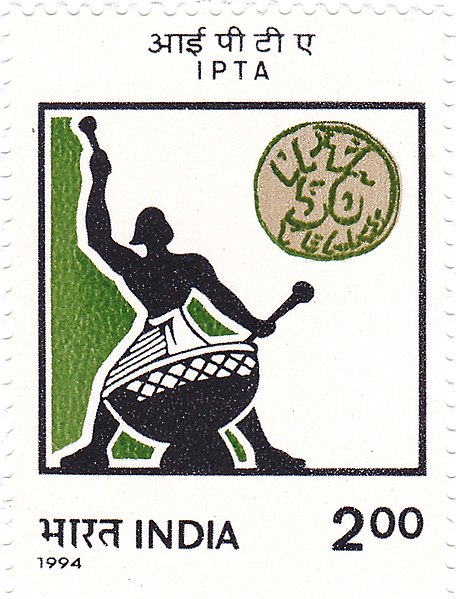
Featured image: Indian People’s Theatre Association commemorated on a postage stamp half a century after its founding. Source: Wikimedia Commons

‘Auratein utthi nahin to zulm badhta jayega

Zulm karne wala seena zor banta jayega

Auratein utthi nahin to zulm badhta jayega’

If women do not rise, oppression will multiply. This is the rough translation for the first two lines of a song written by Safdar Hashmi, theatre person and political activist. Hashmi was assassinated on New Year’s day, 1989, for performing a play in support of trade unions who were on strike for better conditions on the outskirts of Delhi in India. Hashmi’s song was written for a documentary film made in the wake of the horrific burning or ‘Sati’ of a young woman, Roop Kanwar, in Rajasthan, which shook the conscience of the entire country as an example of extreme gender-based violence that was being condoned in the name of ‘tradition’.

The film was made by a young women’s filmmakers’ collective called Media Storm and contained two songs, the one mentioned above and another one that described poignantly the various kinds of work that women do, at home and outside, and yet were subjected to the most horrific forms of violence.

Some lines of the second song are:

Sataati hai rulaati hai use zinda jalati hai

(She is harassed, made to weep, burnt alive)

Songs about gender-based violence have been a significant element of wider struggles in India, having been written spontaneously as part of various campaigns and social and political events that brought issues to the fore, including before the mass mobilisation of the women’s movement in the 1970s.

There are several examples of powerful songs written in the late colonial and early post-independence period. During the Tebhaga peasant movement in Bengal in 1946, where peasants were demanding two thirds of the share of the grain they produced, the brutal murder of a young, pregnant peasant woman called Ahalya produced spontaneous poetry and songs. Ahalya was killed by hired goons of landlords, as she, along with others from her village, stood guard over the grain produced and harvested by them.

Paying homage to Ahalya, a song called ‘Aar koto kaal, bolo koto kaal, shoibo ei mrityur aupoman’ (How much longer shall we have to bear the humiliation of death) was sung by singer Reba Roychowdhury and other young women as they campaigned for the peasants resisting the brutal landlord system in Bengal.

‘Auratein Utthi Nahi Toh Zulm Badhta Jayega’ (Song mentioned at the beginning of the post)

In the Telugu speaking Telangana region in Southern India, rape and murder of women from lower castes by landlords and their gangs formed the subject of several songs written and sung during the Telangana peasants’ movement soon after independence in 1948. Under the aegis of a political cultural organisation called the Indian People’s Theatre Association (IPTA) and of similar organisations at the regional level, the beginning of songs focussing on gender issues, and to some extent gender-based violence, can be found.

However, even if there were many across different languages and different genres, these songs were not created as part of consciously gender-politics-driven objectives. That happened later with the growth of the women’s movement of the 1970s and after. From the late 1970s, the women’s movement started focussing on specific kinds of gender-based violence like dowry, rape, domestic violence, sexual harassment and violence at the workplace and various parts of India saw extensive campaigns against such forms of violence and the outdated and patriarchal laws that governed them.

Street theater and songs became popular ways to reach out to people in the streets, workplaces and near homes. Kamla Bhasin, the fiery, humorous and inspirational feminist from Delhi wrote several songs in Hindi and Punjabi and also raised the famous Azaadi (Freedom) slogans that she heard first in Pakistan and made them popular in India. ‘Freedom from endless violence, freedom from helpless silence’ was one such electrifying slogan. Working with simple and popular folk melodies from North India, Kamla Bhasin wrote songs that not only addressed violence against women frontally but also spoke to the patriarchal structures that shackled both men and women into the system of dominance and dependence that patriarchy represents.

“Todh todh ke bandhanon ko dekho behane aati hai…Ayengi zulm mitaeingi…Yeh to naya zamana laayengi!”

Thus went a song that became a rallying call for the women’s movement, like “Auratein Utthi Nahin To” mentioned before. Several other songs that Kamla Bhasin wrote focussed on gender based violence as part of the 16 Days of Activism Against Gender Based Violence every year between 25 November and 10 December.

As awareness of gender based violence began to spread in the public consciousness, popular media also produced responses in the form of films, advertisements and songs. One such song is ‘Rupaiya’. Based on a folk tune from North India, it was written against dowry by popular songwriter Swanand Kirkire and sung by Sona Mohapatra. Appealing to the conscience and emotional bond of a daughter with her family, the woman protagonist in the song emphatically states ‘I will not be sold for rupees’.

Like in the struggle against patriarchy at the societal level and in individual contexts, cultural activists have had to struggle hard within their own movements to bring focus to gender issues and highlight gender based violence. Songs depicting the lives of women, inside and outside the home, in workplaces and society at large, and particularly focusing on the violence that is inflicted, have had to edge their way into larger repertoires around class, caste, racial and ethnic discrimination.

At the same time, these songs have played a very major role in mobilisation in not only movements that focus on gender-based issues but also go beyond to focus on various kinds of societal domination.

To go back to the Azaadi slogans popularised by Kamla Bhasin in India, they were first raised by Pakistani feminists as calls for emancipation from all kinds of bondage. 

Prof Sumangala Damodaran singing ‘Aar Kotho Kal’

Author Bio
Prof. Sumangala Damodaran is Professor of Economics, Development Studies and Popular Music Studies at Dr. B. R. Ambedkar University Delhi. As a development economist, her research and publications fall broadly within the rubric of Industrial and Labour studies and more specifically on Industrial Organisation, Global Value Chains, the Informal Sector, Labour and Migration. She is also a singer and composer. Her  book  “The Radical Impulse: Music in the Tradition of the IPTA”  is a documentation of the musical tradition of the Indian People’s Theatre Association from the 1940s and 1950s. Her album titled ‘Songs of Protest’ and a collaborative project titled ‘Insurrections’ has resulted in four albums. She is currently engaged in researching the relationship between music and migration, particularly of women in slavery and servitude across centuries and across vast tracts of the globe that were linked through long distance trade in commodities and symbolic goods. This work is being done in collaboration with several universities in Africa and Asia.
DAY FIFTEEN: Does she have a voice? Do we hear her? The silencing of Indigenous women and girls experiences of violence: does it ever change?

It is widely understood that gender-based violence disproportionately impacts Indigenous populations compared to other population groups. Why are their lives not honoured or mourned or valued in the same way?

Kyllie Cripps

Aboriginal and Torres Strait Islander readers are advised that the following article contains reference to community members who have died.

It is widely understood that gender based violence disproportionately impacts Indigenous populations in far greater numbers than other population groups (AIHW 2019). Available evidence tells us that Indigenous women are more likely to be the victims of homicide and be hospitalised for injuries sustained as a result of violence (AIHW 2019, Bricknell 2020).

It is important to recognise that despite these statistics and the devastation that violence has brought to our lives and that of our communities, we have not been voiceless on this issue. There are countless examples dating back decades of Indigenous women speaking up and speaking back to the narratives constructed about our victimhood.

For example, the 1986 Women’s Business Report was the first report to ever consult Indigenous women on a national basis on issues impacting them at the time. It was a landmark report that highlighted issues related to violence, and the findings of that report still resonate with Indigenous women’s experiences today as June Oscar the Social Justice Commissioner so rightly highlights in her Wiyi Yani U Thangani Women’s Voices Securing Our Rights Securing Our Futures report released in 2020.

The problem is that in the public sphere, there have been active choices historically and contemporaneously, made about whether our stories, our voices should be heard.

It is as Professor Marcia Langton so aptly put it at the National Safety Summit in September 2021 “Nobody listens to us. They talk over the top of us”. Examples of this exist in several places. Certainly one only needs to read the powerful text by Distinguished Professor Aileen Moreton-Robinson Talkin’ up to the White Woman, now in its 21st year of publication, to see how this has played out throughout our history.

Or contemporaneously to reflect on the 2021 debates on criminalising coercive control where the voices of our women were ‘talked over the top’ even despite us making it plain that the introduction of coercive control laws could detrimentally impact our women and lead to their further incarceration (see Watego, Macoun, Singh & Strakosch 2021). We know this because we have seen the law wielded harshly on our women and we are left to repair its damage.

Taking this a step further, we have seen public vigils, marches in the streets, national displays of mourning, speeches from political leaders decrying the violence inflicted on other women but never our women.

Leaving us to ask: why are our women unworthy of this attention? Why are their lives not honoured or mourned or valued in the same way?

An example of this is the death of Hannah Clarke and her children on the 19 February 2020 – Australia mourned, and our Prime Minister Scott Morrison declared to Parliament that “There are never any excuses – there are none – or justifications for the evil that Hannah and her children experienced – never – not under any circumstances”. Yet, when Aboriginal mother Adeline Yvette Wilson-Rigney was murdered with her two children on the 20th May 2016 there was no similar displays of public outrage. In fact, of the few media articles that were published most focused on blaming Adeline for the death of her children (Cosenza 2021, Dornin 2016, Lee 2016).

This is a common experience, we see the media’s engagement with us as ‘blameworthy victims’ responsible for what has befallen us; or they refer to Indigenous women as angry, aggressive and violent black women; irrespective of context, the harms our women have and continue to endure fail to be seen.

The public fails to empathise with our situations. They fail to support us when we say this is what we need. They in effect silence us. Amy McQuire says ‘silencing often works by not only silencing voices and testimonies of black women but by replacing the ‘silence’ with disclosure that is most palatable to White Australia’. It is most evident in the reporting of what takes place in court rooms, in criminal trials across this country every day.

For example, in the criminal proceedings related to the sexual homicide of Aboriginal woman Lynette Daley, from her death in 2011 through to the conclusion of appeals in 2021 preference was given to hearing and reporting on the offenders version of events in mainstream media outlets (See Cripps 2021). The headlines during this period were nothing short of sensationalist ‘Rough Sex Death’, ‘Beach sex death – Mum of seven died after a ‘wild, drunken beach sex session’, ‘Review for sex death case’, ‘Woman had seizure after “wild sex”: Court’ (See Cripps 2021).

The devaluing of Indigenous women’s worth but also the exaggerated sexualising of our women’s lives and bodies demeans them to the public. Some might say but this case must of be an anomaly, sadly it is not. In Western Australia there is the case of Stacey Thorne who was also a victim of homicide in 2007. At the time of her death Stacey was 22 weeks pregnant. This matter has been traversing the legal system for 13 years. One element of the media reporting around this case was on the alleged offender’s characterisation of the relationship with the victim as secret, and that it was for the purpose of ‘casual sex’. This focus served to diminish and demean the victim’s reputation when she was no longer alive to say otherwise. It was also contrary to what the victim’s family victim’s family reported and knew of the relationship.

Silencing of Indigenous women has also occurred in trials when they have been charged with killing their partners after experiencing years of domestic violence. Many would remember the case of R v Kina – Robyn was an Aboriginal woman who had experienced years of domestic violence and sexual abuse from her defacto partner. On 20 January 1988 Robyn endured yet another beating but today was different – he threatened to sexually abuse her niece if she did not submit to the sex he was demanding of her. Robyn felt she had few options and she stabbed him. She was charged with his murder, she pleaded not guilty, her trial lasted less than a day. Robyn electing not to give or call evidence. She was then sentenced to life imprisonment with hard labour. Her case would later be the subject of a long campaign to have her pardoned given the miscarriage of justice that occurred on the basis of ‘problems, difficulties, misunderstandings and mishaps occurring in the communication of her instructions to her lawyers’.

Many would have hoped we had learned valuable lessons from Robyn’s case, that systems had reformed, and that Indigenous women are heard and actively represented in such cases in the present. Sadly, I cannot say that that is true. In 2015 Jody Gore was sentenced to life with a minimum non parole period of 12 years for murdering her abusive partner in Western Australia. She, like Robyn, had experienced years of abuse at the hands of her defacto partner. What was interesting in this case was that the defacto partner also had mental health issues that the State couldn’t manage and who were relying in Jody to manage despite the threat of violence towards her. When self-defence was raised at trial it was not successful. It took an extensive campaign led by Associate Professor Hannah McGlade, Jody’s family and others to have Jody released pursuant to a royal prerogative of mercy, which revoked Jody’s sentence but not her conviction (See Deathscapes 2016-2020, Douglas et al 2020).  

The institutions referred to in this article are colonial institutions that are not neutral, they are deeply implicated in the continued practice of colonialism and framing of Indigenous women stereotypically, amplifying the precariousness of our lives to the exclusion of all else. They have served to normalise the violence visited upon us. They have also defined who is a worthy victim and who is grievable.

The detachment and indifference with which these institutions engage with the violence that we endure is deplorable. It offers little by way of support to change the status quo. But that is not to say that there is not hope in our women’s stories and futures. Having had the honour and privilege to work with many women over the years, the inspiration and motivation for addressing and responding to gendered based violence is in our communities.

Author’s bio

Kyllie Cripps is a Scientia Fellow and Associate Professor in the Faculty of Law and Justice and Co-Convenor of the Gendered Violence Research Network at the University of New South Wales, Sydney. Kyllie as a Palawa woman has worked extensively over the past twenty years in the areas of family violence, sexual assault and child abuse with Indigenous communities.


DAY FIFTEEN: Social Action in the 80s –has anything changed?

The late 1970s and 1980s marked a time where it was no longer possible to ignore domestic violence, rape and the sexual assault of children. But is our world a safer place?

Jan Breckenridge and Mailin Suchting

Featured image: “Commemoration of International Women’s Day 2018 at United Nations Headquarters” by UN Women Gallery is licensed under CC BY-NC-ND 2.0

The late 1970s and 1980s marked a time where it was no longer possible to ignore domestic violence, rape and the sexual assault of children. The second wave of the women’s movement emerged alongside other progressive social movements including anti-war/moratorium, gay rights and environmental and anti-nuclear collective actions. 1980’s feminism felt hopeful, and we believed our actions could change our social, political and cultural worlds.

While there was no one feminism or singular political focus, there was a shared commitment to challenge domestic and sexual violence by those of us who saw ourselves as part of the ‘women’s movement’. Analysis of power and gender led to a consistency and diversity of views. In Australia, there were challenges to white middle-class feminists from Aboriginal women, women from migrant and refugee backgrounds and working-class women about their marginalisation on the basis of race, class, culture and ability.

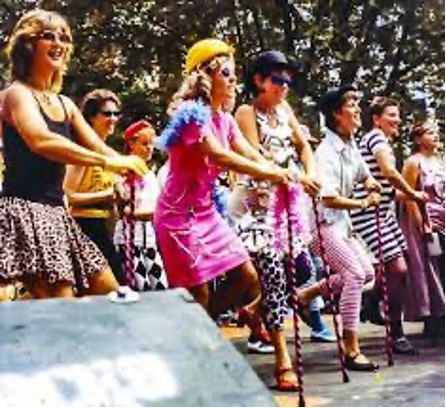
Despite these differences there was still a sense of a woman’s community or communities that contributed to a belief that all things were possible and provided a home for a broad church of political perspectives. We remember women’s cabarets the Freda Stares tapdancing group, the Women’s Choir and a multitude of community festivals and theatre events.

Freda Stares tapdancing group – photo from personal album of Jan Breckenridge

There were actions such as International Women’s Day marches, Reclaim the Night, Women against Rape in War and Women for Survival – Close Pine Gap.

For the first time, women loudly and with passion broke their silence about their experiences about a range of important issues, including gendered violence and abuse. The demand for equal rights was central to feminism and increasingly activists, many of whom spoke from their own lived experience, argued that men’s treatment of women was a central weapon of their subjugation. Again, opinions were divided with liberal feminists arguing that the state was central to any response and other feminist groups arguing that the state was complicit in maintaining structures, attitudes and beliefs that supported the perpetration of gendered violence and did little to address the root concerns.

Collective actions of any kind are never linear or sequential but there are certain issues which benefit from other political actions. Differences were unpacked in working class and middle-class women’s groups.

The focus on child sexual assault as we called it then, followed on from successful collective actions establishing domestic violence and rape as prevalent and serious concerns requiring a response to directly address women’s lived experiences. Women shared their experiences in consciousness raising groups and child sexual assault was raised as an issue that many women had also experienced but felt they could never disclose. When they had tried to tell many of them were not believed or pathologized.

When women started talking, they broke a silence that only gained in momentum. In 1980, The Australian Women’s Weekly, a normally conservative magazine known to reinforce traditional gender roles and stereotypes of women, invited its readership to write in and tell of any unwanted childhood sexual experiences. It was a shock when they received 30,000 responses from their female readers. Feminists in refuges, and rape crisis centres had also been capturing the childhood experiences of women in surveys and groups. This evidence was used to demand changes to legislation, service delivery and even ways of understanding CSA – aligning the impacts with the effects of trauma rather than psychiatric disorders as had previously been the case.

The results of this work were tangible with a proliferation of speakouts, women’s health centres, government policy development, community based incest services, sexual assault services within health systems and as non-government organisations, taskforces, state plans and survivor groups. All of this is documented in one of the first edited books, Crimes of Violence focussed on rape and child sexual assault in Australia.

There is no doubt that these changes established child and adult sexual assault as a serious and prevalent issue. But is our world a safer place?

Between 2013 – 2017 the Commonwealth Royal Commission into Institutional Responses to Child Sexual Abuse provided the opportunity for over 8000 survivors to tell of their experiences of child sexual abuse in institutions. Their Final Report made 409 recommendations to better protect children from institutional child sexual abuse and progress is being made to implement these. These recommendations are no doubt, important.

But survivors of child sexual abuse perpetrated in families have not experienced the same attention. Their stories remain untold publicly – despite the family being recognised as a central institution in all cultures. We now have a renewed set of social movements in the digital age including #MeToo and the public disclosures from individual advocates such as Brittany Higgins and Grace Tame, both of whom at some personal expense, have spoken publicly about their unwanted sexual experiences. Some others have produced memoirs to raise the profile of the issue.

Are we at another crossroads? To date the government’s response to these public disclosures has not inspired hope and we are still circling around silences within the institution of the family.

How many more experiences do we need to hear before silence is a thing of the past? When will speaking out put perpetrators on notice and achieve real safety for all?

Authors’ bios:

Jan Breckenridge is a Professor and Head of School of Social Sciences and the Co-Convenor of the Gendered Violence Research Network, UNSW Sydney. She has undertaken extensive work in the areas of gendered violence, with her research oriented towards maximum impact in innovative social policy development, best practice service provision and outcome measurement of effectiveness.

Mailin Suchting is the Manager of the Gendered Violence Research Network, UNSW Sydney. She has extensive practice, management and research experience in the fields of domestic and family violence, sexual assault and child protection.

DAY FOURTEEN: In search for a better tomorrow – Re-imagining home

Anubha Sinha explores the devastating impacts of domestic violence in Dokal, an Indian village and how the formation of a womens collective and action research has brought about change.

Anubha Sinha

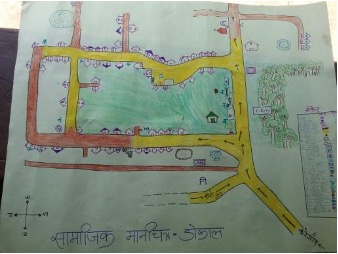
What could be a better place than one’s home? The space of love, safety and care where one gets nurtured and learns social norms. This privilege of being loved in a household is not for everyone. Over the past three years, I have learned how lives can be shaped by experiences and fears of violence coming from the intimacies one shares within the home. My perspective is based on immersive action research that I did in my M.Phil in a village called Dokal in the state of Chhattisgarh. The action research was based on the stances of domestic violence that was recurring in the village and women were suffering it quietly. The populace are the indigenous tribes of this core forest zone of central India.

The populace are the indigenous tribes of this of physical harassment, molestation, marital rape, sexual abuse, mental harassment, emotional abuse, financial crisis, humiliation, self doubt- everything gets formed with the existence of violence or in anticipation of it.

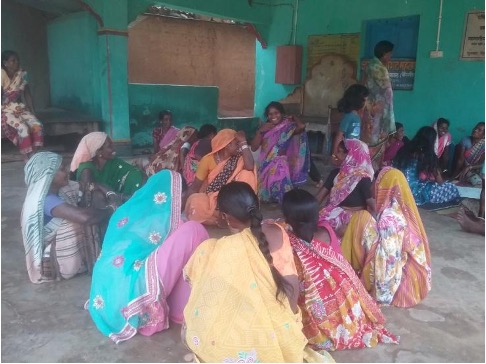
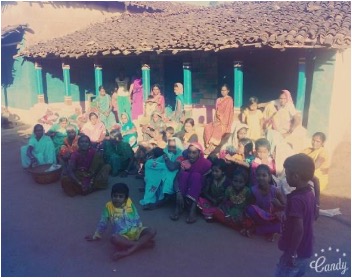
Looking at the continuous suffering of women in the village with continuous effort; together we (me and women) formed a collective of forty women called ‘Sangwaari’ (means companion or friend in Chhattisgarhi; the local language of Chhattisgarh). The collective was a place for women to share their suffering and understand the situation of their houses and together it was an effort to find a way to deal with it as it was an everyday matter. Here are few instances that led us to think about the situation of form the collective:

Incident 1

A seven member house; where two families live together. One woman who is infertile and can never carry a child lives with her husband, who steals everything she earns for consuming Mahua, an alcoholic drink made from fermented flowers of the Mahua tree (Madhuca longifolia). The other is a dominating woman with a political identity in the village. She has a husband and two children. Now, this empowered strong woman has all good faith in making others empowered too; but only outside her house. Instead of a caring and empowering relation with the woman who cannot bear a child, there is one based on disgust and humiliation. I am referring to the infertile one here as Badi Maa. She is the one with a caring heart as it craves for a child but unfortunately the reality is complicated. She bears the threat of getting killed, and is humiliated for being a useless woman. She gets abused since her husband is alcoholic and of no use. In spite of everything, she works hard to earn a bit of respect silently and lets people abuse her thinking this is fate.

Incident 2

Since her birth, Dimple (now 7 years old) has been taken as a bad omen as she is the girl child of Dulaari and Vikend. Vikend (an alcoholic) took every opportunity to beat Dulaari and sexually assault her in order to have a boy child. The marks on Dulaari’s body signifies the terror that she has against her husband and in-laws as they all held her responsible for having a girl child and abused her for not being a good wife. Dulaari is open hearted, loves to dance, have small talks, and is chirpy, but all of these make her an unconventional daughter-in-law. She does not talk to people freely now.

Incident 3

How easy it is to continuously get beaten up and fulfil the expectations of giving love at the same time? Everyday Raajbai opens her door with a smile and to learn something new, forgetting the slap and abuse of last night, but for how long? She is a worker of the panchayat (village council). She has pushed herself to come out of the cocoon just to give her girls a better life. However, it is strenuous for her to rise everyday and make a good day till the end. She is fighting for a better life with four girl children by her side and to make a statement that even if one beats her every day, she won’t stop as it is not going to give her what she deserves or desires.

There are many such stories in the villages that are being made every day. Every story here draws a picture of home coloured with the heaviness of the fear and threats that one acquires from the most intimate relations of people around. It has created self-doubt in many women.

Looking at all the instances, a collective borne out of that pain “Sangwaari” was formed to help each other in rebuilding the lives from scratch with the families they love. The collective was the space where women with such traumatic journeys could come out and get a space to share their lives and dilemmas, sort of a therapeutic place. It was the path of collective therapy that we intended to build.

The normalisation of alcohol consumption and violence after that was such that women or even men (who do not used to drink) never took a gender based violence as an issue; though they used to complain about the misbehaviours of such drunkards. Such paradoxical context several times interrupted the mode of interaction with the collective. Such normalisation creates the culture of violence.

To understand the actual scenario of the ongoing violence and its effect on domesticity, we started having focussed group discussions not only with women but with men as well. Due to severe cases of physical violence and abuse, women also took the critical step of entering the homes that were brewing mahua and broke the distillation set up of those homes as well (where mahua is brewed). Later, the discussion deepened and a conscious thought occurred regarding the changing the course of conversations in the house saying, an eye for an eye will make the world blind and we cannot respond violence with violence itself. Dokal has a group of dancing troops which is called ‘Nacha party’ consisting of men who perform folk dance with folk stories.

We took their help and asked them to be our partners in conveying the message that if change has to be made, it has to be from home.

Small steps are being taken by these strong, collective women every day, just to show her family that she can survive and, by doing this, she is discussing the wrongs of the world and her efforts to make it more liveable.

Author’s Bio

Anubha Sinha, Alumni Dr B R Ambedkar University Delhi, MPhil Development Practice (2015-2017). Her thesis is titled ‘Rethinking Violence, Understanding Domesticity: A Journey with ‘Sangwari’ in Dokal, Dhamtari, Chhattisgarh’ Currently she is a consultant, PRADAN working with women’s collectives. She can be contacted at anubha.rimmy@gmail.com

DAY FOURTEEN: Duties of care: Navigating and narrating traumatic histories

Historians often encounter traumatic and emotionally demanding stories in their research. Claire Aubin and Emily Rose Hay looks at the emotional labour that underpins such research through reflecting on the ’emotionally demanding histories group’.

Claire E. Aubin and Emily Rose Hay

Featured image: Logo of ‘Emotionally Demanding Histories Group’

We are confronted by challenges when doing any type of research. However, there are difficult decisions to make and experiences to endure when studying certain sensitive topics. We started the Emotionally Demanding Histories Group (EDHG) at the University of Edinburgh in early 2019 to provide a much-needed support network for researchers studying particularly difficult, upsetting or traumatic histories. Our own work prompted us to form this network. Emily Rose researches British child/youth homicide in the late twentieth century and Claire examines Holocaust perpetrators in the post-war US immigration process. Both topics present us with ethical and methodological dilemmas, while at the same time taking a toll on our emotional health. 

Since the inception of EDHG, historical gender-based violence has been raised repeatedly as a subject fraught with difficulties. A key concern regards victims, and how to represent their lives and the violence enacted against them. 

Recent scholarly works have placed victims of infamous gender-based violence at the centre in a deliberate move to shed sensationalist, pejorative and marginalising representations, particularly of sex workers.

Louise Wattis’ 2018 work contextualises the lives of the victims of the Yorkshire Ripper by examining their local communities. Similarly, Hallie Rubenhold’s The Five displaces the mythologies cemented around the Jack the Ripper case with a thoroughly victim-centric history.[1] 

However, creating these kinds of histories is not straightforward. Participants in EDHG often share that they don’t know how to approach writing about their victims to best preserve their dignity. This is especially the case with histories that have not previously been written about. Do we anonymise and/or provide as much contextual information about their lives as possible? How do we know what the specific victims in our research would have wanted? We have a responsibility to our subjects, but it is not always clear how to do right by them.

It bears mentioning that we are both contemporary historians working primarily on topics related to the latter half of the twentieth century. Unfortunately, gender-based violence spans historical eras and affects researchers of all time periods.

The issue of temporal ‘distance’ from our subjects arises in several ways, most frequently in terms of practical concerns. Researchers cannot determine which historical subjects would have preferred (or abhorred) anonymity when those subjects are no longer alive to speak for themselves. Conversely, secondary victims of violence or descendants of victims may still be alive to object to a researcher’s approach to narrating the experiences of their loved ones or ancestors.

While temporal distance is not necessarily an impediment to historical understanding, it plays a particularly outsized role in our navigation of ethical anxieties as we shape the afterlives of our source material. The perceived personal safety that temporal distance offers also does not mitigate the real impacts that these sources may have on us as researchers.

Since forming EDHG, the temporary and long-lasting effects of traumatic historical research are finally being discussed. Issues such as vicarious trauma (also called secondary or indirect trauma), wherein symptoms of trauma occur in an individual who interacts with traumatic information without experiencing it directly, have historically been viewed as the province of social workers and mental health professionals. However, discussions within EDHG sessions regularly include topics such as nightmares, anxiety, depression, feelings of isolation and loneliness, irritability, difficulties in interpersonal relationships, and hypervigilance — all in direct relation to traumatic research topics, and all common trauma symptoms.

These feelings are only compounded when secondary trauma occurs at an intersection with relevant personal experiences. A historian of domestic violence who has themself survived domestic violence is at once witnessing and articulating the pain of others, while simultaneously risking the perpetuation or re-embodiment of their own trauma.

The question becomes, then, how can we engage with traumatic histories in a way that does not cause further harm to researchers, but which does justice to the stories we are telling? Emotional engagement is often inescapable, particularly when the line between the ‘historical’ and the contemporary is smudged so thoroughly as to nearly cease existing. Cases such as those of Sarah Everard, Bibaa Henry and Nicole Smallman remind us as historians that the violence we research and discuss also remains a threat outwith the archives. The first step, it seems, is to acknowledge that these experiences are real; the barrier between ourselves and our research is more permeable than we have previously assumed. Only once this is both acknowledged and accepted can we begin to find practicable answers to the questions raised by our work.

Authors’ Bio

Claire E. Aubin and Emily Rose Hay are the founding co-convenors of the Emotionally Demanding Histories Group, an initiative to explore new approaches to researching traumatic and distressing historical subjects.

Claire E. Aubin is a PhD candidate at the University of Edinburgh’s School of Divinity. Her PhD dissertation, entitled ‘From Treblinka to Trenton: Holocaust Perpetrators as Immigrants to the United States,’ focuses on the comparative individual agency of Holocaust perpetrators throughout their experiences of post-war US immigration. Claire’s academic work frequently explores concepts of perpetration, collaboration, community, and justice, as well as public perceptions of these issues. She is an ECR Member of the Royal Historical Society and her research has appeared on History Hack, WW2TV,  and the AskHistorians podcast. She can be found on Twitter at @CEAubin.

Emily Rose Hay is a PhD scholar situated between the School of History, Classics and Archaeology and the School of Law at the University of Edinburgh.  Her research is interdisciplinary and examines press representations of British child and youth homicide in the late twentieth century.  She is particularly interested in local media and situating historic grief within a community context.  She is an Associate Lecturer in Criminology at the Open University, and you can tweet her @emilyrosehay.


Footnote

[1] Wattis, Louise. Revisiting the Yorkshire Ripper Murders: Histories of Gender, Violence and Victimhood. Basingstoke, Hampshire: Palgrave Macmillan, 2018; Rubenhold, Hallie. The Five: The Untold Lives of the Women Killed by Jack the Ripper. London: Doubleday, 2019.