Day Eight | Reflecting on Zimbabwe’s Gukurahundi Genocide through Poetry

Dudu Ndlovu

Zimbabwe

Silence 

Everyone knows of that time

That time nobody wants to go back to

That time that will never be forgotten

That time we never speak of


Screams in the night 

Fear gripping the most brave

Nobody wants to witness the shame

Gukurahundi Genocide


Daylight brings sunshine and blue skies

Yet the brightest song from the birds

Can never soak away 

The blood drenching the earth 

Calling out for justice 


Mothers bear a fatherless generation 

Girls pay with their sexed bodies 

Young men flee for their lives

Fathers killed for their politics


Silence labours to erase 

The trace of that time 

But like a woman bewitched

Produces a thousand times more

The stench of death

(Poem by Duduzile S. Ndlovu, 2015) 


Zimbabwe, a country on the southern tip of Africa, gained independence from direct colonial rule in 1980. This signalled the end of the liberation struggle; however, people in the Matabeleland and Midlands parts of the country (which were also strongholds for the opposition party at that time) experienced another war, this time at the hands of the army of the newly-independent country. 

The poem above reflects on this period, which is popularly known as Gukurahundi, where 20,000 people were killed or disappeared from 1980 to 1987. Much has been written on the causes of the Gukurahundi violence and most importantly that its victims have not received any acknowledgement or restitution for the pain suffered. Many see the Gukurahundi as a genocide meant to annihilate the Ndebele from Zimbabwe. The Zimbabwean government has justified its silencing of the memorialisation of the violence by arguing that speaking about the Gukurahundi will incite ethnic division in the country.

Since the late 1990s, Zimbabwe began to experience economic decline resulting in an increase in the number of those migrating to neighbouring countries such as Botswana and South Africa, some as far as the United Kingdom and other countries across the globe in search of economic opportunities. As people migrate, they carry along with them their memories and trauma across the borders. Some of the victims of the Gukurahundi who migrated to Johannesburg find in it space to commemorate the Gukurahundi – which they couldn’t do in Zimbabwe, where the government prevented such efforts.  

There are calls for the acknowledgment of the Gukurahundi and for the truth about the atrocities to be made public so the perpetrators can be held accountable.  However, a male-centric, ethnic and nationalistic memorial narrative prevails in these memorials and calls for acknowledgement, reparation and reconciliation. Some calls for acknowledgement, for example, demand the cessation of borders to create an ethnically pure nation for the victims. This is despite the fact that many women were sexually violated and conceived and bore children out of the rape, thus making the idea of an ethnically pure nation impossible. Speaking about the sexual violence that many women (and some men) experienced and the presence of children born out of this thus presents an inconvenient truth. 

These calls for acknowledgement therefore do not provide women with spaces where they can speak about their pain from the sexual violence. The gendered location of women, their experience of conflict and how it is remembered is rarely captured and represented in popular memory (see, for example, ‘Gender, Memorialization, and Symbolic Reparations’ by Brandon Hamber and Ingrid Palmary). The above poem, ‘Silence’, which I wrote in 2015, seeks to rectify this, and make visible the ways in which violence is gendered, and how conflict is felt differently on different bodies.


Dudu Ndlovu is a postdoctoral fellow at the African Centre for Migration and Society. Her research interests include exploring arts-based research methods as a form of decolonising knowledge production; interrogating intersectionality through narrative work; and analysing the gendered politics of memory. Since March 2018, she has been developing this research agenda through a Newton Advanced Fellowship attached to the University of Edinburgh, Centre for African Studies (CAS) (2018-2020). Dudu completed her PhD at the University of the Witwatersrand focusing on Zimbabwean migrants’ use of art (poetry, music, drama, film) to navigate precarious lives; speak about violence – including the Gukurahundi in Zimbabwe and xenophobia in South Africa, and memorialise those events. More of her poetry can be found here.
Day Seven | Remember Sex Workers during the 16 Days

Ntokozo Yingwana (Wits University) and Lunga Luthuli (Sisonke)

Seven Ntokozo

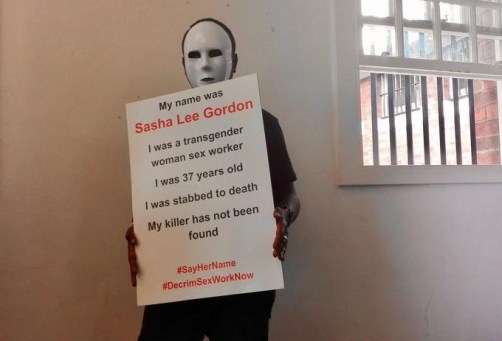
Image of a person carrying one of the #SayHerName campaign placards, by – and used with the permission of – the Sex Workers Education and Advocacy Taskforce


Sex work can simply be understood as the exchange of sexual services for some form of monetary value. More officially, UNAIDS (2001) defines sex work as “any agreement between two or more persons in which the objective is exclusively limited to the sexual act and ends with that, and which involves preliminary negotiations for a price”. 

Under Act 23 of the Sexual Offences Act (SOA) of 1957, sex work is fully criminalised in South Africa. The Act is a remnant of the apartheid regime’s Immorality Act of 1927, which criminalised sexual interactions across racial lines; specifically prohibiting sex between Black (African, Indian and Coloured) and White (Afrikaner and European) people. In 2007, the law was amended to include the purchasing of sex – until then, only the selling of sex had been criminalised. Currently the sex worker, client and anyone living off the earnings of a sex worker is considered a criminal. However, since it is difficult to prosecute someone for engaging in sex work (unless caught in the act), authorities tend to rely on entrapment, and municipal by-laws such as loitering, to arrest sex workers.


Selling sex in South Africa

South Africa’s unemployment rate went up during the second quarter of this year from 27% to 29% (of a total population of about 58 million), and is most notable amongst Black African women, who form approximately 35% of this overall national unemployment statistic. Therefore, poverty is still highly feminised and racialised in South Africa. It should then not be surprising that, under these socio-economic conditions, many Black women turn to sex work as the only (or most) viable option for making a living. 

According to a 2013 sex worker population size estimate study, there are approximately 153,000 sex workers in South Africa, with about 138,000 being women (which amounts to nearly 0.9% of the country’s female population), and most of whom are Black. Around 70% are street-based. 

In addition, according to the Gould & Fick 2008 study sex workers with a primary school education are able to earn nearly six times more doing sex work than they would from formal labour such as domestic work. On average, female sex workers support around four dependents, while their male colleagues about two. The same study also notes that the average age of debut into sex work is 24 years, with the average length of stay in the industry being 12 years.

Why decriminalisation?

   #SayHerName

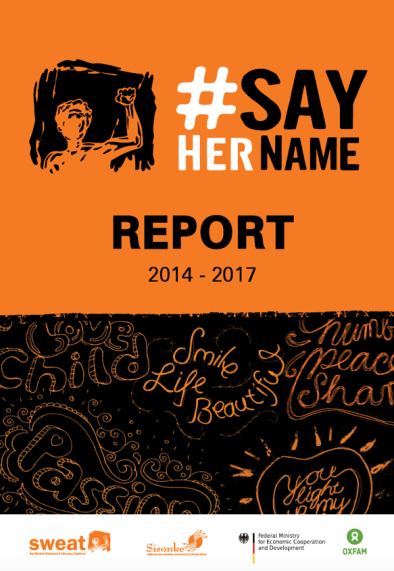
Cover of SWEAT’s #SayHerName Report 2014-2017, reproduced with the permission of SWEAT


During 2014 to 2017, the Sex Workers Education and Advocacy Taskforce (SWEAT) and the South African national movement of sex workers called Sisonke (meaning ‘we are together’ in isiZulu) received reports of 118 cis- and transgender women sex workers who had died as a result of violence. These were compiled into the SWEAT #SayHerName report, which noted that more than 50% of the deaths reported during this period were the result of murder. Of the reported murders, many of the deceased had also been sexually assaulted. Indeed, most of the documented killings included acts of severe brutality; such as repeated stab wounds, mutilations, acid burns and even decapitation.

Another recent (2019) study by the Human Rights Watch (HRW) ‘documents how the criminalisation of sex work fuels human rights violations against sex workers, including by police officers, and undermines their right to health’. HRW interviewed 46 women currently working as sex workers in the country, with about 75% reporting having been arrested more than once. One woman explained:

Usually (the fine is) R100 South African Rand (US$7) or R200 ($14). I get a receipt, it would say ‘gambling’ or ‘being on the streets’, or ‘urinating on the streets.’ But they arrest me because they know I am a sex worker, and because they find me at the hot spot. – Ranilwe Mola, Tzaneen-based sex worker, May 2018 (HRW 2019: 33).

In some instances, sex workers are even arrested just for being in possession of one too many condoms; a preventative mechanism to help fight the HIV/Aids pandemic in the country. South Africa has the highest number of people living with HIV at an estimated 7 million, which is about a fifth of persons living with the virus globally (SANAC 2018). In addition, when the (predominantly male) police enforce criminalisation, there is often a gender bias; they tend to detain the sex worker (or ask for sexual favours in exchange for being released), while letting the client go on a warning (or bribe).


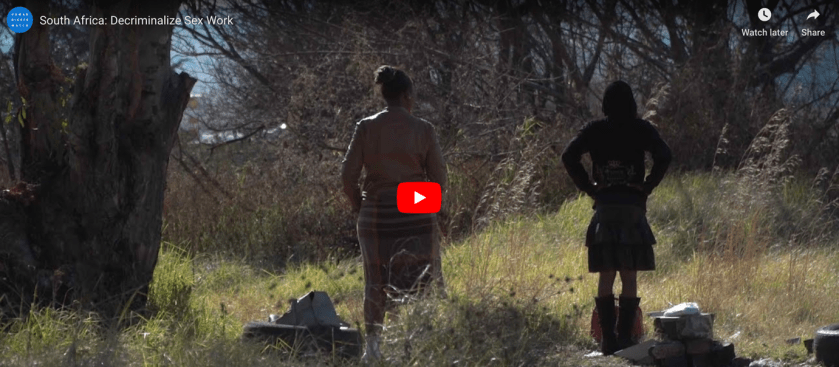
South Africa: Decriminalise Sex Work

So while the world commemorates the 16 Days of Activism Against Gender-Based Violence, we urge you to also remember that sex workers in South Africa remain marginalised, abused and, all too often, killed because of criminalisation. Our government’s lack of response and regressive engagement on the issue of decriminalisation further perpetuates and prolongs the suffering of sex workers. 

Decriminalisation of sex work would help create safe working conditions for adult consenting sex workers to operate under. It would also enable sex workers to report the abovementioned violations, and freely access basic social, legal and primary health care services without stigma and discrimination. Ultimately, it would afford sex workers equal access to labour and human rights, as all. To find out more about SWEAT, Sisonke and how you can support the struggle for sex workers’ rights in South Africa visit our website.

Ntokozo Yingwana is a doctoral researcher at the African Centre for Migration & Society (ACMS), Wits University.

Lunga Luthuli is the membership and communication officer for Sisonke

Day Seven | Presumptions, Prejudice and Progress: The Dynamics of Violence Against Sexual and Gender Minorities in Conflict-Affected Societies

Fidelma Ashe

LGBTQ flag

MARC BRUXELLE VIA GETTY IMAGES VIA HUFFPOST

During a project that investigated how peace is imagined in societies emerging from conflict, I conducted a series of focus groups with LGBTI+ people in Northern Ireland. The focus groups explored the participants’ experiences of conflict-related harms and investigated the impact of the ongoing peace process on ameliorating those harms. As expected, the group discussions uncovered multiple layers of prejudice, inequality and insecurity during the conflict. They also exposed the persistence of past inequities in the present. The testimony of the research participants highlighted clearly that, despite over 20 years of peacebuilding, historical prejudices reinforced by the conflict have persisted and continue to shape the lives of sexual and gender minorities in the region.

In short, while the rest of Northern Ireland society experienced increased levels of security during the period of peacebuilding – which was facilitated by the 1998 peace accord – LGBTI+ people continue to experience high levels of personal insecurity combined with and compounded by social and political exclusion. 

Context-specific case studies allow researchers to explore the local factors that shape the inequities, insecurity and violence that LGBTI+ people experience during conflict and after peace accords. Regional studies also provide local-level insights into the role that sexual and gender ideologies and practices play in shaping the broader contours of violent conflict. For too long, gendered bodies and sexuality have been framed as feminised, apolitical arenas with little connection to political conflict and its aftermath. Historical presumptions that sexual and gender inequalities are residual dynamics in conflict and conflict transformation have been shattered by critical analysts. 

One need look no further than Joane Nagel’s expertly crafted analysis of the interconnections between ethnicity, conflict, gender and sexuality to appreciate the role that heterosexist ideologies play in ethno-nationalist boundary-making and antagonisms. As she notes

“The borderlands that lie at the intersections of ethnic boundaries are “ethnosexual frontiers” that are surveilled and supervised, patrolled and policed, regulated and restricted…”

Those regulatory practices are shaped locally, but there are many cross-cultural patterns in terms of how conflict-related harms are produced and reproduced. 

Combined local and cross-cultural analyses have dispelled the presumption that prejudice against LGBTI+ people in conflict-affected societies and in societies transitioning to peace is a product of free-floating historical norms about sexuality and gender identity that become reinforced during conflict. This reading of conflict-affected violence against sexual and gender minorities suggests that conflict exacerbates pre-existing violences against already ‘vulnerable’ minority groups. ‘Vulnerablity’ to violence during conflict is not an inherent state but is rather produced and reproduced socially, ideologically and politically. Recognition of conflict-related harms – including violence against sexual and gender minorities – must be framed within the conditions of the reproduction of those harms. 

Ethno-nationalist communities, the state, and social institutions increase forms of insecurity for LGBTI+ through the maintenance of hierarchies that preserve and manufacture relationships of privilege and subordination. For example, ethno-nationalism has too often dismissed claims for sexual equality as inconsequential. State security policy can operate to facilitate violence against LGBTI+ people and increase levels of insecurity during conflict. Gender and sexual power-relationships within ethno-nationalist communities often lead to the exiling of LGBTI+ people from their homes. 

When they seek relocation in other countries, sexual and gender minorities can face further violence and oppression. A report by United Nations High Commission for Refugees (UNHCR) published in 2016 found that: 

“LGBTI asylum-seekers and refugees are subject to severe social exclusion and violence in countries of asylum by both the host community and the broader asylum-seeker and refugee community.”

These are the concrete processes of inequality and violence that conflict research must address, and they are underpinned by economic inequities and inequalities in decision-making power that are actively maintained. 

The Havana peace negotiation (2012–2016) – which led to the Colombian peace accord in 2016 – highlights how policies and laws can be included in negotiation processes and in the agreements that emerge. The Colombian accord addressed past inequities, violence, insecurities, and forms of economic and social marginalisation. The agreement not only recognized violence against LGBTI+ people as an aspect of conflict, it also recognized the role of local-level social hierarchies in supporting human rights violations within the transitional framework.

In addition, the recent legalisation of same-sex marriage in Northern Ireland exposes the advances that sustained struggle for legal equality can secure in the context of peacebuilding. Much can be done during peacebuilding to address the historical inequities and violences experienced by sexual and gender minorities. Despite these examples of significant advances in sexual and gender equality, it is important to note that in both Colombia and Northern Ireland, powerful groups have continued to frame demands for legal reform and political inclusion as reprehensible, and as a challenge to the moral integrity of the nation. Moreover, legal change does not invariably lead to reductions in prejudice or violence; Colombia’s murder rate fell to its lowest level in four decades in 2017, but government figures indicated no drop in the number of LGBTI+ people murdered in that year.

Purposeful action is required by national and international actors to address the ongoing violence experienced by sexual and gender minorities during and after conflict, and academics have a responsibility to ensure that those expressions of violence are recognised in conflict-focused and transitional justice research. In this respect, the framers of the Yogyakarta principles have charted a clear theoretical and policy-focused path for scholars and policy-makers.

 Meaningful peacebuilding requires an approach that supports diversity, inclusion and equality for all identities affected by conflict. Peacebuilding cannot be reduced to the management of antagonistic ethnic-blocs. Those who have struggled to end ideological and material violence against LGBTI+ people during conflict and who have campaigned for their inclusion in peacebuilding processes have presented us with a version of peace that is inclusive, diverse and progressive. Conflict research must incorporate that vision because it represents a more meaningful form of peace for the whole society that challenges multiple expressions of violence, injustice and inequality. 

Fidelma Ashe is a reader in politics and member of the Transitional Justice Institute at Ulster University. Her recent book, Gender, Nationalism and Conflict Transformation: New Themes and Old Problems in Northern Ireland Politics (Routledge) interrogates the role of gender and sexuality in shaping both conflict and peace.

Day Six | Towards a just conclusion – a prosecutor’s perspective on tackling domestic abuse in Scotland

Anne Marie Hicks

Hicks

Image of the Crown Office used with the permission of the Crown Office & Procurator Fiscal Service, Scotland

Transforming the institutional response to domestic abuse has been a key focus since I was appointed six years ago to a newly-created role of National Prosecutor, one which is not mirrored in other jurisdictions internationally. With a remit involving overseeing all aspects of policy, practice and training, including case work, service improvements and policy and legislative development, it’s my job to ensure prosecutors have the right tools to do the job and that our response is as effective as it can be. 

My diary over this period reflects the breadth of the role – there’s no ‘typical’ day. To illustrate, I’m delivering training to prosecutors; reviewing the first six months of implementation of our new domestic abuse law; and working with our human resources department on the development of a gender-based violence policy for our staff. I’m also speaking at events and to media to publicise 16 Days, participating in a Ministerial Task Force to improve victims’ justice experience and a Task Force to improve forensic medical services for victims of sexual violence, and attending a multi-agency forum with criminal justice and victim support organisations to discuss the collective response to domestic abuse. Quite a variety!

The key benefits and difference the National Prosecutor role have made are around strategic leadership and specialism – having the authority to work across boundaries, to really drive change, upskill prosecutors and identify and implement service improvements at a national level. Externally, the role has increased understanding and public confidence in our approach, has strengthened multi-agency collaborations and has enabled us to play a more influential role in the national political response to tackling violence against women.

Robust prosecution critical in preventing abuse

Around 30,000 domestic abuse charges are reported annually to the Prosecution Service by the police in Scotland – covering the full ambit of offending including rape and murder. Domestic abuse is also a significant inequality issue – around 80% of cases involve abuse by male perpetrators towards women.

We take a robust approach to the prosecution of domestic abuse, recognising that effective enforcement and prosecution is critical to the success of any wider prevention strategy. Prosecution can disrupt the abuse and enable physical separation and a breathing space for victims through custody, or protective court orders. It can provide an opportunity for intervention with perpetrators and victims, and prevent further abuse towards them or other women who may be at risk in the future. Prosecution also plays a vital role in educating the public and changing cultural attitudes, by sending a strong message that this behaviour won’t be tolerated in society.

Prosecutions are often challenging evidentially given the hidden nature of this crime which still overwhelmingly takes place behind closed doors. Reluctance and disengagement by victims with the criminal justice process due to the dynamics and impact of abuse is also a significant issue and prosecutors have to work harder to get the right results, in close collaboration with other organisations to ensure victim support and safety is at the centre of our approach.

We operate strong presumptions in favour of prosecution where there is sufficient evidence – and against discontinuation of prosecutions once we’ve started, even in the face of reluctance by the victim. Victims’ views will always be important, but the public interest requires that all relevant factors are properly considered. This approach recognises the repeated nature of the crime and the state’s obligations – as confirmed by the European Court of Human Rights – to tackle violence against women and protect citizens from future harm. 

Criminal enforcement alone will not eliminate domestic abuse; but without robust, consistent and effective enforcement and prosecution, we will never eradicate this behaviour in society and make victims and children safer.

Scotland’s new domestic abuse law

From April this year, Scotland has had the benefit of a new domestic abuse law which criminalises a course of abusive behaviour between partners or ex-partners (unlike other UK jurisdictions, the Scottish legislation doesn’t extend to other familial relationships). 

Introduced to close a gap in the law in relation to many of the coercive and controlling behaviours which weren’t previously criminal, the new law is significant in a number of ways. For example, it moves away from an incident-based episodic approach and enables patterns of repeat victimisation to be prosecuted as a single course of conduct. It also defines abusive behaviour as including not only physical and sexual violence and threats, but also other coercive and controlling behaviours, including those designed to isolate, control, regulate, restrict freedom, punish, degrade and humiliate.

A further strength of the new law is that it focuses on the perpetrator’s behaviour and likelihood of this causing harm rather than requiring proof of actual impact and harm to the victim;and it recognises the harm caused to children by domestic abuse and introduces an aggravation to the charge where a child is involved. Finally, it enhances victim safety provisions, introducing mandatory consideration of protective non-harassment orders for victims and children on the conviction of the perpetrator.

It’s early days but already we’ve raised numerous prosecutions and are securing convictions. Crucially we’ve been able to prosecute coercive and controlling behaviours which were not previously criminal, making the true pattern of abuse visible and allowing courts to address the full extent of victims’ experiences. This is a significant step forward for Scotland in ongoing collective efforts to transform the justice response to tackling this insidious behaviour and keeping victims and children safe. 

Anne Marie Hicks is the National Procurator Fiscal for Domestic Abuse at the Crown Office & Procurator Fiscal Service, Scotland

Day Five | Holding foreign fighters accountable for sexual violence

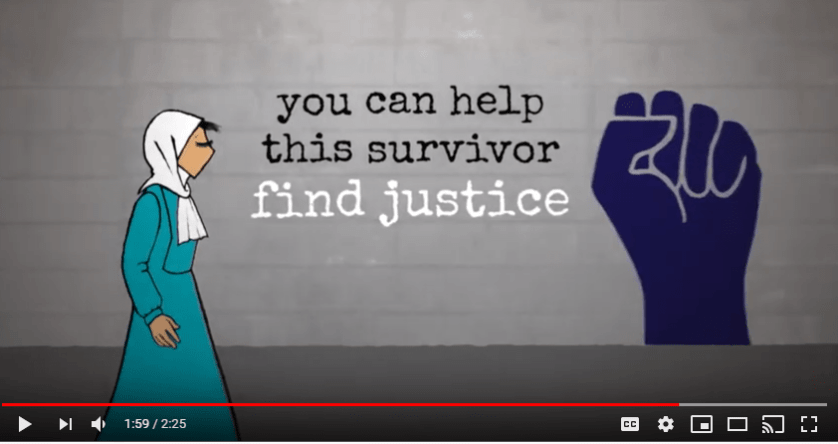
Sexual violence YT video

Susan Hutchinson

As the security situation continues to deteriorate in Syria and Iraq, Western nations are being forced to reconsider the issue of what to do with their nationals stuck there since the war with ISIS. When Turkey invaded northern Syria, the Kurdish authorities who had been managing the prisons holding ISIS fighters, including those who are foreign nationals, said they could no longer prioritise the management of these prisons. Many of those prisoners are responsible for perpetrating gross sexual violence as war crimes, crimes against humanity and genocide. But the Kurds are now facing another genocide of their own.

Too often, conflict-related sexual violence is considered a problem too difficult to resolve because it occurs in another country, by people from another country, against people from another country. But we have a unique moment in time to help end impunity for conflict related sexual violence. An estimated 40,000 foreign fighters from 89 countries travelled to Syria and Iraq to fight with ISIS. Many of the source countries are State Parties to the Rome Statute of the International Criminal Court, obliging them to investigate and prosecute war crimes, crimes against humanity and genocide in their own domestic court systems. 

We needn’t wait indefinitely for the big boys of the UN Security Council to refer these crimes to the International Criminal Court. Countries like Australia have incorporated these crimes into their own domestic criminal code and have an obligation to investigate and prosecute their own nationals for the sexual violence they perpetrated as war crimes, crimes against humanity and genocide while fighting with ISIS in Syria and Iraq. We have the jurisdiction and the competent authority; all that remains is the political will and investment. 

For the International Day for the Elimination of Violence against Women, ‘prosecute; don’t perpetrate’ released a short, animated video (above) explaining why and how we need to end impunity for conflict-related sexual violence. We made it with sketches and graffiti from an incredible Afghan artist and professor, Shamsia Hassani, who does a lot of beautiful work on women’s rights. 

There are countless incredible women from conflict-affected countries defending women’s rights. Nadia Murad has been fighting for years for justice for survivors like her, not just of trafficking and sexual violence, but of genocide as well. She has shared her story countless times, but so far not a single ISIS fighter has been prosecuted for sexual violence as war crimes, crimes against humanity or genocide. The time has come for us to take up the baton, to fight for women like Nadia, to make sure she receives the justice she deserves, and all the women like her. 

Investigating and prosecuting these crimes would be the responsible thing to do from the perspective of the rules-based international order. It would be the responsible thing to do if we wanted to end impunity for conflict-related sexual violence. It would be the right thing to do if we wanted to take action against gender violence. It would be far more responsible than leaving perpetrators in Syria, Iraq, Turkey or elsewhere to continue wreaking havoc on the world. It is also more responsible to ensure they are securely imprisoned within our own borders under the auspices of our own security agencies rather than in extremely unstable countries recovering from the conflict with ISIS.

When Yazidi activist Ameena Saeed Hasan bemoaned the UN Security Council’s inaction during a debate on trafficking of persons in armed conflict, she told of a Yazidi girl who had phoned her, begging, “if you can’t free us, bomb us”. “Where is the justice?” Ameena asked aghast by the total inaction of the international community. 

Today is the International Women Human Rights Defenders Day. As part of our activism this 16 Days, we can help women human rights defenders like Ameena and Nadia. We can work to ensure our governments meet their obligations to investigate and prosecute their own nationals who perpetrated sexual violence as war crimes, crimes against humanity and genocide. 
Susan Hutchinson is the architect of the prosecute; don’t perpetrate campaign to help end impunity for conflict related sexual violence. She is also a PhD scholar at the Australian National University’s Coral Bell School of Asia Pacific Affairs. Her research focuses on the implementation of the Women, Peace and Security agenda. Susan regularly blogs for the Lowy Institute’s Interpreter and BroadAgenda. She is a member of the Australian Civil Society Coalition on Women, Peace and Security and the Australian Arms Control Coalition.