Day Ten |Women’s right to physical security in the Pacific region

Nicole George

Pacific Islands violence The Pacific Islands may be well-known as an idyllic tourist destination, but gendered violence remains a chronic issue for Island women. AAP/Diana Plater via the Conversation

Since 2013, I have worked with women’s groups in the Pacific Islands countries of Fiji, Bougainville (in PNG), New Caledonia, Solomon Islands and Vanuatu, to reflect on women’s right to physical security, and ask what that principle looks like in our Pacific region. My research has had two aims; first to understand how the right to safety is institutionalised and reforms are implemented in each country, and second, to examine how the right to safety is understood by women in an everyday sense.

To give some context, it is important to consider the global origins of women’s right to live in security from violence. In 1993, the United Nations General Assembly formally recognised violence against women to be a violation of women’s human rights. In doing so, the issue of women’s vulnerability was no longer considered a source of personal shame and stigma. Rather, it was given full recognition as a global challenge, and states were asked to do more to support their female populations who experienced this violence, as well as to work towards its elimination. 

Since 1993, Pacific Island countries, including the larger island countries of Australia and New Zealand have all responded to this shift in global policy making on violence against women. We have come a long way from the days of 1995 when one Pacific leader jested amongst his male peers at the Pacific Islands Forum meeting, that Pacific men used the idle hours of the “Sunday Sabbath” to kick “either a football or one’s wife around”. 

Nearly twenty years later, the Pacific Island Forum leaders meeting in 2012 was, by contrast are more sympathetic event. Here the regions leaders made a powerful commitment to tackle gender inequality in their countries and also to do more to challenge violence against women. In the years since, we have seen Pacific Island governments recognise their responsibilities towards women and establish reforms that aim to eliminate violence against women.

In PNG, Vanuatu and Solomon Islands we have seen new family law legislation and new domestic violence legislation with more protections for women and harsher penalties enacted for those who perpetrate violence. In Solomon Islands, additionally, the government has established a National Policy to Eliminate Violence Against Women and Girls in 2016 which integrates government and civil society programs to assist those exposed to violence. 

In Fiji, we have seen new policing policy which stipulates a “zero tolerance approach” and “no drop” directing all officers to investigate cases of violence against women brought to their attention, even if women later try to withdraw the complaint. In New Caledonia there have been state and civil society initiatives such as the establishment of shelters and women’s bureaus who offer assistance to women who have been exposed to violence. 

All of these reforms show state and civil society commitment to the objective of eliminating gender violence. But what is their concrete effectiveness? Do they mean women experience less violence in their daily lives? This is always a hard question to answer ask because we also know that when there is more public debate about violence against women, and more effort to improve state authorities’ responses to this issue, more women who might not have reported abuse decide to come forward to demand assistance. 

But given that we are now 16 years on from that landmark international policy shift of 1993, and 7 years on from the Pacific Islands Forum declaration recognising women’s insecurity as an issue of regional concern, we might also expect to see the beginning of a decline in numbers of women being exposed to this violence. Sadly, this is far from evident, and in many countries around the region we see violence against women perpetrated at significant rates consistent, or even higher than, those of 20 years ago.  

So my research has really sought to understand why. My findings indicate to me that while state reform is important, implementation remains a challenge.  

Part of the problem lies in the difficulties that women continue to face in trying to progress charges against violent family members through the criminal justice system. In Solomon Islands, for example, between the establishment of the Family Safety bill in 2014 and 2018, there were only 18 people convicted of family violence offences and only one person had received a custodial sentence. 

There are many dedicated police officers that are sympathetic towards women who bring complaints of violence to their attention. But there are also many others who continue to treat this issue as of minimal importance in general law and order work. Through my research in the Pacific Islands region, I have amassed too many stories which show that even when official policing policy states that women’s complaints of violence must be investigated, individual police officers frequently dissuade women from pressing charges against family members and instead encourage them to return home and reconcile with their husbands.

The scope of policing authority in many Pacific Island countries is also usually quite limited too and this can have an impact on women’s safety. For example, when I began research on violence against women in Fiji in 2013, as the government was implementing the aforementioned “Zero Tolerance” policy on violence against women. This involved a community policing approach and cooperation from local community leaders. Many people around the country praised this program and urged me to study it. The fact that it sought to complement policing responses with the input and authority of community leaders seemed promising. 

Yet, when I went to rural villages, or squatter settlements around the main cities in Fiji to find out more, I encountered less enthusiasm. Women in these places made statements such as “men have no idea what we go through” or “our experiences are just our own”. This suggested that even this program with its zero tolerance message, and degree of community-level cooperation was struggling to make an impact. The testimonies of the women I spoke to in this context, suggested to me that that government programs must do more than show success in a few well-publicised locations if women’s rights to security are to be upheld generally.   

The question of what women might want in terms of state support when they are exposed to violence is interesting too, and suggests the ‘punish and protect’ model of policing may itself not be a solution that those exposed to violence always seek.  My work in Vanuatu with Melissa Bull has yielded particularly interesting results on this question. It has shown that where police do have the capacity to intervene, women simply want officers to bring about a halt in household or family violence so that order is re-established and do not expect or want their partners subjected to punishment. Women here also explained that police can play an important role in educating perpetrators that their violent actions are against law and human rights. 

So what can we take away from all of this? Certainly, we have come a long way in the Pacific region from the days when it was thought appropriate for Pacific leaders to make jokes about women’s vulnerability to violence and show little regard to questions of women’s safety. Today, many Pacific Island states take this challenge seriously and have enacted legal, policing and welfare reforms to uphold women’s rights to security, and make that an issue of state responsibility. But more work needs to be done to ensure that these commitments are more than just words. The design of reform is the first step.

Meaningful implementation in ways that provide women with valuable aid, support and protection from violence, is a second but far more challenging part of the process. This will be vital if we are committed to challenging the scenario where women’s rights to security are respected and we find it unacceptable that women’s stories of violence should remain “simply their own”. 

Nicole George is Associate Professor at the University of Queensland. Her research focuses on the gendered politics of conflict and peacebuilding, violence, security and participation. Since the early 2000s, she has conducted research in the Pacific Islands region focusing on gender politics, gendered security and post conflict transition in Fiji, New Caledonia, Bougainville and Solomon Islands, working in collaboration with women’s organisations, women decision-makers and women policymakers in these settings. 

Day Nine | Fighting against Disablist Gender Based Violence: A Double Dose of Discrimination

Caroline Bradbury-Jones and Sonali Shah 

Disability, Gender

Disability and violence are global human rights issues that cut across gender, race, age, sexuality, geographical, religious, socio-economic and cultural boundaries. They are socially produced and culturally constructed, and can manifest at different or multiple, generational locations over a person’s life-course (childhood, youth, adulthood and older age). Disability and violence have a bi-directional relationship in that the onset of impairment can be caused by being exposed to violence, or violent actions by a perpetrator can be stimulated by a victim’s impairment.

While both were once considered to be private problems hidden from public view, increasingly they are recognised as issues that call for public attention and intervention. Moreover, both are gendered, and both begin early in life. Here, we focus on what we term ‘disablist gender-based violence’, that is, violence that is specific to being disabled and that is targeted at women and girls because they are women and girls. It is, in effect, a double dose of discrimination.

Across the globe, the risk of violence for children with impairments is up to four times greater than their non-disabled contemporaries. Violence against disabled children tends to be more severe than for non-disabled children, while severity is correlated with the impairment type. They are likely to experience more than one type of violence across their lifetime starting from an early age.

From infanthood, disabled people are continuously reminded of their ‘difference’ and ‘otherness’ in society. There is now indubitable evidence that there are considerable gendered risks that lead to disablist gender-based violence. Accounting for gender, significantly more disabled girls than disabled boys are likely to experience sexual abuse, while the opposite is true for physical abuse. 

The high proportion of disabled women and girls exposed to and experiencing violence during their lives is associated with a number of factors, starting with the societal contention that the life of a disabled child is a wrongful life and an economic burden to the family and society. The objectification and manipulation of the disabled female body have been suggested to create opportunities for violence.

Disablist gender-based violence includes actions that simultaneously increase the powerfulness of the perpetrators and the powerlessness of the disabled women and girls. Although disabled women and girls can experience the same types of abuse as their non-disabled contemporaries – physical, sexual and emotional – they are likely to be subjected to additional abuse triggered by the objectification and manipulation we mentioned earlier. Moreover, abuse may be perpetrated by people who are supposed to ‘care’ for them, such as personal assistants or carers in institutions, parents and health care workers.

Into adulthood, over half of all disabled women have experienced physical abuse, compared with one third of non-disabled women. Nearly 80% of disabled women have been victims of psychological and physical violence, and are at a greater risk of sexual abuse than non-disabled women. Traditionally, as a group, disabled women and girls have been exposed to disempowering messages about their reproductive choices from early childhood, for example having limited exposure to sexual knowledge and opportunities while growing up. 

This arises from them being excluded from the cultural spaces where such exchanges take place or being constrained by high levels of surveillance. Disabled women have been discouraged and sometimes physically prevented from exercising their reproductive capacities and becoming parents. They are subject to social infantilisation, being conceptualised as weak, passive and dependent. The disabled female body has not been seen as beautiful or sexual, but as fragile, weak and asexual. Moreover, the disabled female has historically been objectified asexually by media, medical and legal discourses; conceptualised as undesirable sexual partners or mothers. 

The fact that disabled women and girls may have to depend on others for basic personal and social needs, not only places them at greater risk of abuse compared to non-disabled females, but also reduces opportunities to disclose. Professionals may not necessarily recognise scars of disabled child abuse and misdiagnose them as being related to the child’s impairment. Such diagnostic overshadowing can thwart opportunities for child protection and support and exacerbate marginalisation and risk to disabled women and girls. Moreover, limited violence prevention support and intervention for disabled females at different points of their life can leave them feeling disempowered and doubting their rights to protection and support. 

In conclusion, gender-based violence perpetrated against women and girls is a major human rights issue that blights the lives of millions worldwide. This risk is greater for disabled women and girls and is less likely to be recognised among policy makers and health service providers. Disabled women and girls are more likely to encounter barriers to support and protection for a number of reasons, connected to the overall pattern of disablism in society.

The evidence suggests that indicators of violence can be overlooked by practitioners who see the disability first, rather than the woman or girl as a person. The reality is that many disabled women have intersectional identities – they may identify as homosexual, identify as transgender, are of minority ethnic or religious background, and are of different ages – which contributes to unique experiences of oppression and disadvantage.

Across the globe, there is a dearth of voices and experiences of disabled women and girls in mainstream research, policy and practice in relation to violence, victimisation, protection and prevention. The inclusion of these hidden voices will not only help achieve the goal “nothing about us without us”. It will also raise an awareness of the need to include disablist violence in official definitions of gender-based violence and child abuse. 

The issues covered in this blog are addressed more fully in our book: Disability, Gender and Violence over the Life Course: Global Perspectives and Human Rights Approaches. Shah, S. & Bradbury-Jones, C. (2018), Routledge, London. 


Caroline Bradbury-Jones is a registered nurse, midwife and health visitor. Her research interests lie broadly within the scope of addressing inequalities and more specifically are focused on issues of family violence and child abuse and neglect. She has led or been actively involved in securing funding for a number of research projects relevant to these areas. She has undertaken research or engaged in scholarly activities with a number of countries including Japan, New Zealand, Denmark, Germany and Finland. Caroline leads the Risk, Abuse and Violence research programme at the University of Birmingham. 

Sonali Shah is a Research Fellow in the School of Nursing at the University of Birmingham. She is funded by a Burdett Trust award to undertake a qualitative study ‘Eternal: UK healthcare of women with Cerebral Palsy across the female life cycle’. The purpose is to address the gap in existing understandings about growing older with Cerebral Palsy, and women’s health, and to highlight the health and healthcare experiences of disabled women in general, and women with CP in particular. The proposed outcome is to develop an educational tool for nurses, midwives and allied healthcare practitioners to understand the embodied changes experienced by girls and women with Cerebral Palsy across the life course (from menarche to menopause), and how to overcome structural and cultural barriers to healthcare services, environments and treatments, particularly in relation to reproductive and sexual health. 

Day Eight | Reflecting on Zimbabwe’s Gukurahundi Genocide through Poetry

Dudu Ndlovu

Zimbabwe

Silence 

Everyone knows of that time

That time nobody wants to go back to

That time that will never be forgotten

That time we never speak of


Screams in the night 

Fear gripping the most brave

Nobody wants to witness the shame

Gukurahundi Genocide


Daylight brings sunshine and blue skies

Yet the brightest song from the birds

Can never soak away 

The blood drenching the earth 

Calling out for justice 


Mothers bear a fatherless generation 

Girls pay with their sexed bodies 

Young men flee for their lives

Fathers killed for their politics


Silence labours to erase 

The trace of that time 

But like a woman bewitched

Produces a thousand times more

The stench of death

(Poem by Duduzile S. Ndlovu, 2015) 


Zimbabwe, a country on the southern tip of Africa, gained independence from direct colonial rule in 1980. This signalled the end of the liberation struggle; however, people in the Matabeleland and Midlands parts of the country (which were also strongholds for the opposition party at that time) experienced another war, this time at the hands of the army of the newly-independent country. 

The poem above reflects on this period, which is popularly known as Gukurahundi, where 20,000 people were killed or disappeared from 1980 to 1987. Much has been written on the causes of the Gukurahundi violence and most importantly that its victims have not received any acknowledgement or restitution for the pain suffered. Many see the Gukurahundi as a genocide meant to annihilate the Ndebele from Zimbabwe. The Zimbabwean government has justified its silencing of the memorialisation of the violence by arguing that speaking about the Gukurahundi will incite ethnic division in the country.

Since the late 1990s, Zimbabwe began to experience economic decline resulting in an increase in the number of those migrating to neighbouring countries such as Botswana and South Africa, some as far as the United Kingdom and other countries across the globe in search of economic opportunities. As people migrate, they carry along with them their memories and trauma across the borders. Some of the victims of the Gukurahundi who migrated to Johannesburg find in it space to commemorate the Gukurahundi – which they couldn’t do in Zimbabwe, where the government prevented such efforts.  

There are calls for the acknowledgment of the Gukurahundi and for the truth about the atrocities to be made public so the perpetrators can be held accountable.  However, a male-centric, ethnic and nationalistic memorial narrative prevails in these memorials and calls for acknowledgement, reparation and reconciliation. Some calls for acknowledgement, for example, demand the cessation of borders to create an ethnically pure nation for the victims. This is despite the fact that many women were sexually violated and conceived and bore children out of the rape, thus making the idea of an ethnically pure nation impossible. Speaking about the sexual violence that many women (and some men) experienced and the presence of children born out of this thus presents an inconvenient truth. 

These calls for acknowledgement therefore do not provide women with spaces where they can speak about their pain from the sexual violence. The gendered location of women, their experience of conflict and how it is remembered is rarely captured and represented in popular memory (see, for example, ‘Gender, Memorialization, and Symbolic Reparations’ by Brandon Hamber and Ingrid Palmary). The above poem, ‘Silence’, which I wrote in 2015, seeks to rectify this, and make visible the ways in which violence is gendered, and how conflict is felt differently on different bodies.


Dudu Ndlovu is a postdoctoral fellow at the African Centre for Migration and Society. Her research interests include exploring arts-based research methods as a form of decolonising knowledge production; interrogating intersectionality through narrative work; and analysing the gendered politics of memory. Since March 2018, she has been developing this research agenda through a Newton Advanced Fellowship attached to the University of Edinburgh, Centre for African Studies (CAS) (2018-2020). Dudu completed her PhD at the University of the Witwatersrand focusing on Zimbabwean migrants’ use of art (poetry, music, drama, film) to navigate precarious lives; speak about violence – including the Gukurahundi in Zimbabwe and xenophobia in South Africa, and memorialise those events. More of her poetry can be found here.

Day Seven | Remember Sex Workers during the 16 Days

Ntokozo Yingwana (Wits University) and Lunga Luthuli (Sisonke)

Seven Ntokozo

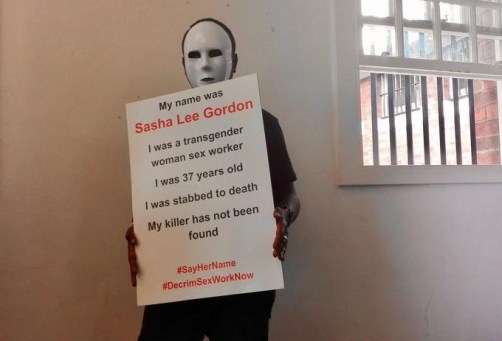
Image of a person carrying one of the #SayHerName campaign placards, by – and used with the permission of – the Sex Workers Education and Advocacy Taskforce


Sex work can simply be understood as the exchange of sexual services for some form of monetary value. More officially, UNAIDS (2001) defines sex work as “any agreement between two or more persons in which the objective is exclusively limited to the sexual act and ends with that, and which involves preliminary negotiations for a price”. 

Under Act 23 of the Sexual Offences Act (SOA) of 1957, sex work is fully criminalised in South Africa. The Act is a remnant of the apartheid regime’s Immorality Act of 1927, which criminalised sexual interactions across racial lines; specifically prohibiting sex between Black (African, Indian and Coloured) and White (Afrikaner and European) people. In 2007, the law was amended to include the purchasing of sex – until then, only the selling of sex had been criminalised. Currently the sex worker, client and anyone living off the earnings of a sex worker is considered a criminal. However, since it is difficult to prosecute someone for engaging in sex work (unless caught in the act), authorities tend to rely on entrapment, and municipal by-laws such as loitering, to arrest sex workers.


Selling sex in South Africa

South Africa’s unemployment rate went up during the second quarter of this year from 27% to 29% (of a total population of about 58 million), and is most notable amongst Black African women, who form approximately 35% of this overall national unemployment statistic. Therefore, poverty is still highly feminised and racialised in South Africa. It should then not be surprising that, under these socio-economic conditions, many Black women turn to sex work as the only (or most) viable option for making a living. 

According to a 2013 sex worker population size estimate study, there are approximately 153,000 sex workers in South Africa, with about 138,000 being women (which amounts to nearly 0.9% of the country’s female population), and most of whom are Black. Around 70% are street-based. 

In addition, according to the Gould & Fick 2008 study sex workers with a primary school education are able to earn nearly six times more doing sex work than they would from formal labour such as domestic work. On average, female sex workers support around four dependents, while their male colleagues about two. The same study also notes that the average age of debut into sex work is 24 years, with the average length of stay in the industry being 12 years.

Why decriminalisation?

   #SayHerName

Cover of SWEAT’s #SayHerName Report 2014-2017, reproduced with the permission of SWEAT


During 2014 to 2017, the Sex Workers Education and Advocacy Taskforce (SWEAT) and the South African national movement of sex workers called Sisonke (meaning ‘we are together’ in isiZulu) received reports of 118 cis- and transgender women sex workers who had died as a result of violence. These were compiled into the SWEAT #SayHerName report, which noted that more than 50% of the deaths reported during this period were the result of murder. Of the reported murders, many of the deceased had also been sexually assaulted. Indeed, most of the documented killings included acts of severe brutality; such as repeated stab wounds, mutilations, acid burns and even decapitation.

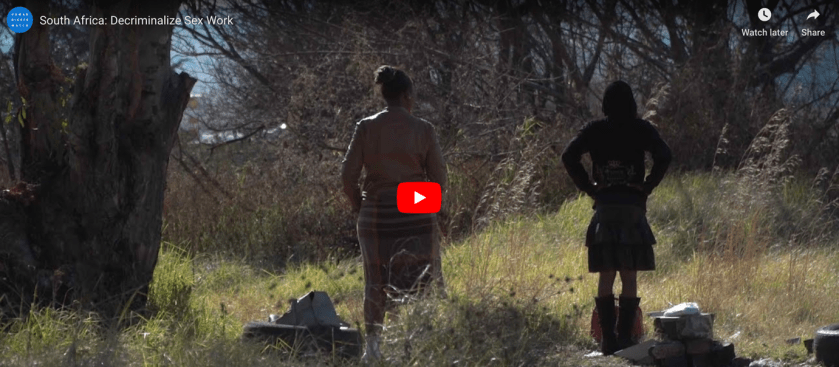
Another recent (2019) study by the Human Rights Watch (HRW) ‘documents how the criminalisation of sex work fuels human rights violations against sex workers, including by police officers, and undermines their right to health’. HRW interviewed 46 women currently working as sex workers in the country, with about 75% reporting having been arrested more than once. One woman explained:

Usually (the fine is) R100 South African Rand (US$7) or R200 ($14). I get a receipt, it would say ‘gambling’ or ‘being on the streets’, or ‘urinating on the streets.’ But they arrest me because they know I am a sex worker, and because they find me at the hot spot. – Ranilwe Mola, Tzaneen-based sex worker, May 2018 (HRW 2019: 33).

In some instances, sex workers are even arrested just for being in possession of one too many condoms; a preventative mechanism to help fight the HIV/Aids pandemic in the country. South Africa has the highest number of people living with HIV at an estimated 7 million, which is about a fifth of persons living with the virus globally (SANAC 2018). In addition, when the (predominantly male) police enforce criminalisation, there is often a gender bias; they tend to detain the sex worker (or ask for sexual favours in exchange for being released), while letting the client go on a warning (or bribe).


South Africa: Decriminalise Sex Work

So while the world commemorates the 16 Days of Activism Against Gender-Based Violence, we urge you to also remember that sex workers in South Africa remain marginalised, abused and, all too often, killed because of criminalisation. Our government’s lack of response and regressive engagement on the issue of decriminalisation further perpetuates and prolongs the suffering of sex workers. 

Decriminalisation of sex work would help create safe working conditions for adult consenting sex workers to operate under. It would also enable sex workers to report the abovementioned violations, and freely access basic social, legal and primary health care services without stigma and discrimination. Ultimately, it would afford sex workers equal access to labour and human rights, as all. To find out more about SWEAT, Sisonke and how you can support the struggle for sex workers’ rights in South Africa visit our website.

Ntokozo Yingwana is a doctoral researcher at the African Centre for Migration & Society (ACMS), Wits University.

Lunga Luthuli is the membership and communication officer for Sisonke

Day Seven | Presumptions, Prejudice and Progress: The Dynamics of Violence Against Sexual and Gender Minorities in Conflict-Affected Societies

Fidelma Ashe

LGBTQ flag

MARC BRUXELLE VIA GETTY IMAGES VIA HUFFPOST

During a project that investigated how peace is imagined in societies emerging from conflict, I conducted a series of focus groups with LGBTI+ people in Northern Ireland. The focus groups explored the participants’ experiences of conflict-related harms and investigated the impact of the ongoing peace process on ameliorating those harms. As expected, the group discussions uncovered multiple layers of prejudice, inequality and insecurity during the conflict. They also exposed the persistence of past inequities in the present. The testimony of the research participants highlighted clearly that, despite over 20 years of peacebuilding, historical prejudices reinforced by the conflict have persisted and continue to shape the lives of sexual and gender minorities in the region.

In short, while the rest of Northern Ireland society experienced increased levels of security during the period of peacebuilding – which was facilitated by the 1998 peace accord – LGBTI+ people continue to experience high levels of personal insecurity combined with and compounded by social and political exclusion. 

Context-specific case studies allow researchers to explore the local factors that shape the inequities, insecurity and violence that LGBTI+ people experience during conflict and after peace accords. Regional studies also provide local-level insights into the role that sexual and gender ideologies and practices play in shaping the broader contours of violent conflict. For too long, gendered bodies and sexuality have been framed as feminised, apolitical arenas with little connection to political conflict and its aftermath. Historical presumptions that sexual and gender inequalities are residual dynamics in conflict and conflict transformation have been shattered by critical analysts. 

One need look no further than Joane Nagel’s expertly crafted analysis of the interconnections between ethnicity, conflict, gender and sexuality to appreciate the role that heterosexist ideologies play in ethno-nationalist boundary-making and antagonisms. As she notes

“The borderlands that lie at the intersections of ethnic boundaries are “ethnosexual frontiers” that are surveilled and supervised, patrolled and policed, regulated and restricted…”

Those regulatory practices are shaped locally, but there are many cross-cultural patterns in terms of how conflict-related harms are produced and reproduced. 

Combined local and cross-cultural analyses have dispelled the presumption that prejudice against LGBTI+ people in conflict-affected societies and in societies transitioning to peace is a product of free-floating historical norms about sexuality and gender identity that become reinforced during conflict. This reading of conflict-affected violence against sexual and gender minorities suggests that conflict exacerbates pre-existing violences against already ‘vulnerable’ minority groups. ‘Vulnerablity’ to violence during conflict is not an inherent state but is rather produced and reproduced socially, ideologically and politically. Recognition of conflict-related harms – including violence against sexual and gender minorities – must be framed within the conditions of the reproduction of those harms. 

Ethno-nationalist communities, the state, and social institutions increase forms of insecurity for LGBTI+ through the maintenance of hierarchies that preserve and manufacture relationships of privilege and subordination. For example, ethno-nationalism has too often dismissed claims for sexual equality as inconsequential. State security policy can operate to facilitate violence against LGBTI+ people and increase levels of insecurity during conflict. Gender and sexual power-relationships within ethno-nationalist communities often lead to the exiling of LGBTI+ people from their homes. 

When they seek relocation in other countries, sexual and gender minorities can face further violence and oppression. A report by United Nations High Commission for Refugees (UNHCR) published in 2016 found that: 

“LGBTI asylum-seekers and refugees are subject to severe social exclusion and violence in countries of asylum by both the host community and the broader asylum-seeker and refugee community.”

These are the concrete processes of inequality and violence that conflict research must address, and they are underpinned by economic inequities and inequalities in decision-making power that are actively maintained. 

The Havana peace negotiation (2012–2016) – which led to the Colombian peace accord in 2016 – highlights how policies and laws can be included in negotiation processes and in the agreements that emerge. The Colombian accord addressed past inequities, violence, insecurities, and forms of economic and social marginalisation. The agreement not only recognized violence against LGBTI+ people as an aspect of conflict, it also recognized the role of local-level social hierarchies in supporting human rights violations within the transitional framework.

In addition, the recent legalisation of same-sex marriage in Northern Ireland exposes the advances that sustained struggle for legal equality can secure in the context of peacebuilding. Much can be done during peacebuilding to address the historical inequities and violences experienced by sexual and gender minorities. Despite these examples of significant advances in sexual and gender equality, it is important to note that in both Colombia and Northern Ireland, powerful groups have continued to frame demands for legal reform and political inclusion as reprehensible, and as a challenge to the moral integrity of the nation. Moreover, legal change does not invariably lead to reductions in prejudice or violence; Colombia’s murder rate fell to its lowest level in four decades in 2017, but government figures indicated no drop in the number of LGBTI+ people murdered in that year.

Purposeful action is required by national and international actors to address the ongoing violence experienced by sexual and gender minorities during and after conflict, and academics have a responsibility to ensure that those expressions of violence are recognised in conflict-focused and transitional justice research. In this respect, the framers of the Yogyakarta principles have charted a clear theoretical and policy-focused path for scholars and policy-makers.

 Meaningful peacebuilding requires an approach that supports diversity, inclusion and equality for all identities affected by conflict. Peacebuilding cannot be reduced to the management of antagonistic ethnic-blocs. Those who have struggled to end ideological and material violence against LGBTI+ people during conflict and who have campaigned for their inclusion in peacebuilding processes have presented us with a version of peace that is inclusive, diverse and progressive. Conflict research must incorporate that vision because it represents a more meaningful form of peace for the whole society that challenges multiple expressions of violence, injustice and inequality. 

Fidelma Ashe is a reader in politics and member of the Transitional Justice Institute at Ulster University. Her recent book, Gender, Nationalism and Conflict Transformation: New Themes and Old Problems in Northern Ireland Politics (Routledge) interrogates the role of gender and sexuality in shaping both conflict and peace.