Almost 50 years on, Anne Summers writes about the opening of Elsie Women’s Refuge in 1974 (Australia).
Anne Summers
It is almost impossible to fathom that in just 27 months it will be 50 years since we opened Elsie Women’s Refuge. In March 1974 a rowdy group of feminists in the inner-Sydney neighbourhood of Glebe broke into an abandoned house, which serendipitously bore the nameplate Elsie (many houses in Australia used to have names). We changed the locks, declared squatters’ rights, and opened Australia’s first modern women’s refuge. As luck would have it, the adjoining house was also unoccupied, so we smashed our way in there as well, giving us two tiny cottages to operate from. It took three nerve-wracking days before the first woman and her kids showed up. We had opened the refuge under the most precarious of circumstances: our tenancy legally questionable, no funds, very little support from other sections of the women’s movement which questioned whether feminists should be providing services. And now, after much media fanfare on the need for safe housing for women and kids escaping domestic violence, no one had shown up.
Video above: Excerpt from the film ‘Brazen Hussies’ featuring Anne Summers. Reproduced with permission from writer and director Catherine Dwyer.
We learned later of the women who had written down the phone number after hearing me interviewed by Sydney’s most notorious shock-jock radio host (who turned out to be amazingly sympathetic and kept repeating the number long after I had left the studio). After our first ‘client’ arrived, a Scottish woman and her three little boys who, to her astonishment, was given an extremely effusive welcome, we were never not full to overflowing.
By June 1975, just fifteen months later, there were eight women’s refuges around the country, all operating on uncertain future funding. A friendly feminist who worked in the Office of Women’s Affairs in Canberra urged us to ring around the other refuges and “get some figures on how many families had come through”.
Diana Beaton, one of the volunteers who kept Elsie going for many years after that shaky start, made the calls: “Over that period, we’d sheltered 13,500 women and children. Even we were gob-smacked,” she said in a magazine interview many years later.
Image above: Photograph taken inside a women’s refuge at Glebe, Sydney, New South Wales 1975. Source: National Archives of Australia, A6180, 2/6/75/11
For years after I was no longer involved, I would hear stories from women who had sought sanctuary at Elsie. Mandy Sayer, a well-known Sydney writer, tells of her mother piling into a cab with she and her brother, wearing only their pajamas, and asking to be taken to Elsie. It was a $50 cab ride. Her mother had no money but at Elsie they were welcomed, the cab was paid for, and Mandy and her family began the reset of their lives.
Back on that first day, in March 1974, I had given countless radio and television interviews, to (always) male and often patronizing interviewers. A famous ABC journalist informed me that “nagging wives” invited such violence. Fortunately, such views were not commonly expressed (at least not to our faces).
Our daring act in announcing that we – a bunch of 20-something students and others – were going to provide safety, succor and help in finding a new life for women and kids escaping violence, attracted scorn, curiosity, applause and a huge amount of overt sympathy and support. We were both astonished and gratified when a local men’s charitable organization, Rotary, turned up and offered practical help. They spent a weekend securing our back fence and building a playground for the kids. Joyce Mayne, a large Sydney whitegoods retailer, got on the phone – herself! – and asked what we needed. The next day a truck delivered a refrigerator, washing machine, and dryer. The locals in Westmoreland Street started dropping off clothes and other useful items.
Image above: Women’s Liberation Calendar 1985, Women’s refuges opened 74/74. Source: Sybylla Cooperative Press and Publications Ltd
Our struggle back then was to secure funding just so we could keep going, and we did not think too much about the future. I am certain that none of us could have contemplated a time fifty years on when there would be almost 100 refuges in NSW. Or that in 2021 a conservative state government would announce funding for a further 75 refuges designed to replace the communal style housing we started with the more appropriate ‘core and cluster’ model. This style of accommodation gives women more privacy, enables them to bring teenage boys, and pets, with them while still being able to access the support services provides by refuges.
Image above: Poster for a concert to raise money for the Elsie Refuge, 1975 featuring the women’s liberation band, Clitoris. Source: Toni Robertson and Julie Bishop / National Gallery of Australia Collection
Women’s shelters, as many prefer to call them these days, are now mainstream, supported across the political spectrum. It seems they are here to stay.
Is this what we intended? That we would have to accept that domestic and family violence would be with us forever? We probably did not articulate it clearly at the time, but I think that what we wanted was for the violence to end. Refuges were part of the plan, but they were a means to an end, never the end itself.
I don’t want to see it as failure that are almost doubling the number of shelters in NSW because we need those safe places. We need the services that help women and kids reset their lives. We need those brave and selfless shelter workers who have devoted their lives to helping other women try to leave violence behind them.
But as we move towards marking – celebrating? – 50 years since we opened Elsie, maybe we should once again be brave, break the rules, dare to imagine a future without domestic and family violence. And plan how to make it happen.
Image above: Anne Summers at Elsie Women’s Refuge
Author’s bio:
Anne Summers is an Australian feminist with a long involvement in the women’s movement. She is the author of nine books, including the ground-breaking Damned Whores and God’sPolice (1975), and is currently involved in a project on how to reduce domestic and family violence. She was one of a group of Sydney feminists who established Elsie, Australia’s first women’s refuge.
In the late 90s, I worked for domestic abuse charity, Scottish Women’s Aid. I was, simultaneously, also a fledgling folksinger, devouring field recordings from Edinburgh University’s School of Scottish Studies and learning gritty ballads knee-to-knee from older singers in the city’s pub music sessions.
I was amazed to find a Scots song tradition brimming with stories of violence against women.
I heard ‘The Laird o the Dainty Dounby‘ from the great Gordeanna McCulloch. In it, the Laird asks a farmworker’s daughter:
“O lassie, o lassie, whit would ye gie (Oh girl, oh girl, what would you give)
if I was tae lie ae nicht wi ye?” (if I was to lie a night with you?)
She replies:
“Tae lie ae nicht that will never, never be, (To lie a night, that will never, never be)
though you’re Laird o’ the Dainty Dounby” (even though you are the Laird of the Dainty Dounby)
The Laird “laid her doun” anyway. Indeed “it was a lang, lang time e’er he raised her up again”.
The daughter gets pregnant. The Laird weds her. Her family rejoices. It’s a jaunty song, often sung with a raised eyebrow.
I find its jauntiness awful.
In 2005, I recorded ‘The Ballad of Eppie Morrie’, arranged by my friend Corrina Hewat. It includes a visceral depiction of an attempted forced marriage, and Eppie’s tooth and nail fight against her abductor and would-be rapist, Willie.
The Ballad of Eppie Morrie by Karan Casey
“Willie takes her to bed and attempts to sleep with her”, reads a 1970 field note entry, thus dodging a catalogue search under ‘rape’ on the sound archives portal Tobar an Dualchais/Kist O Riches.
“In the morning, Eppie Morrie is still a virgin and is rescued by John Forsyth of Breadalbane”, the record continues. Eppie’s epic, night-long resistance, the reason so many women singers connect with this song, doesn’t merit a mention.
As yet, there are no search options for ‘sexual violence’ or ‘domestic abuse’ on the Tobar an Dualchais website, though examples abound.
In ‘The Bonnie Banks of Fordie/Airdrie’, a robber demands that each of three sisters marry him, stabbing two for their refusal. The third warns that her estranged brother will avenge them. When she reveals his name – Babylon – the robber realises he’s killed his own sisters.
His crime against kin, and his subsequent suicide, are the dramatic denouement to this song. For the two young women he murders, his sisters, it’s not their story. It’s his.
The Bonnie Banks o Fordie/Pennknivsmordaren by Malinky
Too often, it is. Australian writer Jane Gilmore addresses the contemporary centring of abusive men’s experiences via her Twitter tag #FixedIt. She edits news headlines which excuse men’s violence against women, underplay their criminal agency, and render abused women invisible[1].
‘Lassie Gaitherin Nuts’ is sung by legendary Traveller singers Jeannie Robertson and her daughter, Lizzie Higgins. It’s described in 1961 and 1970 field notes as a ‘bawdy song’ about a woman ‘taken advantage of by three men passing by’.
It’s a song about the gang rape of a sleeping woman. #fixedit
I’ve never heard this sung live. Would, could, anyone sing it now? On the 1970 tape, Lizzie Higgins describes the raped woman as a “silly lass”, which catches my breath. But in 2021, there’s plenty talk still of silly lassies and their responsibility for preventing crimes against their own bodies.
In 2003, as a member of the band Malinky, I wrote a ballad in Scots called ’Thaney’. It’s a telling of the myth of St Enoch (aka. Thenew and Thaney), one of Glasgow’s two patron saints, known locally for the shopping centre and underground station named after her. Prior to reading Elspeth King’s ‘A History of Glasgow Women’, I assumed Enoch was a man. I suspect many assume so still.
In medieval legend though, she was a 6th century princess, from the area now called Lothian. Thaney was banished from her father’s court for refusing to submit to a forced marriage. Whilst living in exile, the Welsh prince Owain mab Urien raped her, and she became pregnant by him.
When he discovered her pregnancy, out of wedlock, Thaney’s father, Loth, ordered her execution. She was stoned and thrown from Traprain Law, East Lothian. But she survived, and was cast out in a coracle at Aberlady. She washed up safely across the Forth at Culross, where monks took her in, and her son, Mungo, was born.
Elspeth King regards Thaney/Enoch as Scotland’s first recorded survivor of rape and domestic abuse.
Thaney by Malinky
Mungo would become well known as Glasgow’s founding saint. But Enoch is only in recent years more widely recognised in her own right. Here she is, nursing a baby Mungo, as represented by street artist, Smug:
Glasgow’s founding story is bound up with rape, flight and refuge. Potentially, this speaks powerfully to the experiences of Glasgow women today, and to all those seeking asylum in the city in flight from gender-based violence, and other forms of persecution.
The stories we remember, and keep alive, matter now.
Scotland’s vast intangible cultural heritage of myth, song and story has been passed orally from generation to generation across many centuries via the immense skills and knowledge of traditional singers and storytellers who went before us. Collectively, we owe a huge debt of gratitude to them, and to the fieldwork ethnologists, on which the University of Edinburgh School of Scottish Studies Archives and other sound repositories have been built over the past seventy years.
But we live in this time, not theirs. As contemporary singers, storytellers, historians, and cultural institutions we need to reappraise the inequalities, injustices, cruelties and prejudices, which have been written and sung into our living traditions. And that requires careful, critical intervention in our archives and catalogues so that we can navigate and cherish these traditional sources with a contemporary understanding of violence against women, and gender-based violence.
https://www.tobarandualchais.co.uk is a portal to a selection of sound archives from The School of Scottish Studies Archives, The Canna Collection (National Trust for Scotland) and BBC Radio nan Gàidheal.
Author’s bio:
BBC Radio 2 Folk Singer Of The Year 2018, Karine Polwart is a multi-award winning Scottish songwriter and musician, as well as theatre-maker, storyteller, spoken-word performer and author. Her songs combine folk influences and myth with themes as diverse as Donald Trump’s corporate megalomania, Charles Darwin’s family life and the complexities of modern parenthood. She sings traditional songs too and writes to commission for film, theatre, animation and thematic collaborative projects. Karine is seven-times winner at the BBC Radio 2 Folk Awards, including three times for Best Original Song. https://www.karinepolwart.com
Further Resources
Spotify playlist provided by Karine Polwart for 16Days of Activism
https://www.tobarandualchais.co.uk is a portal to a selection of sound archives from The School of Scottish Studies Archives, The Canna Collection (National Trust for Scotland) and BBC Radio nan Gàidheal.
Welcome to the 16 Days Blogathon 2021. From November 25 – December 10 we will be posting voices, stories and insights to raise awareness of the 16 Days of Activism Against Gender-based violence.
Today is the International Day for the Elimination of Violence Against Women and the beginning of the 16 Days of Activism Against Gender-Based Violence which runs from 25 November to 10 December, Human Rights Day. Welcome to Day One of our annual blogathon bringing together voices from academia, activism, art and media to raise awareness of this ongoing struggle. The blogathon marks a continuing collaboration between the University of Edinburgh, Dr B.R. Ambedkar University, Delhi, and the University of New South Wales.
This year our theme is Histories, Legacies, Mythsand Memories. It is 30 years since the 16 Days of Activism campaign was first launched by the-now Center for Women’s Global Leadership at Rutgers University in the States, and more than 50 years since feminists of the so-called Second Wave women’s movement began mobilising to expose, confront, and campaign for the elimination of violence against women. We reflect upon these contemporary histories and lessons, including reflections from Australia and the UK. But we also take the longer view with posts exploring manifestations of gender-based violence – sometimes hiding in plain sight – through the centuries. Listening as past voices surface — from the archive, or through myth, traditional songs and stories, or via truth-telling criminal and media investigation — highlights striking continuities of lived experience and feeling, of societal and cultural stigma, and of strategies of resistance.
There has sometimes been a reluctance by scholars and curators to fully acknowledge the historical traces of gender-based violence, whilst others struggle with the ethical dilemmas and emotional costs of recovering these marginalised stories of trauma, injustice and agency.
Over the next 16 Days we will travel from Australia to India, Scotland to the Caribbean, and Mexico to England. Our contributors take us from Ancient Rome to a squat in 1970s Sydney; from Scotland in the 1500s to the partition violence of 1940s India. We meet women seeking justice through medieval courts and modern true crime podcasts; we hear stories of abuse and survival from epic myths and traditional songs from India and Europe; we share the dilemmas of educators and curators; we learn about the struggles of marginalised and racialised women for justice and support both within their own communities and wider societies; and we reflect on lessons to be learned from both contemporary and ancient histories.
Ultimately, a focus on histories, legacies, myths and memories gives us a very important tool. It helps us to identify more lucidly what is unique and distinct about the moment and location we inhabit. It reinforces our understanding of the ubiquity of gender-based violence as well as the ways that the modes and experiences of gender-based violence are shaped by intersecting structures and identities of difference and inequality.
It helps us to understand where we have come from, and the continuing resonances of the past over the long haul of time. And it helps us to imagine where we want to go.
We launch our 2021 Blogathon with a powerful contribution by award-winning Scots singer and composer Karine Polwart who surfaces stories of sexual and gender-based violence in traditional music and oral traditions and their contemporary relevance.
Content note: posts inevitably address distressing experiences and issues around sexual and gender-based violence. We hope they also provoke, energise and sometimes uplift.
The 2021 curators:
University of Edinburgh: Prof. Fiona Mackay (Director) and Aerin Lai (PhD web and editorial assistant) for genderED; Dr. Zubin Mistry (Lead), Prof. Louise Jackson, Prof. Diana Paton, Dr Hatice Yildiz, for the Histories of Gender and Sexualities Research Group.
Dr B R Ambedkar University Delhi: Prof. Rukmini Sen (Director, Centre for Publishing), Dr Rachna Mehra (School of Global Affairs).
University of New South Wales: Prof. Jan Breckenridge (Co-Convenor), Mailin Suchting (Manager) and Georgia Lyons (Research Assistant) for the Gendered Violence Research Network.
Our annual 16 Days of Activism against gender based violence will be back soon with a new theme – Histories, legacies, myths and memories – this year. Here’s an exclusive sneak peek on our vision statement for the year.
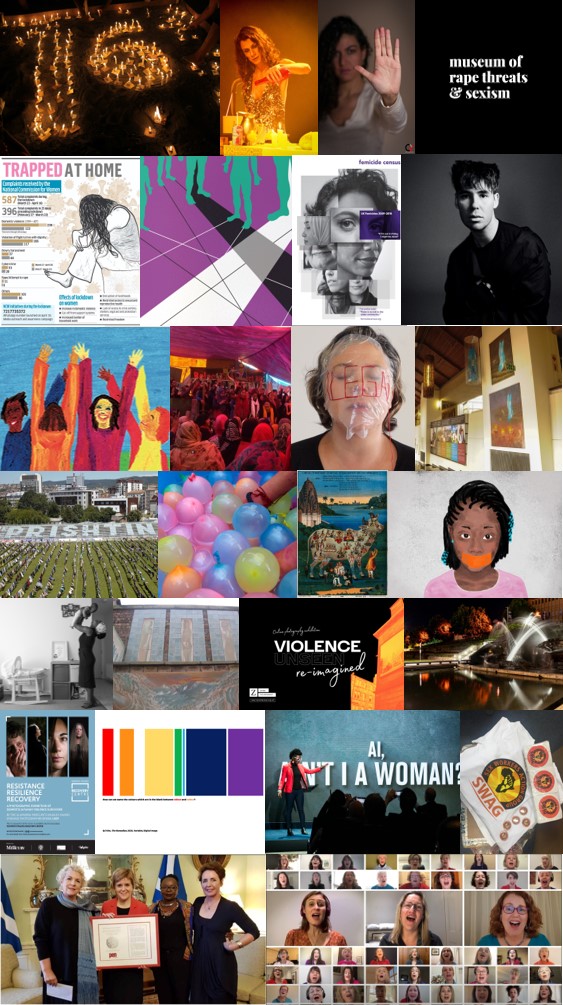
Image above: Montage of posts from 16 Days Blogathon 2020
Coming Very Soon! We are one week away from the beginning of our annual 16days blogathon campaigning against Gender-Based Violence (November 25-December 10). We are excited to announce that 2021’s focus will be on histories, legacies, myths and memories, led from Edinburgh by the Histories of Gender and Sexualities Research Group. As always, during our 16 days marathon of blogposts, we will feature posts from academics, students, activists, practitioners, artists and survivors (noting that these categories are not exclusive).
We will explore the connection between past and present, highlighting the historical and longitudinal dimensions that have shaped narratives, experiences and activisms surrounding gender-based violence today. In doing so, we hope to draw attention to voices and perspectives from multiple geographies and time periods (from antiquity to the very recent past) accessed through the formal archive and oral history as well as through literature and the creative arts, including traditional music, poetry and storytelling.
Through legend, myth and collective memory, the past shapes contemporary understandings and narratives of gendered violence but can also be used as a resource in cultures of resistance.
The residues and traces of the past connect us through common humanity and through women’s shared though not identical experiences of living in patriarchal societies.
Ultimately, we hope that this year’s theme will help us to identify what is unique and distinct about the ‘where’ and ‘when’ we inhabit, what came before, and how to get to where we want to be.
Here are some of our contributions for this year:
Anne Summers, Where it all began – Almost 50 years on, Anne Summers writes about the opening of Elsie Women’s Refuge in 1974.
Maha Krayem Abdo OAM, Bringing back hope – In working towards a domestic and family violence free Australia, Muslim Women Australia (MWA) use faith as a tool for empowerment.
Claire E Aubin and Emily Rose Hay, Duties of care – The Emotionally Demanding Histories Group asks, how do we ensure emotionally engaged researchers are not harmed during the process while bringing justice to past stories?
Tanuja Kothiyal – While we expect oral traditions which provide voice to marginal communities and groups, to create space for women’s voices, even in these traditions women’s locations remain marginal and mostly with respect to the male figures.
Monimalika Day – Sometimes, apparently simple words such as respect and trust open a Pandora’s box, the answers to these uncomfortable questions about human relationships cannot be found in the curriculum…can we assume that family is a safe space? Can we assume any relationship to be safe?
You can read the full vision statement for this year’s 16 Days Blogathon below.
University of Edinburgh: Prof. Fiona Mackay (genderED), Dr. Zubin Mistry (lead, Histories of Gender and Sexualities Research Group), Prof. Louise Jackson, Prof. Diana Paton, Dr Hatice Yildiz, Aerin Lai (PhD web and editorial assistant) for genderED and Histories of Gender and Sexualities Research Group
Dr B R Ambedkar University Delhi: Prof. Rukmini Sen (Director, Centre for Publishing), Dr Rachna Mehra (School of Global Affairs)
University of New South Wales: Prof. Jan Breckenridge (Co-Convenor), Mailin Suchting (Manager) and Georgia Lyons (Research Assistant) for the Gendered Violence Research Network.
It’s a wrap! We’ve reached the end of #16daysblogathon! It’s December 10th, Human Rights Day and the final day of the global 16 Days of Activism 2020
The 16 Days Blogathon Team
Today is International Human Rights Day and the final day of the 16 Days of Activism Against Gender-based Violence for 2020. We have been sharing daily blog posts to raise awareness in our annual 16 Days Blogathon as part of our commitment to the ongoing struggle to put an end to gender-based violence around the world, once and for all.
How often have you heard the phrase ‘Due to #COVID19…’ this year? In 2020, the global COVID-19 pandemic has loomed large – exposing and exacerbating deep and intractable social, political and economic inequalities and vulnerabilities to gender-based and intersectional violence for women and members of marginalised groups. Lockdowns and restrictions on movement have thrown the spotlight on the ‘shadow pandemic’ of domestic violence and underlined the grim reality of “home” for many women and LGBTQ people.
This year, our main theme has been arts-based and creative responses to gender-based violence and we’ve been honoured to share the blogathon with a wonderful array of artists, writers, musicians, playwrights and performers. They join activists, academics, students, and survivors – noting that the boundaries between all these categories blur.
We’ve posted stories, reflections and performances from around the world. From Scotland to Brazil, from Australia to Nigeria, and from South Africa to India. Through images, video and text we have shared ideas, experiences and acts of remembrance and resistance that have been sometimes harrowing and challenging but always illuminating and, ultimately, hopeful.
On Day Eight, we explored art installations that play a role in transitional justice efforts. The Blue Dress in South Africa and Thinking of You in Kosovo (and travelling) provide alternative ways to remember and address women’s experiences of sexual and gender-based violence in conflict situations.
Gender-based violence still exists everywhere and in multiple forms
Gender-based violence and abuse is still happening across the world, in private homes, workplaces, and in public spaces. And it is comes in many different forms, a number of which we have covered in the last 16 days including domestic violence , psychological abuse, femicide, and mass conflict related sexual violence . The Covid-19 pandemic has forced much of our lives online, and has exposed the rise and variety of gender-based and intersectional violence and abuse online.
On Day Four of the 16 Days Blogathon, the UK Femicide Census released its ground-breaking report analyising ten years of men’s fatal violence against women and girls in the UK. Karen Ingala Smith, co-founder and Director of the UK Femicide Census, gave an in-depth look at the findings of the report and what it outlines for the future.
On Day Eleven, Scottish lawyer Claire Mitchell QC – who fights contemporary miscarriages of justice in her day job – together with author Zoe Venditozzi shared their campaign The Witches of Scotland. Claire and Zoe hope their campaign will highlight historic miscarriages of justice and the persecution and murder of women during the witch hunts of the 16th-18th centuries in Scotland. The campaign also hopes to expose the accusations of witchcraft that continue to be used to persecute women and girls in other parts of the world.
Speaking out and speaking up has always carried risks for women, whether in the real or the virtual worlds. On Day Fifteen, Margie Orford traced how old and how deadly this taboo is on women’s free speech and their safety. The International PEN Women’s Manifesto takes stand against the vilification and censorship of women activists, artists, writers and journalists – and provides a powerful tool to fight for women’s right to free speech and creative expression.
Focussing on online abuse: on Day Two, we read a personal account from interdisciplinary artist and activist Megan Bellatrix Archibald who attracted persistent online misogynistic threats after going public with a campaign, and quickly realised there is much progress to be made surrounding technology and the law. The Museum of Rape Threats and Sexism post on Day Three provides inspiration in terms of sharing and resisting online abuse. Through a digital installation, Isha Yadav is bringing the experience of digital harassment, usually suffered by women as individuals in private, into the public space in an act of collective reckoning.On Day Fourteen, Zelda Solomon outlined more subtle violence and the difficulties we face in fighting bias when it is encoded into algorithms; where “women of colour are often found in the intersections of oppression in the new digital world.”
Creative acts of resistance are happening everyday
Small and large acts of defiance continue to take place across the world. On Day One Jo Clifford wrote about her transgressive and transformative play Jesus, Queen of Heaven which continues to change lives in the face of transphobic hate and violence from Scotland to Brazil. Delhi is one of the most unsafe cities in the world for women but also a site of creative resistance: on Day Nine, Meenakshi Nair shared three stories of young women speaking out against gender-based violence and harassment through challenging impunity, spoken word videos and public dance performances. In Australia, two academics turned their park orange, in support of the 16 Days campaign, creating a safer public space for residents and paving the way for future social change campaigns. And the Zero Tolerance Unseen Violence Campaign projected powerful images on public buildings in Scotland. Meanwhile a group at UNSW School of Public Health are campaigning to establish of a Women’s Trauma Recovery Centre, the first of its kind in Australia. In South Africa – where criminalisation of sex workers increases their vulnerability to gender-based violence, a small advocacy group literally ‘played politics’ – intervening in the presidential elections to put the rights of sex workers on the agenda (Day Fifteen).
The voices of survivors have been central to the blogathon and their stories of courage and creative agency have been inspiring: from the Scottish young survivors (Day Six) to Australian Musician Jack Colwell’s haunting new work aired on Day Five which addresses the childhood trauma of domestic abuse from the vantage point of a young man. In conversation with award-winning photographer Alicia Bruce, the Scotland-Gambia anti-FGM campaigner Fatou Badeh talks about the image they co-created: “That year was one of the most difficult years in my life. But that picture for me shows; I see a defiant woman who refuses to give up, who refuses to be defined by her experience.” (Day 10) And as Fatima Ishiaku, author and founder of a shelter for sexually-abused girls, describes her act of memoire: “My pain became my beautiful testimony.” (Day Ten).
The blog posts in a nut shell
Every #16daysblogathon post is summarised below. While there is a long way to go before gender-based violence becomes an abuse of the past, there are many powerful and effective initiatives underway designed to protect, empower and centre the survivors of gender-based violence. This gives us reason to hope.
By Jo Clifford, Scottish playwright, performer and activist
In Brazil – a country that kills more trans women than anywhere else – performing trans art as resistance can be a matter of life and death. Jo Clifford, acclaimed author of plays and internationally known trans performer and activist, shares the story of actress Renato Carvalho’s experience performing in Brazil.
By Megan Bellatrix Archibald, interdisciplinary artist and Masters student at Edinburgh College of Art
Megan gives a powerful personal account of being threatened online after speaking out about the laws on hysterectomies in the UK, and being faced with an unhelpful police force when she sought help. She discusses the lag in progress between technology and the law in Scotland, and the difficulties faced by someone who experiences online abuse.
By Isha Yadav, Founder and Curator of Museum of Rape Threats and Sexism and PhD candidate in Women and Gender Studies at Ambedkar University Delhi
Isha Yadav introduces her curated art installation, The Museum of Rape Threats and Sexism, and her experience creating it with crowd-sourced screenshots of rape threats and sexist comments that women have received online for raising their voices for social justice. The installation brings the digital artifact (screenshot) into the physical space of the exhibition, making something normally experienced privately, public.
By Rukmini Sen, Professor of Sociology, Ambedkar University Delhi
What does the home mean to us? Rukmini focuses on India in her post, and while engaging with some of the reasons around the rise of domestic violence, she looks into the multiple meanings and metaphors associated with home that the pandemic has made us confront. In her writing she covers increased gender-based household work, access to technology, space, privacy, domestic violence, the implications for migrant workers and students.
By Natasha Chandhock, graduate student at the School of Design, Ambedkar University, Delhi
Natasha explores the ways in which dialogue-based design, or discursive design, can create safe spaces for Trans Binary and Trans Non-Binary identities – a need which has been significantly worsened in the Covid-19 pandemic. She suggests design has the capacity to produce triggers or nudges to make individuals reflect or realign their thinking, that journey mapping exercises could encourage empathetic ways of engaging with others, and design can be key in bringing the concept of non-binary into the everyday life.
By Karen Ingala Smith, co-founder and Director of the UK Femicide Census
This week the Femicide Census released a ground-breaking report analysing ten years of men’s fatal violence against women and girls in the UK. Karen Ingala Smith, co-founder and Director of the UK Femicide Census, gives an in-depth discussion of the report’s findings.
By Jack Colwell, Australian singer/composer and activist
Singer/composer Jack Colwell’s new work The Sound of Music addresses the childhood trauma of domestic abuse. It is ‘a dialogue between three people: myself at 28, myself as a child and the idea of my father.’ In his moving piece, Jack shares his experience of domestic abuse while growing up, and how he used music to work through childhood trauma.
By Ruth Friskney and Claire Houghton, University of Edinburgh.
This piece shares a range of innovative and creative projects young survivors in Scotland have organised to reach out to others experiencing domestic violence while mobilising support for domestic violence survivors, including websites, films, training videos and resources for professionals.
By Shwetha Gopalakrishnan, National Law University Delhi
Shwetha, a member of the Zanana Ensemble, tells the story of the Ensemble’s performance of ‘Zanana ka Zamana’ (The Era is Feminine), a collective act of resistance against the Citizenship Amendment Act in India through expressions of solidarity using songs, poetry and conversations.
ByMaria Adela Diaz, Guatemalan native and international performance artist
Performance Artist Maria Adela Diaz discusses her performance piece tackling psychological abuse of women during Covid-19. She gives an insight into what prompted her to create, and how she hopes the work will inspire women who may be trapped in an abusive situation to speak up.
By Eliza Garnsey, British Academy Postdoctoral Fellow in International Relations, University of Cambridge.
In this post, Eliza Garnsey explores how the powerful South African artworks ‘The Blue Dress’ provide an alternative record of women’s experiences of sexual and gender-based violence (SGBV)
By Maria Alina Asavei, Assistant Professor at the Institute of International Studies, Charles University Prague.
Maria’s piece focuses on women survivors of violence from war and conflict, centring artist Alketa Xhafa-Mripa’s Kosova installation, Thinking of You. She asks how the experiences of women affected by sexual violence from war can be highlighted through art, without further reproducing and perpetuating trauma.
By Meenakshi Nair, a student at SOAS, University of London
Delhi as one of the most unsafe cities in the world for women but it is also a site of creative resistance. In this piece, Meenakshi explores three acts of resistance by young women in Dehli against gender-based violence, including by filing police complaints, through spoken word videos, and performing in public spaces.
By Anisha Palat, PhD student at the Edinburgh College of Art
Anisha’s post focuses on the India artist-activist Sujatro Ghosh’s recent project Cow Mask project which highlights that, in India, women are seemingly less safe and less protected than cows.
This post shares a conversation between photographer Alice Bruce and Fatou Baldeh, an FGM campaigner providing space spaces for survivors of Female Genital Mutilation (FGM). Alicia photographed Fatou as part of the Zero Tolerance ‘Violence Unseen’ campaign launched in 2018. They reflect on the image they created together.
By Claire Mitchell QC , Scottish lawyer and author Zoe Venditozzi
The Witches of Scotland Campaign, set up in 2020 by Scottish lawyer Claire Mitchell QC, seeks pardons, memorials and apologies for the women who died in witch trials in Scotland between the 16th and 18th century. It is hoped that this campaign can shed also light on allegations of witchcraft and gender-based persecution that still occur in communities around the world.
By Jo Zawadzka, Campaigns and Engagement Office for Zero Tolerance
When the pandemic curtailed the travelling exhibition Violence Unseen, the organisers had to reassess. And they re-imagined and ‘digitally painted’ the images onto cityscapes.
By Effie Karageorgos and Kcasey McLoughlin, University of Newcastle
To mark 2020 16 Days of Activism theme ‘Orange the World: Fund, Respond, Prevent, Collect!’ Australian academics worked with local authorities to turn the city of Newcastle orange for the 16 days.
By Patricia Cullen, Research Fellow, National Health and Medical Research Council Population Health, UNSW, and Sally Stevenson, General Manager of the Illawarra Women’s Health Centre.
While domestic and family violence is prevalent across Australia with a murder rate of one woman per week, there remains an absence of centres that offer support to women survivors over the long term. This post focuses on the campaign to establish a Women’s Trauma Recovery Centre, by the UNSW School of Public Health and the Illawarra Women’s Health Centre and their partners.
By Qri Kim, PhD candidate at Edinburgh College of Art
How do we encapsulate the experiences and voices of those who occupy liminal spaces in society? Qri Kim writes about her project ‘Due To’, and the reconceptualisation of the Nomadian in her art.
By Zelda Solomon, History of Art student at Edinburgh College of Art
Zelda Solomon discusses the problems of digital discrimination and the racist underpinnings of algorithms, through the incident with An Nguyen, a Vietnamese curator due to exhibit at the Affordable Arts Fair, only to be rejected because of the Covid-19 pandemic and its associations with ‘Asianness’.
By Ishtar Lakhani, feminist and activist, South Africa
On day fifteen, this piece from Ishtar Lakhani outlines how she, and SWEAT, an advocate group for the health & human rights of sex workers and the Decriminalisation of Sex Work in South Africa, used politics to bring sex worker issues to the public stage, by running for president.
Silencing and censoring women’s free expression date back to ancient times. In this piece, Margie examines the impact of the PEN International Women’s Manifesto in the struggle for women to speak and write freely without censorship or violence.
The Hummingsong Choirs in New South Wales build “community”, bringing together women of all backgrounds and stages in life to sing, laugh, nourish their souls and build close-knit connections. The other important purpose is to extend support to those most vulnerable in the community, women and children escaping domestic violence.
It’s a wrap!
That’s the end of the blogathon to honour the 16 Days of Activism campaign for another year – but the struggle for women’s human rights and the end to all gender-based violence continues. Thanks to our wonderful contributors and to all of you who have read and shared these stories. Please keep reading and sharing, and we will be back in 2021!
The 16 Days Blogathon team:
Fiona Mackay, co-curator, Director of genderED, University of Edinburgh
Louise Chappell, co-curator, Director of the Australian Human Rights Institute, University of New South Wales
Rukmini Sen, co-curator, Director of the Centre for Publishing, Dr B.R. Ambedkar University Delhi


 16 Days Blogathon