Day Three | We, the Women Warriors, are Unstoppable!

Shalu Nigam

Shalu NigamImage reproduced with the  permission of Shalu Nigam

After a long wait, the National Crime Record Bureau of India has recently published its report pertaining to crimes in India  in 2017. According to this report, 104,551 cases have been filed under section 498A IPC, a criminal law dealing with `cruelty’ against married women by their husbands and in-laws. A further 7,466 cases have been registered under section 304B, which pertains to dowry deaths, while 10,189 cases have been registered under the Dowry Prohibition Act, a law that bans the giving and taking of dowry. In addition, 5,282 cases have been registered for abetment of suicide among women and 616 cases have been registered under the Protection of Women Against Domestic Violence Act, for breaching the civil orders granted under this law in favor of the victims of domestic violence.

The NCRB report further indicates that the conviction rate was as low as 9.5% under section 498A cases in 2016, but which rose to 15.9% in 2017. In cases pertaining to dowry deaths, the conviction rate is 41.1% in 2017. These figures indicate that majority of women who knock on the doors of the court are not receiving justice. Compounding this, violent men are being acquitted by the courts. 

This data shows that a large number of women are not safe in their own homes. They are being physically and psychologically assaulted, verbally and emotionally tortured, discriminated, sexually harassed, murdered, forced to commit suicide and attacked in numerous ways. Serious complaints of violence are normalised and trivialised, framed as ‘disputes’ or `ego tussles’. Myths and misogyny operate in  society and the courtrooms alike to deny justice to women survivors of violence.


The role of the Supreme Court 

 Despite the fact that a large number of women are approaching the police and the courts with their complaints of violence within homes, police are rarely arresting violent men and the courts are failing to hold them accountable. In some instances, the courts are actually making the problem worse. For example, in 2014, the Supreme Court decided the matter of Arnesh Kumar v State of Bihar. It delivered a sweeping statement that section 498A, a criminal law provision relating to domestic violence, is being ‘misused and abused by disgruntled women’ and directed for the dilution of the provisions relating to the arrest and bail of accused persons. 

Then, in 2017, in Rajesh Sharma v State of UP the Supreme Court passed a directive to police and magistrates that no arrests were to be made or coercive actions taken without ascertaining the veracity of the complaints lodged under section 498A. It suggested the formulation of Family Welfare Committees to scrutinise every complaint of domestic violence to ensure that no ‘false cases’ were registered. Without examining the on-the-ground realities, the court concluded that the law is misused by ‘vengeful’ women, and saw men as victims of this ‘cruel’ law. While himpathising (a term coined by Kate Manne) with the accused persons, the bench remarked that there was “violation of human rights of innocents”. In contrast, no compassion is shown towards the women who are abused, abandoned, burned, murdered, killed, raped and brutalised.

However, after protest by several women’s organizations and petitions filed in the Supreme Court, the Court heard the matter of Social Action Forum for Manav Adhikar v Union of India in 2018. It ordered the Family Welfare Committees be done away with, while retaining the provision relating to arrest and bail for the accused persons. Even earlier, the Law Commission and several other state institutions too, have recommended the dilution of the domestic violence laws.

The legal system provides a platform for women to raise their concerns; however, there is a lack of commitment in implementation. Over the years, concerted actions have been taken by state actors to dilute the provisions of law. The system is being manipulated to serve the logic of the patriarchy, protecting the interest of the dominant group while reinforcing the prevailing biased stereotypical norms. The state more broadly is treating domestic violence as a social crime and using manipulative tools –including mandatory mediation – designed to compel women to arrive at a ‘compromise’ or ‘settlement’ with the accused persons without any assurance for their safety (and that of their children), and without punishing the abusive men. In many other cases pertaining to domestic violence, dowry deaths and suicide by married women, the courts have granted immunity to violent men by placing weight on the principle of ‘family harmony’, and in the process, disregarding the constitutional rights of women as citizens.


We, the Women, are Warriors and We Will Persist!

Yet the survivors, who may be seen as powerless and vulnerable, through their sheer grit, are demanding justice, breaking the codes of prolonged imposed silence, shaking the system and forcing it to respond. They are not feminists or experts but they are everyday women who, with their own sense of justice, and with scant resources or little support, are seeking a violence-free life for themselves and their children. They are fighting battles not only against abusive men but also against the patriarchal structures within homes, misogyny in courts, and androcentric culture and sexism in society. In doing so, they are reclaiming ownership of their lives with persistence, courage and resilience.

The law is currently implemented in a way that means complainants are being revictimised in the process. Despite this, women are using the law to reclaim their rights and resist violence. Those who are registering their complaints are negotiating their rights and contesting their claims while challenging the stubborn patriarchy. While writing their own stories of emancipation, they are shifting the inegalitarian structure within families, creating democratic spaces within society and –  in fighting to seek freedom, or aazadi, from violence – they are demanding the recognition of their dignity. 

For the state, as well as national and international organisations working on the issue of violence, it is essential to focus on women’s autonomy and agency in a patriarchal society and to provide support measures that help them to attain socio-economic self-sufficiency while countering ingrained misogyny. Many women are compelled to stay and bear violence because they lack any other options. There is therefore a  need to create a mechanism whereby women can access support that is specific to their circumstances. Until then, through their tough persistent legal and social battles, the simple message women are giving is this: “We, the women warriors, are unstoppable; unless violence is eliminated, we will persist”. 


Shalu Nigam (@ShaluNigam) is an advocate, researcher and an activist working at the intersection of gender, law, governance and human rights issues. She is currently practicing at the courts in Delhi and is associated with the People’s Union for Civil Liberties, Delhi, Indian Social Institute, Delhi, as well as the Centre for Women’s Development Studies, Delhi. She was awarded a Senior Fellowship by the Indian Council for Social Science Research, Delhi. She has published several books, the recent one is Women and Domestic Violence in India: A Quest for Justice. She has been a regular contributor to countercurrents.org and has published her essays in journals such as the Indian Journal of Gender Studies, South Asia Journal, Social Action, International Journal of Gender and Women’s Studies, Women’s Link, Legal News and Views among others. You can read some of  her work here and here


Day Two | Abusive Language and Violence Against Women in the Public Sphere

Jennifer M. Piscopo, Occidental College, USA

Strongmen across the globe are ascending to the position of president or prime minister. Sexist and racist rhetoric is part of their brand, which followers find authentic and even unifying. Male political leaders who use swaggering masculinity to cultivate support express the growing global backlash to diversity, inclusion, and multiculturalism. When powerful men use their platforms to abuse women, they send the message that abuse is okay. It also makes abusing women an integral part of a right-wing agenda.  

Boris Johnson, the Prime Minister of the United Kingdom, has an impressive track record of demeaning women. He has called women Members of Parliament (MPs) by their husband’s names and described women journalists and athletes in terms of their bodies – he once described female volleyball players “glistening wet otters”, for instance. 

Across the Atlantic, US President Donald Trump uses adjectives like “fat” and “ugly” to demean women who have spoken out against him. He rallies crowds to chant “lock her up” in reference to his former rival, Democratic presidential candidate Hillary Clinton. Brazilian president Jair Bolsonaro once told a congresswoman she was not “worth” raping, saying that she “didn’t deserve it”. 

Jennifer PiscopoLock Her Up” by James McNellis, 2017.

These leaders often reserve their most vitriolic comments for women of colour – attacks that often merge gender and race. Trump told four women Members of Congress – all of whom criticised his policies and his person – to “go back and help fix the totally broken and crime infested places from which they came”. Three of them were born in the United States, while the fourth – Somali refugee Ilhan Omar – was painted by Trump and other critics as a Jew-hater. Similarly, Johnson has spouted racialised descriptions of Muslim women, variously portraying them as objects and criminals. 

These incidents are not isolated. When powerful men deliver abuse, the attacks receive media coverage. But many women with public profiles – from activists to athletes – receive hateful messages daily. The senders are not usually powerful men, but everyday people. 

A study examining 152 leading British women in politics, business, entertainment, the media, and sports estimated that each received about 200 sexually-explicit tweets a day. In another study of nearly 600 women journalists, 63 percent reported being threatened and harassed on-line and 26 percent reported physical assaults. Amnesty International documents various quantitative and qualitative studies, all demonstrating that high-profile women on Twitter endure significant levels of abuse.


Abusive language as political violence against women

Abusive language is a form of violence against women. Much of it may happen online, but virtual harms cause actual damage. Hateful messages and death threats cause stress and trauma. Victims experience diminished self-esteem and an inability to focus and to complete their work. They fear for their safety and for their family’s safety, and they face disruption to their routines caused as a result of increased security. Many leave Twitter. In Britain, female MPs received such profane attacks that they received police protection.

But this language affects many more than just the immediate victims: it also tells the larger audience of women and girls to stay out of public life. Mona Lena Krook and Juliana Restrepo Sanín call these “message crimes.” Whether world leaders or everyday jerks, abusers want women in public life to shut up and go away. 

Since abusive language aims to diminish women’s influence over politics, policy, and the public debate, these attacks are forms of political violence. In my research with Elin Bjarnegård and Gabrielle Bardall, we argue that political violence is gendered in three ways: in its motive, in its form, and in its impact. The abusive language aimed at women in public life has all three elements. 

In terms of motive, attackers are driven by hate towards women in public, not hate towards public figures irrespective of gender. The rates at which women and men endure abuse are simply not the same: visible women receive disproportionate amounts of abuse when compared to visible men. In terms of form, attackers use gendered language, including threats of sexual harm and sexual assault. 

In terms of impact, the victims extend beyond the women targeted. They signal to other women and girls the costs of a public profile. And women and girls have received this message. A respected U.S. survey firm found that 70 percent of women, and 83 percent of young women, identified online harassment as a major problem, compared to just 54 percent of men and 55 percent of young men. Indeed, programs that train women candidates now include lessons that prepare women to handle abuse. Their tips include immediately reporting the abuse to authorities, using humour to diffuse the situation, and writing op-eds to call attention to the problem. 


Stopping abusive language 

Documenting and denouncing abusive language have not stemmed the attacks against publicly-visible women. The anonymity of online platforms combined with social media companies’ commitment to free speech means that attackers behave with impunity. Abusers even become leaders of powerful countries. 

The vicious and sexist abuse of women in public life has become so normalised that solutions focus not on holding perpetrators accountable, but on helping women cope. In the candidate training program, women politicians are told to be brave. A British MP, herself standing down because of online abuse, recommended that women MPs create circles of support

The women and girls of the world deserve better solutions. When the #MeToo movement brought down prominent men like Harvey Weinstein, the effects reverberated across the globe. Sexual harassment suddenly bore real consequences, even for powerful men. Likewise, voters must reject male political leaders who bully those weaker than them, especially women and racial and ethnic minorities. In the current political climate, protecting women from abuse cannot be divorced from resisting the right-wing forces that reject diversity and inclusion more broadly.   


Jennifer M. Piscopo (@Jennpiscopo) is an Associate Professor of Politics at Occidental College in Los Angeles, California. Her research on women’s political participation and representation has appeared in over 15 academic journals. With Susan Franceschet and Mona Lena Krook, she co-edited The Impact of Gender Quotas (Oxford University Press, 2012). An international speaker and consultant, she has collaborated with international organizations such as UN Women, the Inter-Parliamentary Union, and the Carter Center. Her op-eds have appeared in The Washington Post, The New York Times, and The Los Angeles Times, among other outlets. 

Welcome to the 16 Days Blogathon 2019!

Introduction to 2019 Blogathon

Welcome to our annual blogathon to mark the 16 Days of Activism Against Gender-Based Violence Campaign. We are now in our third year of bringing together some of the most important voices from civil society, academia and government around the world. Once again, the blogathon marks a collaboration between GenderEd at the University of Edinburgh, the Australian Human Rights Institute at UNSW Sydney and Ambedkar University, Delhi

From refugee policies putting women in danger of gender-based violence to the undermining of women’s reproductive rights at the UN, to the Counting Dead Women projects (such as in Australia, the UK and in the US), there is much to suggest that the world is as grim a place as ever for women, girls and their rights. As UN Women note,

“Violence against women is the leading cause of death and disability of women no matter their age”.

Along with the writers whose work you will read over the coming days, and the more than 6,000 organisations who run 16 Days campaigns every year, we are united in our commitment to women’s equality and share a desire to see a world free from sexual and gender-based violence. 

From Monday 25 November 2019 (the International Day for the Elimination of Violence against Women) to 10 December (Human Rights Day), we will be posting blogs that explore some of the most pressing issues in gender-based violence. Our remarkable contributors look at the many ways in which gender-based violence interacts with health, trans identities, migration, sexualities and disabilities. They write about political rhetoric that invokes gender-based violence, and the promises and limits of legal systems. They write narratives and poetry, and explore the potential of thread and comic books to tell different stories – or to tell stories differently.

Through their blogs, we travel from Scotland to Myanmar, and from the Pacific to South Africa via India and beyond. We see how gender-based violence exists in all spheres – from past to emerging and ongoing conflicts, in houses and on university campuses, and in the smallest of villages to the largest of cities. It affects women and girls of all ages, of all backgrounds, from all places.

We will be posting updates on Twitter from @UoE_genderED and @HumanRightsUNSW and look forward to sharing these stories with you over the next 16 days. We hope that you will share them further.  

We couldn’t have asked for a better person to open our 2019 blogathon than Eve Ensler – best-selling author, playwright, anti-violence activist, and initiator of V-Day and 1 Billion Rising. In her powerful blog, Eve reflects on the crafting of her 2019 book The Apology, in which she wrote the apology that she knew she would never receive from her abuser: her father. For our first blog of the year, we are therefore delighted to introduce Eve Ensler’s piece, ‘My father never apologized for sexually abusing me. So I wrote his apology for him’ (reposted with kind permission from NBC News).

Signed, Co-curators of the 16 Days blogathon

  • Fiona Mackay, Director genderED, University of Edinburgh
  • Louise Chappell, Director Australian Human Rights Institute, University of New South Wales
  • Rukmini Sen, Director Center for Publishing, Ambedkar University Delhi
  • Caitlin Hamilton, Postdoctoral Research Associate, Australian Human Rights Institute, University of New South Wales
  • Natasha Dyer, PhD candidate, School of Social and Political Science, University of Edinburgh 

Day One | My father never apologized for sexually abusing me. So I wrote his apology for him.

Eve Ensler talks about her new book, the apology from her father that he could never make…

Eve Ensler

When I was five years old my father began to sexually abuse me. This went on until I was ten, and then the daily physical battery and terror began. This life of endless brutality and invasion rearranged my chemistry, forced me out of my body, repressed my ability to think and made me terrified of love.

My father never told me why he did what he did. He never explained how he became a man capable of this kind of sadism and he died without apologizing.

In recent months, I have read the accounts of several men accused of sexual violence. Their words often focused on the pain and repercussions they had experienced after being accused rather than thinking of the pain of their victims or admitting what they had done and how they had worked on themselves to understand their own histories and behavior.

It then occurred to me that I had never heard a man make an honest, thorough, public accounting of his abuse. I had never heard a man openly apologize. I wondered what it would be like to hear an apology like this, what impact it might have on me and other survivors and how it might help end the scourge of violence altogether.

And so I decided to write the apology from my father that I always needed to hear; to find the words and the language, to outline the anatomy of an apology that could possibly set me free and act as a possible blueprint for other men seeking a pathway to atonement, accountability and reckoning.

As I wrote “The Apology” I felt as though I began to hear my father’s voice. He told me of his childhood, how he was adored rather than loved and how adoration forced him to live up to someone else’s idealized image of himself rather than being able to be his authentic, imperfect human self. He told me of the ways that patriarchy and toxic masculinity had forced him to push feelings of tenderness, vulnerability, tears, doubt, uncertainty and wonder underground, and how they later metastasized into another persona called “Shadow Man.”

This disassociated self was capable of sexually abusing a five-year-old girl and physically torturing and gaslighting her thereafter. He told me in ruthless detail everything he had done to me and why. He allowed himself to feel the pain, heartbreak and betrayal he had caused in me. He reflected deeply on his past in order to understand what had led him to these terrible actions. He explained his behavior rather than justifying it. And through his agonizing detailed admissions, he expressed deep sorrow, remorse, guilt and self-hatred. He took responsibility and he made amends.

In the book, my father also confessed to me that to apologize is to be a traitor to men. That there is an unwritten code of silence that is not to be broken without unraveling the whole story of patriarchy.

But he also told me that what he had done to me had poisoned his soul and consumed him in the next world. He was desperate to tell the truth, to make an apology so he could get free.

Until I wrote this book, both my father and I were caught for nearly 60 years in an ongoing vise of pain, rage, guilt and shame. We were consigned to a particular terrible time in our history. Me, defined as victim; him defined as perpetrator.

Because my father owned his actions and apologized in the book, my suffering was honored and made real. I experienced justice and respect. I heard the words I needed to hear that released the resentment, pain and hurt. I was able to have a deeper understanding of his history, wounds and motivation, and because of that the ongoing, haunting question of why was finally resolved. I was able fully let him go and move on.

Of course I wrote my father’s apology for him. But I must say it was a profoundly healing and liberating exercise. Because my father has lived inside me my whole life, I was able to move him in a new direction, from monolithic monster to apologist, from terrifying entity to broken, damaged little boy. In doing so, I gained agency and he lost his power over me.

In the process, I also discovered how central apologies are to the next stage of our human evolution. We must create pathways for men to do this critical work of atonement, and men must be brave now and willing to come forward — risking being called gender traitors — in order to free the suffering of their victims and themselves. The time of reckoning is here.

This piece was first published by NBC news and reproduced with permission.

Eve Ensler is a Tony Award-winning playwright, performer and activist best known for “The Vagina Monologues.” Her critically acclaimed memoir “In the Body of the World” was published by Metropolitan Books in 2013. Her most recent book is “The Apology.”

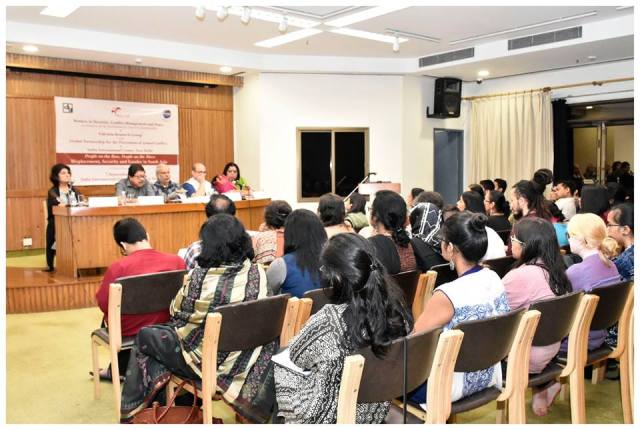
FINAL POST OF 2018: People on the move and on the run: displacement & security through a South Asian feminist lens

4

Written by Meenakshi Gopinath, Shilpi Shabdita and Diksha Poddar, this blog post was originally published on the Gender Politics at Edinburgh blog on 13 December 2018.

“We lost our home, which means the familiarity of daily life. We lost our occupation, which means the confidence that we are of some use in this world. We lost our language, which means the naturalness of reactions, the simplicity of gestures, the unaffected expression of feelings. We left our relatives in the Polish ghettos and our best friends have been killed in concentration camps, and that means the rupture of our private lives.”Hannah Arendt, We Refugees(1943)

Each year, millions of people are forcibly displaced at astonishing rates from places they have regarded as home in search of shelter, safety, and freedom. As per United Nations High Commissioner for Refugees (UNHCR) records, an unprecedented 68.5 million people are forcibly displaced around the world. Despite the swelling numbers and the magnitude of their trauma, they have generally remained in the periphery, not just in terms of spatial location but in terms of public consciousness.[1]Increasingly now, compelling visuals and testimonies of displaced communities from across the world have ignited an international outcry over the human cost of the migration crisis. This includes disturbing image of the lifeless body of a toddler washed ashore in Turkey while fleeing Syria in 2015 which was widely publicized with hashtags of ‘humanity washed ashore’.

Among displaced communities worldwide, possibly the most persecuted are those who are stateless, living on the margins of society, pushed to the ‘oblivion of rightlessness’[2]and most vulnerable to exploitation. They are seized within the protracted cycles of displacement and precarity, where “today’s IDP is tomorrow’s refugee, tomorrow’s refugee is day after’s economic migrant.”[3]And therefore, it will be insufficient to understand statelessness through the prism of state and law.[4]This article critically explores the interaction between displacement and security from a feminist lens, in South Asia.

The Rohingya in the South and Southeast Asian region, living in precarious situations as ‘Asia’s new boat people’, are one of the world’s most persecuted stateless communities. In recent years, the mass exodus of over 4,00,000 Rohingya from Myanmar reignited an international debate in South and Southeast Asia on issues of displacement, statelessness and the rights of refugees. Almost a year has passed and the plight of the Rohingya remains largely unchanged as they languish in inhuman conditions in the ‘camps’ and replete with everyday indignities, threats, fear, erasure of personhood, and the sustained violence of marginalization that epitomize the half-life of statelessness.

Within Myanmar, ethnic and national identities have effectively merged and intersected with political disempowerment and economic impoverishment of vulnerable communities. These issues are nestled within the context of Myanmar, Bangladesh and India’s historical linkages, porous borders and shared pasts, which are increasingly overlooked as the borders of these interdependent states increasingly hostile and inhospitable.

In mainstream narratives in India, the Rohingya are often described as a ‘threat to security and national interests’, ‘Muslim Bangladeshi infiltrators’, ‘illegals’, ‘victims’, or are attributed responsibility for adversely affecting strategic bilateral relations with Myanmar. The turbulent history of the region, coupled with the post-9/11 regime of securitization and the increasing currency of the discourse of terrorism and concurrent rise of Islamophobia, have combined to make the plight of the Rohingya precarious in ways that are difficult to redress[5]. Further, there are systematic efforts in the region to sanitize states by creating an ideal notion of citizenship narrowly defined by three attributes—Male, Monolithic and Majoritarian[6]. In this context, there is a need to exhort sensitivity towards the complexity inherent in issues of displacement and statelessness by moving beyond the paradigm of ‘security’ and reimagining a new vocabulary rooted in values of human dignity, interdependence, dialogue, respect for diversity, and compassion. Therefore, in South Asia, how can we begin a process of ‘Restorying’ and redefining the conceptual vocabulary of security, and move outside the framework of state and law[7]?

Prof. Shiv Visvanathan’s reflections on the limits of policy raise several pertinent questions. “Policy often destroys language, it objectifies the other person, it has no language for suffering or memory. When we say what is our policy, the moment of violence has already begun.”[8]What are the experiences that lead people to feel stateless, homeless, disadvantaged? How do we rehumanize the ‘other’? Where do we listen for the silences in narratives? How do we bear witness to the symbols of everyday resistance and resilience of displaced communities? How can we shift away from characterizing forced migrants as silent victims and move towards privileging narratives of the displaced to combat their state of voicelessness and restore agency? What is our language for memory, longing, belonging, the body and suffering?

In this context, there is a need for states to explore creative avenues of engagement at the regional level for the protection of stateless populations.

[C]an there be a policy for hospitality, a policy to be kind? … The pertinence and the impossibility of the question suggest for us, of course, the need for a dialogic approach to the issue of care and hospitality. New rules can be built only on such dialogic awareness that will tell us of the need for continuous conversation within the country and internationally; among shelter-seekers, shelter-givers, and the institutions of care and justice, including public and community bodies.[9]

This invites an iconoclastic recovery of the ideas of security — of what it means to be secure, what it means to be human, and above all, whether citizenship can frame the canvas of humanity.

Link to video: http://wiscomp.org/events/people-on-the-move-people-on-the-run-displacement-security-and-gender-in-south-asia/

About the authors:

Dr. Meenakshi Gopinath is an educationist, political scientist and writer. She is Founder and Director of WISCOMP and has served as the Principal of Lady Shri Ram College For Women, University of Delhi for 26 years.

Shilpi Shabdita is currently Program Associate, WISCOMP and holds a Masters’ degree in International Peace Studies from University of Notre Dame, USA.

Diksha Poddar is working as a Consultant with WISCOMP. Currently, she is pursuing her PhD from Jawaharlal Nehru University, New Delhi.

[1]Paula Banerjee, “Editorial”, Forced Migration and Displacement Peace Prints South Asian Journal of Peacebuilding(New Delhi: Women in Security, Conflict Management and Peace), Vol. 4, No. 1 (2012).

[2]Hannah Arendt, The Origin of Totalitarianism(New York: Schocken Books, 2004), 353-5.

[3]Rita Manchanda at a Panel Discussion in New Delhi on 7 September 2018. See, Shilpi Shabdita & Diksha Poddar, People on the Run, people on the Move: Displacement, Security and Gender in South Asia(New Delhi: WISCOMP, 2018), 15-16.

[4]Ranabir Samaddar at a Panel Discussion in New Delhi on 7 September 2018. See, Shilpi Shabdita & Diksha Poddar,People on the Run, people on the Move: Displacement, Security and Gender in South Asia(New Delhi: WISCOMP, 2018), 13-14.

[5]Madhura Chakraborty et al., The Rohingya in South Asia: People Without a State, ed. Sabyasachi Basu Ray Chaudhury and Ranabir Samaddar (New York: Routledge, 2018), 110.

[6]Paula Banerjee at a Panel Discussion in New Delhi on 7 September 2018. See, Shilpi Shabdita & Diksha Poddar, People on the Run, people on the Move: Displacement, Security and Gender in South Asia(New Delhi: WISCOMP, 2018), 18-19.

[7]Ranabir Samaddar at a Panel Discussion in New Delhi on 7 September 2018. See, Shilpi Shabdita & Diksha Poddar, People on the Run, people on the Move: Displacement, Security and Gender in South Asia(New Delhi: WISCOMP, 2018), 13-14.

[8]Opening Remarks by Prof. Shiv Visvanathan at a WISCOMP Roundtable titled (Re)Storying Kashmir: Exploring Possibilities for Constructive Partnershipsin New Delhi on 25 October 2017.

[9]R. Samaddar (ed.), Refugees and the State: Practices of Asylum and care in India, 1947-2000(New Delhi: Sage, 2003), 60.