Day Twelve: Stocktaking on the functioning of The Sexual Harassment of Women at Workplace (Prevention, Prohibition and Redressal) Act, 2013 (2014-2019)

It’s been a decade since India’s premier law governing sexual harassment at work, the Sexual Harassment of Women at Workplace (Prevention, Prohibition and Redressal) Act, 2013 (PoSH-Act) came into effect. What concerns remain?

Featured image source and in-text images: Website of Partners for Law in Development

Partners for Law in Development (PLD)

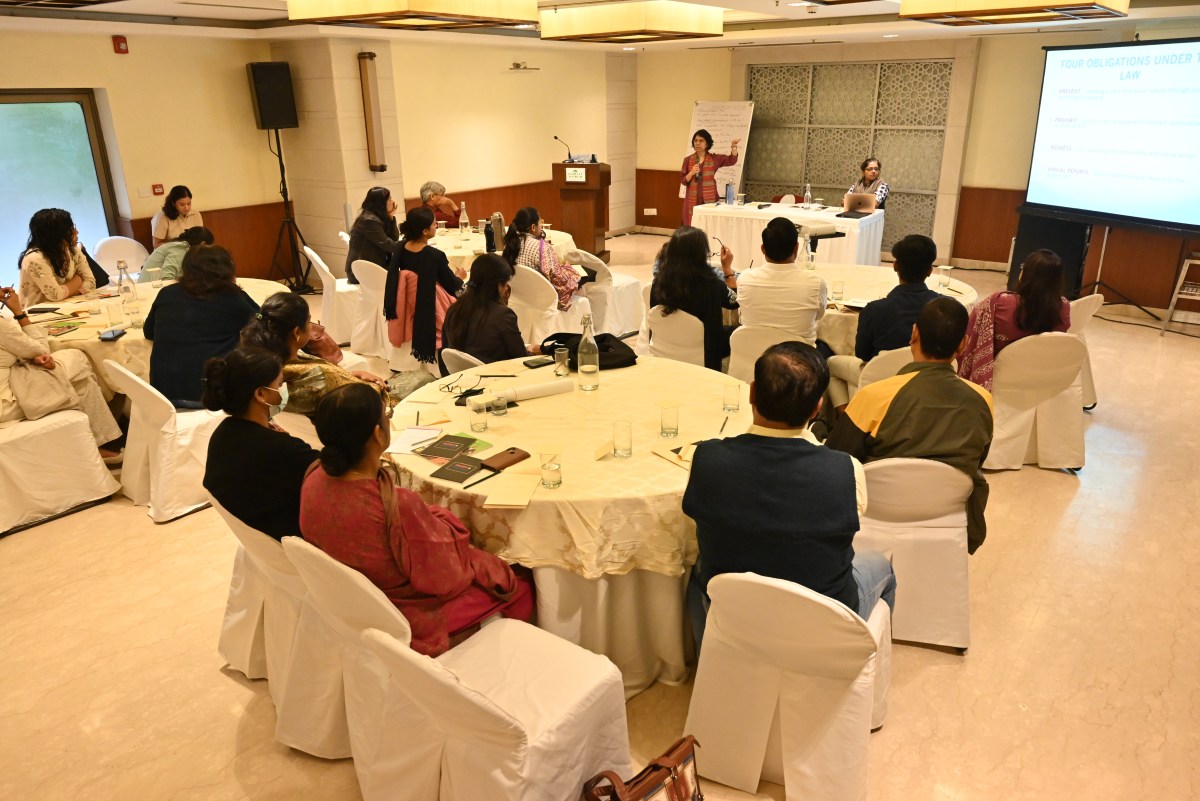
It’s been a decade since India’s premier law governing sexual harassment at work, the Sexual Harassment of Women at Workplace (Prevention, Prohibition and Redressal) Act, 2013 (PoSH-Act) came into effect. Today, the law makes news mostly in the context of high-profile cases and broader social movements like the #MeToo movement. The absence of a formal monitoring and review process, and availability of public data has rarely been the focus of public attention and debate, but is of serious concern. Partners for Law in Development (PLD), a legal resource group, has systematically documented observations through its work on building capacities with government and higher education institutions. We have examined how the law functions under the PoSH-Act and outlined the protection gaps in order to contribute towards building knowledge and the discourse on the subject. Although not an exhaustive list, these are the concerns that relate to the functioning of the law that appear to cut across sectors and deserve attention.

I. Compliance largely limited to the creation of Internal Committee:

Workplaces often prioritise the formation of Internal Committees (IC) to demonstrate compliance with the law. However, it’s common to establish ICs only after a complaint of sexual harassment at the workplace. Delays in appointing ICs and long gaps between the appointments of new members have been observed within the first five years of the law’s implementation. This emphasis on IC creation may give the misleading impression that a workplace is free of sexual harassment. Unfortunately, training and orientation sessions are often neglected, held briefly, or treated as one-time events. Furthermore, government departments and agencies encounter challenges in organising meetings due to officials’ busy schedules. Many employees, including senior staff, are often unfamiliar with their workplace’s sexual harassment policies.

While many ICs exist, they may be inactive, lack functioning email addresses, or consist of unaware committee members. A similar situation is observed with Local Committees (LC), which are often unappointed or non-functional. Despite the existence of penalties for non-compliance, the lack of monitoring renders these penalties ineffective.
II. Insufficient training and sensitisation for the Committee:

Insufficient training and sensitisation result in uninformed committee members who lack the necessary skills to handle sensitive cases. Maintaining confidentiality is challenging, and committee members are often unclear about their responsibilities and the law’s requirements. Confusion often arises regarding disclosure of complaint content, regularity of IC meetings, the committee’s role in preventive work, the committee’s mandate to provide recommendations, interaction between parties involved in a complaint, and whether an unsuccessful case of sexual harassment constitutes a false claim. In some cases, external members’ roles are rendered ineffective, as they may not be included in inquiries, receive short notice, or lack impartiality.

III. Challenges in relation to new and emerging workspaces: 

The law does not provide guidelines for adapting it to new and emerging workplace types, such as shared workspaces, where individuals or groups rent communal workspace by the hour or day. Workers in the unorganised or informal sector often struggle to access the law, given the requirement to go to district headquarters to file complaints and participate in inquiries, resulting in lost wages. Unorganised sector workers and new workplace models do not align with the IC structure outlined in the law. Challenges also arise in addressing complaints against third parties in the organised sector when there is no financial contractual relationship with the organisation. Although Local Committees may be an alternative, they often do not exist or remain non-functional, creating a gap in the law. Even when they function, LCs lack the means to compel respondent participation or enforce their directions.
IV. Efficiency versus transformatory approaches:

Efficiency often takes precedence over holistic redressal, with organisations adopting approaches like the ‘zero-tolerance’ model, which results in termination for any harassment transgressions. However, this approach may lead to disproportionate punishments for minor wrongs that could be addressed through counselling, apologies, or other approaches as recommended by the law. It also avoids investing in transformation and problem-solving. Other shortcuts to inquiry include respondents resigning upon notification of a complaint, complainants facing retaliation, and workplace cultures that prioritise efficiency and profit over social responsibility.

V. Local Committee and the Informal Sector

Local Committees are intended to serve women workers in the unorganised sector, including domestic workers, cases where ICs do not exist, and cases against employers. However, LCs face delays, a lack of information, and inadequate training. Their role in relation to the unorganised sector, particularly domestic workers, is largely notional, as they can only refer matters to the police for inquiry and action. Accessing remedies is unrealistic and onerous for domestic workers in the absence of support services, workers’ unions, job security, and the need to travel long distances.

Conclusion

The above findings have emerged from extensive trainings carried out by PLD, which formed the basis for documenting the types of cases commonly reported, frequently asked questions and the gaps in statutory law. The full report of the findings can be assessed here.

Author bio

Partners for Law in Development (PLD), established in 1998 as a legal resource group works towards realising social justice and women’s rights. PLD carries out evidence based research studies, produces legal explainers on laws, posters for raising awareness on gender justice for women, and among other things engages actively with diverse stakeholders. Since the enactment of the PoSH-Act in 2013, PLD has conducted more than 160 trainings and workshops till 2019, covering more than 7300 participants from about 17 states. The findings emerging from these trainings have informed the current research paper. 

Additional Media Learning

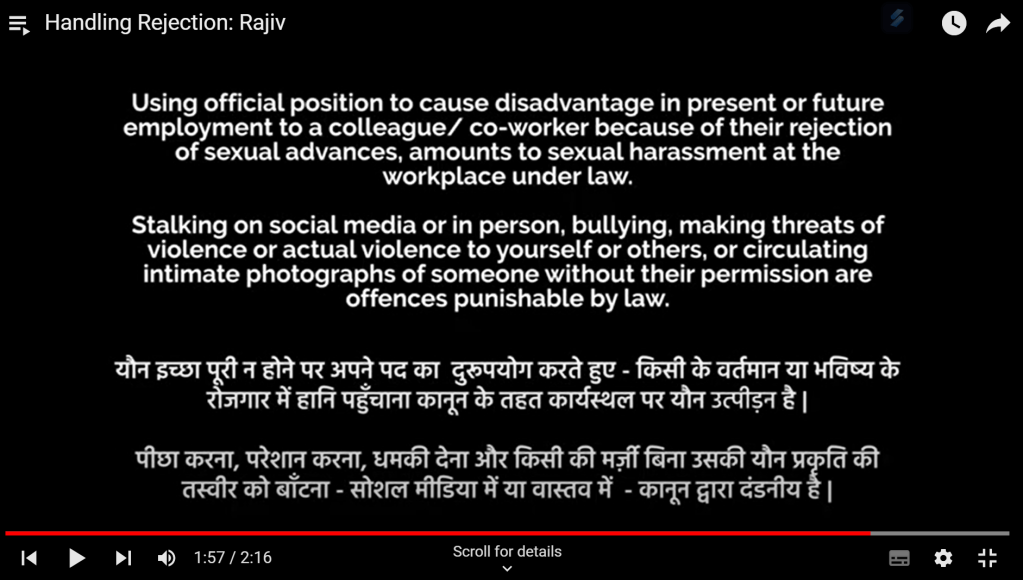
This is a series of 11 short videos on consent and rejection – conversation starters to nuance framing consent beyond binaries of victim-perpetrator, or yes-no, developed from real stories that emerged through the sexual harassment prevention work carried out by Partners for Law in Development, the video-series encourages critical, self-aware expressions of intimacy and the related grey areas of boundary setting, peer pressure, stereotyping that shape our conduct and assumptions. This series seeks to go beyond crime and punishment to explore and encourage conversations leading to transformatory approaches to popular attitudes and assumptions about sexuality.
Day Three: Sexual Consent – Nodding Your Head but Meaning No

Sexual consent is taught in educational institutions as a direct question of ‘yes’ and ‘no’ but, as Ngozi Anyadike-Danes writes, definitions often lack the context of the culture and society they are embedded within.

Ngozi Anyadike-Danes

Sexual consent is commonly presented as the defining concept of sexual violence and, thus, often seen as the differentiating factor between consensual and non-consensual sexual activity

(Munro, 2008).

Yet, what sexual consent means and how this meaning is applied appears to result in some degree of discord, particularly in the context of university based sexual violence. 

Sexual consent is best understood as an agreement between those wishing to engage in sexual activity. Each core concept is associated with some conditions: 

  • The agreement must be informed, freely given and can be taken back at any time. 
  • Each person must agree and have the capacity to agree (e.g., be of legal age, not excessively intoxicated) and understand what they’re agreeing to.
  • The sexual activity is specific to the sexual act.

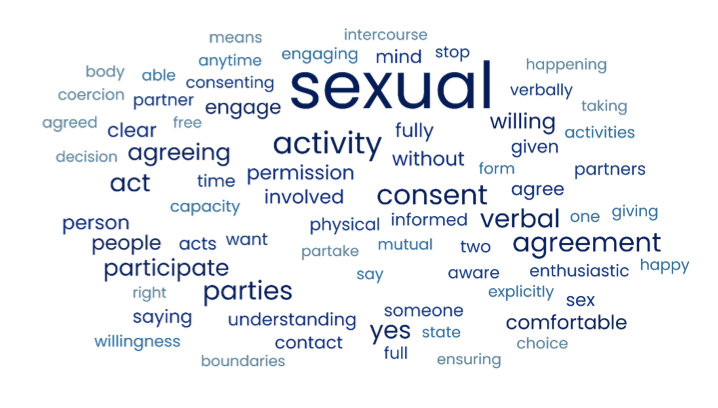
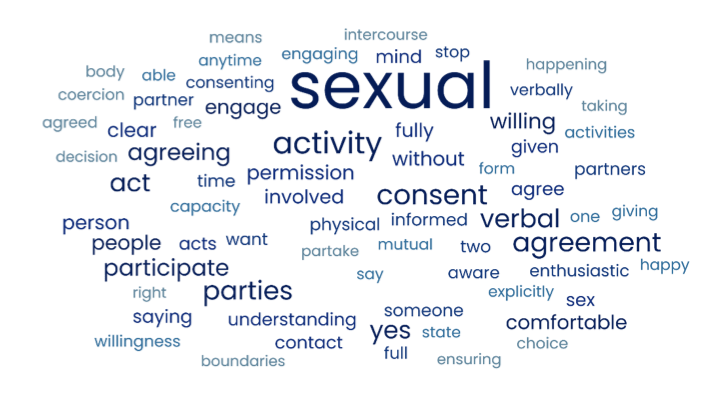
Stripped back, sexual consent is relatively straightforward. But definitions of sexual consent merely highlight construct and conceptual structure, they lack the context of culture and society. When we consider students, for example, research suggests that their sexual consent definitions, generally, accord with the above (Wignall et al., 2022; Brady et al., 2018) – an agreement to engage in sexual activity with some awareness of factors that might mitigate consent (e.g., age, intoxication, coercion). Similar results were identified during my PhD research (Anyadike-Danes, 2023) when university students were asked to define sexual consent (Figure 1). Yet, consent definitions, understanding and behaviour are not necessarily the same (Beres, 2014; Marg, 2020). 

Sexual consent understanding supplements definitions with contextual information like societal norms, cultural attitudes, and adherence to religious beliefs (Muehlenhard et al., 2016). This could mean that there are situations where students think sexual consent is not necessary (e.g., married, certain sexual acts). Though research seems to suggest that certain gendered and victim-blaming beliefs are reducing in students (Yapp & Quayle, 2018), students’ responses may also reflect their awareness of social desirability and suggest that our measures require updating (Zidenberg et al., 2022). 

Figure 1. Word cloud of university students’ sexual consent definitions.

Sexual consent understanding also influences how individuals communicate consent – whether that’s their communication to/with someone, or their interpretation of someone else’s consent communication. Affirmative consent (Friedman & Valenti, 2019), or ‘yes means yes, no means no’, means that anything other than a ‘yes’ (often a verbal ‘yes’) is non-consent. The verbal ‘yes’ has been heralded as the ‘gold-standard’ of consent communication because it limits the risk of miscommunication (Beres, 2014). Yet, putting such expectation on the word ‘yes’ means that other cues that refute that ‘yes’ might be missed. For example, if someone consents after having said ‘no’ several times throughout the night, is that consent? 

A group of white speech bubbles with blue text

Description automatically generated

Figure 2. Awareness raising campaign from Geelong (Australia) Sexual Assault & Family Violence Centre.


Figure 2 features a campaign message from an Australian support centre that highlights the reality that ‘no’ may not always be literal, it can take different forms. Just like we understand that ‘yes’ can be non-verbal, so too can be said for ‘no’. From research, studies suggest that students may understand the importance of verbal communication, but that is not how they communicate (Muehlenhard et al., 2016). Rather, they prefer non-verbal or more implicit means of communication (Jozkowski & Peterson, 2014). And, expectedly, this introduces a greater likelihood of miscommunication. If we expand sexual consent beyond a binary conceptualization and view it as a spectrum – yes, no, and somewhere in between – then we should also reimagine communication the same way: verbal, non-verbal and nothing at all. Especially as we consider what drives whether someone consents (or not). 

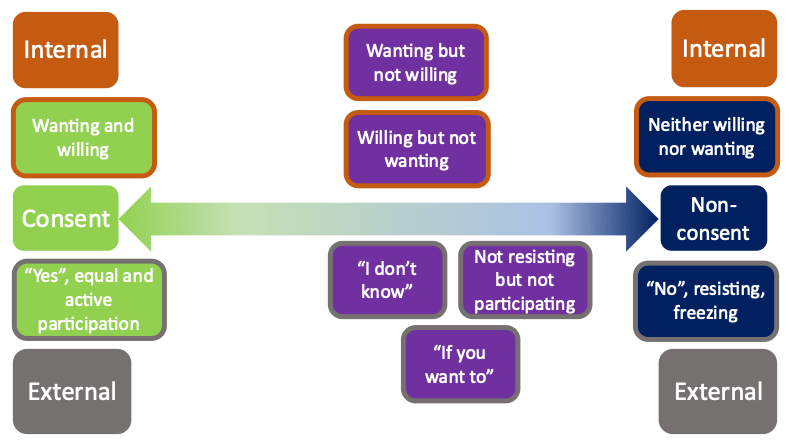
Figure 3. Visualizing sexual consent as a spectrum.

To some, sexual consent is an internally motivated desire or willingness to engage in sexual activity. This is more in keeping with when someone is asked how they knew someone wanted to have sex and they say that “you just know” (Wignall et al., 2022; Willis & Jozkowski, 2019). In research terms, this is known as ‘tacit knowing’ (Beres, 2010). Rather than solely an external or internal manifestation, sexual consent is more than likely a blend of both. Figure 3 seeks to visualize different consent concepts and behaviours across that spectrum.

But how does this all relate to gender-based violence? 

Research suggests that secondary school students do not receive sufficient education on sexual consent and what that means for their relationships

(Pound et al., 2016; Setty, 2023).

Understanding sexual consent is just as much about learning definitions as it is about empowering young people to know their boundaries and feel confident voicing what they like and what they do not like. Not only might this education impact the prevalence of gender-based violence but it may also provide those victimized with the language to report their experiences (Rousseau et al., 2020). Conceptualizing sexual consent as yes or no may be a catchy slogan but it is merely a conversation starter – we must follow up these catchphrases with in-depth learning discussions about the breadth of sexual consent and what that means for relationships. 

The importance of sexual consent cannot be overstated: it determines whether a sexual act is criminal. But in reality, it can mean so much more.

REFERENCES

Anyadike-Danes, N. (2023). Sexual consent within unwanted/non-consensual sexual experiences: exploring definitions, understanding and impact amongst university students in Northern Ireland [Unpublished doctoral thesis]. Ulster University.

Beres, M. (2010). Sexual miscommunication? Untangling assumptions about sexual communication between casual sex partners. Culture, health & sexuality12(1), 1-14. https://doi.org/10.1080/13691050903075226

Beres, M. A. (2014). Rethinking the concept of consent for anti-sexual violence activism and education. Feminism & Psychology, 24(3), 373-389. https://doi.org/10.1177/0959353514539652

Brady, G., Lowe, P., Brown, G., Osmond, J., & Newman, M. (2018). ‘All in all it is just a judgement call’: issues surrounding sexual consent in young people’s heterosexual encounters. Journal of Youth Studies21(1), 35-50. https://doi.org/10.1080/13676261.2017.1343461.

Friedman, J. & Valenti, J. (2019). Yes means yes! Visions of female sexual power and a world without rape. Seal Press.

Jozkowski, K. N., & Peterson, Z. D. (2014). Assessing the validity and reliability of the perceptions of the consent to sex scale. The Journal of Sex Research51(6), 632-645. https://doi.org/10.1080/00224499.2012.757282

Marg, L. Z. (2020). College men’s conceptualization of sexual consent at a large, racially/ethnically diverse Southern California University. American Journal of Sexuality Education15(3), 371-408. https://doi.org/10.1080/15546128.2020.1737291

Muehlenhard, C. L., Humphreys, T. P., Jozkowski, K. N., & Peterson, Z. D. (2016). The complexities of sexual consent among college students: A conceptual and empirical review. The Journal of Sex Research53(4-5), 457-487. https://doi.org/10.1080/00224499.2016.1146651

Munro, V. E. (2008). Constructing consent: Legislating freedom and legitimating constraint in the expression of sexual autonomy. Akron L. Rev.41(4), 923-955. https://ideaexchange.uakron.edu/akronlawreview/vol41/iss4/5

Pound, P., Langford, R., & Campbell, R. (2016). What do young people think about their school-based sex and relationship education? A qualitative synthesis of young people’s views and experiences. BMJ open6(9), e011329. https://doi.org/ 10.1136/bmjopen-2016-011329

Rousseau, C., Bergeron, M., & Ricci, S. (2020). A metasynthesis of qualitative studies on girls’ and women’s labeling of sexual violence. Aggression and violent behavior, 52, 1359-1789. https://doi.org/10.1016/j.avb.2020.101395

Selwyn, N., & Powell, E. (2007). Sex and relationships education in schools: the views and experiences of young people. Health Education107(2), 219-231. https://doi.org/10.1108/09654280710731575

Setty, E. (2023). Co-designing guidance for Relationships and Sex Education to ‘transform school cultures’ with young people in England. Pastoral Care in Education, 1-19. https://doi.org/10.1080/02643944.2023.2228804

Wignall, L., Stirling, J., & Scoats, R. (2022). UK university students’ perceptions and negotiations of sexual consent. Psychology & Sexuality13(3), 474-486. https://doi.org/10.1080/19419899.2020.1859601

Willis, M., & Jozkowski, K. N. (2019). Sexual precedent’s effect on sexual consent communication. Archives of Sexual Behavior48(6), 1723-1734. https://doi.org/10.1007/s10508-018-1348-7

Yapp, E. J., & Quayle, E. (2018). A systematic review of the association between rape myth acceptance and male-on-female sexual violence. Aggression and violent behavior41, 1-19. https://doi.org/10.1016/j.avb.2018.05.002

Zidenberg, A. M., Wielinga, F., Sparks, B., Margeotes, K., & Harkins, L. (2022). Lost in translation: A quantitative and qualitative comparison of rape myth acceptance. Psychology, Crime & Law28(2), 179-197. https://doi.org/10.1080/1068316X.2021.1905810

AUTHOR BIO

Ngozi Anyadike-Danes is a postdoctoral researcher within Ulster University’s School of Psychology. Currently, she’s working on a Shared Island Initiative funded project: Consent, Sexual Violence, Harassment and Equality in Higher Education (COSHARE). This project aims to produce an all-island strategy in response to consent, sexual violence and harassment (C-SVH) in HE and facilitate knowledge exchange between academics and professionals (COSHARE Network). In January 2024, Ngozi will begin a lectureship within Ulster University’s Criminology and Criminal Justice program. Ngozi’s research interests concern sexual consent knowledge and understanding, unwanted/non-consensual sexual experiences, rape myth acceptance and designing measurement tools that explore sexual victimization.

Contact e-mail: n.anyadike-danes1@ulster.ac.uk

Day Two: I am a feminist. These are the things I struggle with.

Our blogathon begins by turning to domestic abuse research to ask what kind of an object violence is and how it articulates with everyday ‘relationship rules’ that shape how we see and understand it

Featured image from Photo Phiend / Flickr.

Catherine Donovan

I am a feminist. These are the things I struggle with. How do we get a better understanding and response to domestic abuse in the relationships of lesbians, gay men, bisexual women and men, trans and non-binary folk?

There is a public story about domestic abuse that tells us that ‘the problem’ is that of cisgender heterosexual men being, primarily, physically (including sexually) violent towards cisgender heterosexual women.

(Donovan and Hester 2014)

We know that men are vastly more likely to be the perpetrators and women the victim/survivors. But the public story of domestic abuse has unintended consequences for members of LGBTQ+ communities who are victim/survivors of domestic abuse and seek help. Assumptions follow from this public story of domestic abuse: that men can’t be victim/survivors; women can’t be perpetrators; perpetrators are bigger and stronger than victim/survivors who are smaller and weaker/passive. The public story of domestic abuse doesn’t just describe a problem, it creates a problem with particular contours in our minds, in the minds of those who are victimised and in the minds of help-providers. It makes it difficult to tell different stories and it makes it difficult for them to be heard. How can we make it easier for victim/survivors from LGBTQ+ communities to recognise and name what is happening to them and get the help that they need? 

Could we – should we? – stop talking about gender when we talk about domestic abuse and talk instead about the power seen/felt in what we call relationship rules and practices of love?

(Donovan and Hester 2014)

The first rule is that the relationship is for the abusive partner and they will make all the key decisions. The second is that the victim/survivor is responsible for everything – the abuse, the abusive partner, the relationship, the household if they share, the children if they parent. And love can somehow be a glue keeping abusive relationships together and encouraging victim/survivors to keep forgiving and remaining loyal and staying or returning to abusive relationships. Perpetrators use love and promise to change, beg forgiveness and seek understanding by explaining their abuse and their neediness. 

Of course, these relationship rules and practices of love have been shaped by dominant ideas about cis heterosexuality, femininity, and masculinity with binaried and unequal gender norms at the heart of them. I don’t want to lose this analysis and the consequences of patriarchy. But I also want to make sure that anybody who is being victimised by domestic abuse can get access to help. It seems to me that unless we can unhook the perpetrator/victim binary from a heterosexual man/woman binary and their accompanying strong/weak binary and active/passive binary (Donovan and Barnes 2020) then those who are not heterosexual, those who are bigger and/or physically stronger than their abusive partner, those who are not victimised primarily with physical force including physical sexual violence, will not be seen or heard and supported. 

If not, and this seems quite common, where there are two women or two men in an abusive relationship there is a tendency to assume there might be mutual abuse or, as it is sometimes called, bi-directional violence. I think this is because without the heterosexual abusive binaries outlined above it becomes difficult to ‘work out’ who is the perpetrator and who is the victim/survivor. If we could focus on how power operates through relationship rules and the practices of love we might be better able to identify whether, in fact, one partner is using physical violence or other behaviours to manage, resist, and/or defend themselves against the domestic abuse of their partner. If we can put assumptions about heteronormative, binaried gender to one side and focus on the direction of power, the relationship rules, the way that love operates in the relationship then we might better understand that rarely are any victim/survivors passive and weak. On the contrary, victim/survivors are made responsible by the perpetrator, they manage everything including their own behaviours and those of their abusive partner, attempting to pre-empt their needs and demands in order to mitigate the abuse. They also fight back, they try to (re)establish an equal relationship. It doesn’t work because perpetrators are more willing to use abusive behaviours (and use them regularly) to remind victim/survivors of the relationship rules and/or to punish them for not obeying them. But this is why domestic abuse is often so difficult to name. The imagery that reflects the public story – the man in the foreground, standing, a hand in a fist raised, larger by perspective than the woman in the background, on the floor, kneeling, sitting, smaller, at the mercy of the man. This is powerful imagery. Perhaps it has been too powerful or successful because it has unwittingly created limited ideas about what counts as domestic abuse and who counts as legitimate victim/survivors. The public story of domestic abuse is not enough to allow all of those victimised by domestic abuse to get the help they need. This what I struggle with, and I am a feminist. 

REFERENCES

Donovan, C.; Hester, M. (2014) Domestic Violence and Sexuality: What’s Love Got to do with it?  Policy Press: Bristol. http://www.policypress.co.uk/display.asp?ISB=9781447307433& Now out in 2015 paperback.

Donovan, C. and Barnes, R. (2020) Queering the Narratives of Domestic violence and Abuse. Palgrave: London.

AUTHOR BIO

Catherine Donovan is Professor in Sociology and Head of Department at Durham University UK. For the last 30 year she has been researching the intimate and family lives – more recently focussing on domestic and sexual abuse – of lesbians, gay men, bisexual, and, trans folk. Her work, both with Prof Marianne Hester and with Dr Rebecca Barnes, has been innovative focussing as it has first of all on comparing love and violence in same sex and heterosexual relationships and then on lesbians, gay men, bisexual and trans folk who use violence and abusive behaviours in their intimate relationships. She has also been involved with research considering perpetrators of family abuse in minoritised communities including targeting lesbians, gay men bisexual and trans folk. She is on the Drive Partnership national working group on LGBTQ+ perpetrators and is a Board member of WWiN a domestic abuse service in Sunderland, North East England.

DAY NINE: Myth and reality of gender-based violence in India’s partition and thereafter 

Rachna Mehra traces the legacies of Partition-era gender-based violence and abductions on community relations and consensual inter-faith marriages in contemporary India.

Rachna Mehra

ਅੱਜ ਆਖਾਂ ਵਾਰਸ ਸ਼ਾਹ ਨੂੰ ਕਿਤੋਂ ਕਬਰਾਂ ਵਿਚੋਂ ਬੋਲ
ਤੇ ਅੱਜ ਕਿਤਾਬੇ ਇਸ਼ਕ ਦਾ ਕੋਈ ਅਗਲਾ ਵਰਕਾ ਫੋਲ
ਇਕ ਰੋਈ ਸੀ ਧੀ ਪੰਜਾਬ ਦੀ ਤੂ ਲਿਖ ਲਿਖ ਮਾਰੇ ਵੈਣ
ਅਜ ਲੱਖਾਂ ਧੀਆਂ ਰੌਂਦੀਆਂ ਤੈਨੂ ਵਾਰਸਸ਼ਾਹ ਨੂੰ ਕਹਿਣ
ਵੇ ਦਰਦਮੰਦਾਂ ਦਿਆ ਦਰਦੀਆ ਉੱਠ ਤੱਕ ਆਪਣਾ ਪੰਜਾਬ
ਅਜ ਬੇਲੇ ਲਾਸ਼ਾਂ ਵਿਛੀਆਂ ਤੇ ਲਹੂ ਦੀ ਭਰੀ ਚਨਾਬ

(To Waris Shah, I say unto today! 

Speak up from your grave!

 And in the book of love turn the next leaf,

Once, when a daughter of Punjab cried,

You filled pages with songs of lamentation

Today a million daughters are wailing

and beseeching you O Waris Shah!

O symapathiser of the heartbroken, arise and see your Punjab

Corpses are strewn on the pastures and blood is overflowing in Chenab)

On 15th August 2021 India celebrated 75 years of political independence from colonial rule but to this day the joy of freedom is marred by the tragedy of partition  (August 1947) which was presented as a fait accompli to gaining the long awaited sovereignty. The partition of India was the division of the subcontinent into two independent dominions, India and Pakistan based on religious differences. This led to one of the worst refugee crises in history, resulting in about two million deaths and an estimated 20 million people displaced along communal lines. The excerpt above from Punjabi poet Amrita Pritam’s elegy “Aaj Aakhaan Waris Shah Nu” reflects on that fateful decision which resulted in en masse displacement and gendered violence in both grotesque and insidious ways. The poem is addressed to an acclaimed Punjabi Sufi poet of the 18th century Waris Shah, and asks him to arise from his grave and bear witness to the pain of partition by adding another chapter in his book of love (written a century ago). Shah was well known for his tragic love story Heer Ranjha which symbolises eternal love and separation. Pritam’s poem recalls how Shah penned an entire saga when one daughter (Heer) cried about her misery to him, but now he needs to rise up to the occasion when a million daughters are grieving and river Chenab is overflowing with blood.

In March 1947 communal riots and the ensuing violence resulted in mass scale abduction, rape and forcible conversion of women from both communities. In September, the leaders and representatives of the government of India and Pakistan met and resolved to restore abducted persons to their original homes. Soon an Inter-Dominion Conference was held at Lahore where the two countries agreed upon a joint exercise which resulted in the ‘Abducted Persons Recovery and Restoration Act 1949’. Mridula Sarabhai, who was a frontrunner social worker in the recovery program, estimated that about 1,25,000 (0.12 million) women were missing on both sides of the border (Balakrishnan 2011). Though the Act was to remain in force for a year or so, the recoveries continued for almost a decade. The full extent of abductions remains a matter of debate. While on the one hand the forcible abduction and conversion had caused outrage and rancour; on the other the process of recovery had opened a Pandora’s Box. Many women were either pregnant or had children with their abductors and were not sure if they wanted to return or would be accepted by their families. Hence they neither had a choice in their abduction nor a say in the recovery program as both decisions were made outside their consent. 

The stories of the women as victims or men as aggressors usually come from oral testimonies narrated by family members, neighbours, social workers, leaders, administrators or reports circulated through newspapers. Other heartrending accounts come from fictional representations which brought out the dilemmas associated with partition. Jyotirmoyee Devi’s ‘Epar Ganga, Opar Ganga’, Jamila Hashmi’s ‘Exile’, Rajinder Singh Bedi’s ‘Lajwanti’Manto’s ‘Khol do’, ‘Thanda Gosht’, ‘Khuda ki Qasam’, and many other literary works brought out the predicament and effects of violence on both the victims and the aggressors.

It has been observed that antagonism based on religious differences before and since 1947 seem to exacerbate and not wane with time. With each incidence of new hostility between Hindus and Muslims, the ghost of the past is resurrected and traced to the communal riots of partition and beyond. While some fiction writers have written cathartically about the event, creative writing along with newspaper reports and political propaganda through pamphlets can also be seen as a means to produce and reproduce stereotypes both historically and in contemporary times. 

Historian Charu Gupta (2009) has emphasized the deeper historical roots to stories and beliefs that the abduction and conversion of Hindu women is a characteristic Muslim activity. She draws from diverse sources to show how a communal narrative was constructed during the public campaigns of the Shuddhi Movement in Uttar Pradesh in the 1920s. In colonial Bengal as well, the privileges associated with majority-minority status acquired communal overtones where a prejudiced portrayal of lascivious Muslim men was publicised post the 1919 Montford Reforms, which introduced self-governing institutions. P K Datta (2010) ascertains that abduction as a phenomenon and a narrative  allowed powerful binaries of antagonism and desire, permissibility and repudiation to thrive, which have left enduring legacies.

One such legacy can be seen in the hostility and jeopardy regarding consensual inter-faith marriages in India. Seven decades on from partition-era abductions, the Hindu and Muslim communities continue to be suspicious of each other and the so-called ‘Love Jihad’ (war on love) forbids interfaith marriages. There is a belief that Muslim men feign love and use seduction, deception and kidnapping as a means to convince, coerce, convert and marry Hindu women. The consent or elopement of women in such cases is disregarded because it transgresses prescriptive norms. In 2018, the Supreme Court of India restored the marriage of Hadiya and Shafin Jahan which had been annulled by Kerala High court on the plea of the girl’s parents who believed that she had been influenced and forcibly converted to Islam. The couple had to undergo 15 month long legal battle to win their conjugal rights. In another state, for instance Dakshina Karnataka, the Hindu Janajagriti Samiti (Hindu People’s Awakening Organisation) claimed that 30,000 young women had been duped by ‘Love Romeos’ (Rao 2011).

There is constant anxiety about development of amorous relationships particularly between men hailing from the Muslim community and women belonging to the Hindu community. Hence most of the cases are either fought in courts or end up in honour killing. Whether it was 1947 or it is 2021, the honour of the Hindu family, community and nation is inextricably linked with a woman’s body and any amatory desires towards Muslim men is considered illicit or a challenge to social norms which is neither forgiven nor forgotten.

References

Das Veena (2007) Life and Words: Violence and the Descent into the Ordinary, (UCLA Berkeley)

Datta P K (2010), Heterogeneities: Identity Formations in Modern India (Tulika, Delhi)

Gupta Charu (2005), Sexuality, Obscenity, Community: Women, Muslims and the Hindu Public in Colonial India (Permanent Black, Delhi)

Pritam Amrita ‘Aaj Aakhaan Waris Shah Nu’ poem

Rao Mohan, (2011), ‘Love Jihad and demographic fears’ Indian Journal of Gender Studies, 18 (3), pp.425-430.

Bio: Dr Rachna Mehra is Assistant Professor in the Urban Studies Program (SGA), Dr. B. R Ambedkar University Delhi. She completed her PhD in history from JNU and her research interests include partition studies and urban history of small towns and cities. https://aud-in.academia.edu/RachnaMehra

DAY SEVEN: Systemic Stereotypes: Violence against Bonda tribal women

Nancy Yadav writes about stereotypes embedded in myth and colonial history that oppress the Bonda tribal women in India.

Nancy Yadav

Featured Image: Bonda women at Bhubaneswar (Odisha) Tribal Fair (author’s own)

“We have the same colour of blood as others, why are we kept behind and exploited?”

Mini (Bonda Adivasi/Tribal advocate

The right to live free from violence is one of the most fundamental human rights; the Universal Declaration of Human rights internationally recognised documents advocate these rights. In India ‘Article 21 of the Constitution of India, constitutes a basic human right, the right to life with dignity sans violence. The introduction of “Report no.230 on Atrocities and Crimes Against Women and Children” mentions that women’s “status witnessed a sharp decline with pervasive gender stereotypes in society.” The situation of tribal women remains perilous, the reports observe that in the rural, tribal areas the communities accept atrocities as a way of life in the absence of organisational assistance. As per the National Crime Records Bureau records, which are documenting crime against women from Scheduled Tribes (ST) specifically since 2015, we see 1137 cases of rape being recorded against ST women in 2020 as against 885 intent to outrage the modesty of ST women. The situation of Bonda women is no different. 

Odisha’s “Remo” Bonda tribe is one of the Particularly Vulnerable Tribal Groups (PVTGs) among 13 PVTGs in Odisha and 75 PVTGs in India. The PVTGs categorisation, which was supposed to provide special rights, itself creates a divide discriminating the tribal women based on their ethnicity, gender and class in the larger Indian society.

Mini’s experience of hostility is one such example which indicates the systemic violence faced by tribal women in Odisha. Mini is a Bonda woman from Malkangiri district Odisha (whom the researcher met and conversed with during her fieldwork), every year she puts up her stall, selling agricultural produce at Adivasi Mela Ground (annual tribal fair) at Bhubaneshwar.

When asked about her community, Mini says that she does not like the attitude of people from the plains; her community is often perceived as “violent” and women are seen as photographic objects because of the customary attire. “Only for mere 10 rupees tourists take pictures and advertise our community women as ‘exotic’ Indians and “naked” Indian tribes”. As someone actively engaging in social work in her region, Mini is determined to shatter the stereotyped identity of her community and challenge the idea that by “giving alms to the tribals they (the non-tribals) cannot exploit and restrict them from developing.”  

Mini’s reaction is against a long-standing historical violence and injustice done to the Bonda community. The narratives and knowledge formation of the community have its roots in colonial ethnography which stereotyped the community as “primitive” and “savage.” The “strange dress” and appearance of Bonda women, violent and homicidal ways of men, and inaccessibility of their villages, in the colonial narratives remained the primary information, recognising the Bonda tribe as “classical savage type.”

Historically, Bonda women keep their head shaved, covering it with a fillet of palmyra, olive shells or scarlet seeds. They cover their upper body with brass collars of different patterns of brass chains and beadwork necklaces of different colours. Their lower body is covered with a small ‘ringa’ skirt tied by a waistband attached in front. Though Bonda women cover themselves with a lot of ornaments and necklaces, their semi-naked appearance to others is determined to form the identity of the community as “naked tribe.”

In the Bonda community, all significant roles of gender-based identities are attached to myth and rituals, and the customary attire is part of myth which constrains Bonda women from wearing any other cloth except” ringa” (loin cloth). Gregory Staley (2008) in his essay published in the anthology Laughing with Medusa: Classical Myth and Feminist Thought, articulates that investigating myth is a constructive feminist exercise.

Myth becomes a tool through which women can escape the world which men have constructed for them through myth, can attack it, can begin their voyage of discovery’

Gregory Staley (2008:219)

Revisiting the Bonda myth explains the origins of the prohibition of clothing among the Bonda community.

The shaven heads and half-clad bodies are the result of a curse given by goddess Sita, as a penalty for laughing at the bathing goddess. It is necessary to note that the goddess Sita is a Hindu goddess, and the curse version is most widespread among ‘outsiders’–the non Bondas, most likely the non-tribals. The second myth explains that the scrap of cloth is given as a gift by Mahaprabhu (Bonda deity). There is no offence and no curse, the skirt is a gift of Mahaprabhu’s mercy, as an advance on complete nudity. In the third myth, a Bonda woman who has removed her clothes to husk grain on a warm day, jumps below the earth to avoid being seen in the nude by her brother; he catches her by the hair, and it comes in his hand. The woman thus stayed hairless and with only a tiny rug she was holding to wipe off her sweat.

These curse myths are the most narrated myths explaining Bonda women’s attire. The significant issue with the myth is that it propagates the stereotyped identity of the Bonda community as “naked,’ and ‘uncivilised”.

The myths reinforce the violent gendered stereotypes of cursed nudity, and  propagate and reinforce colonial stereotypes that justified the documentation of the tribe as ‘uncivilised’.  Thus, caught between tradition and coloniality, the Bonda women, ironically, face violence both within and outside the community.

Over time, wearing sarees (as many women in some parts of Eastern and Southern India do) and shedding the traditional clothing and nudity led to the Bonda women being outcast from within the community. On the other hand, appearing in customary clothing in weekly Onukadelli markets, Bonda women are objectified through a sexual gaze and ‘voyeuristic tribal tourism’ and “human safaris.” 

In sum, the myth and recorded history of the Bonda community intersect with violence against Bonda women making them stereotyped and reduced to bodily descriptions. But Bonda women like Mini brings a ray of hope, interrogating negative stereotypes that they are born into and repositioning their identity.   

Researcher with Bonda women at Mudulipada (Odisha)

Author’s bio:

Nancy Yadav is PhD candidate in Gender Studies at the School of Human Studies at Dr B R Ambedkar University Delhi.