DAY THREE – 37 Years of Struggle: Academics and Refugee Women Working Together to End Rape, Sexual and Gender-based Violence

Linda Bartolomei and Eileen Pittaway reflect on what has been achieved 37 years since the UN’s Nairobi Third World Conference on Women and commitments made by all governments to protect refugee women and girls from sexual abuse and violence. [Content warning: Rape, Sexual Violence]

Linda Bartolomei and Eileen Pittaway (Forced Migration Research Network, UNSW)

We have tried to tell people, but no-one will listen. They don’t want to hear. They say women will not talk about rape because we feel ashamed. Who should be ashamed? Us, or those who raped us? (El Salvadorean refugee woman 1990)

In 1985, the United Nations (UN) held the Nairobi Third World Conference on Women with the goal of achieving gender equality for women everywhere. One of the key areas of concern was refugee women and girls, named as one of the most vulnerable groups in the world with the rape and sexual abuse they face clearly identified. Commitments were made by all governments to improve the protection of refugee women and girls worldwide. Thirty-seven years on, and after almost three decades of joint research and advocacy with refugee women and girls, academics Linda Bartolomei and Eileen Pittaway reflect on what has been achieved.

While progress has been made, in 2022 the majority of refugee and other displaced women and girls continue to suffer from rape and sexual violence.

‘All my sisters, my mother, my friends – all the women have been raped. The military, they rape us. When we try to cross borders they rape us, when we go for water they rape us, when we go for food they rape us, when we go to the bathroom, they rape us. The police, they rape us. Our life is rape’.

(Rohingya refugee women 2019)

Rape occurs at all stages of the displacement journey. It is often part of persecution in homes and villages, as a strategy of conflict, in flight, at borders and in refugee sites. In 2017, a Senior United Nations High Commissioner for Refugees (UNHCR) staff member stated that 100% of the refugee women fleeing conflicts in boats had been raped and sexually abused on their journeys.

Women attempting to escape the horrors of war via smugglers are advised to carry condoms, as rape is inevitable. 

It is perpetrated by military, guards, militia, police, males from host communities and males from displaced communities, sometimes by humanitarian workers. Women are raped in front of husbands, fathers and children. The impacts are profound. Many abused women bear children of rape. Young girls die because they are too young to bear the children conceived from rape. Men are shamed because they cannot protect women and girls, and whole communities suffer collective guilt. It occurs in all aspects of their lives and cross cuts all the areas of the protection they should receive from the international community. Many displaced women are forced to sell sex to feed themselves, their children and their families. Displaced women and girls remain some of the most marginalised people in the world and this culminates in a range of human rights violations and abuses with rape, sexual and gender-based violence being the biggest barrier to gender equality (Collated findings from 33 years in the field, in Pittaway and Bartolomei, Only Rape! Human Rights and Gender Equality for Refugee Women, forthcoming 2022).

Some things have improved. Rape in conflict and refugee situations is now acknowledged and is widely reported.

Rather than being viewed as a ‘vulnerable group’ in need of saving, refugee women are being recognised as leaders in community based-protection and advocacy and the voices of the courageous refugee women and girls who are speaking out are finally being heard. They have proven time and time again that they are resilient, capable, knowledgeable and strong and can contribute sharp analysis of the risks they face, and the solutions required.

This has been demonstrated repeatedly in the Refugee Women and Girls Key to the Global Compact of Refugees Project, funded by Australia’s Department of Foreign Affairs and Trade (DFAT) and being undertaken with refugee woman, academics, NGO and UN partners in Bangladesh, Malaysia and Thailand.

Increasingly refugee women’s voices are being heard on the world stage and in important UN fora including at meetings of the UNHCR. They are now demanding a seat at the policy making table as equal players in the fight for security and justice. This has happened because of their capabilities and determination, and through the work behind the scenes of a multitude of refugee representatives who made this happen. Vibrant refugee networks, such as the Global Refugee led Network (GRN), the Asia Pacific Network of Refugees (APNOR), and Global Independent Refugee Women Leaders (GIRWL), all with strong commitments to human rights, gender transformative and inclusive age, gender, and diversity approaches, are taking the lead in advocacy and work on the ground.

But the fight for safety, justice and gender equality is far from over. Human rights activists, refugee women, and all stakeholders must continue to work together until we stop this horror for all women everywhere.

Authors’ Bio

Linda Bartolomei: Linda is a founder and co-convenor of the Forced Migration Research Network (FMRN) and the convenor of the Master of Development Studies at the University of New South Wales. Since 2002, Linda has been involved in a series of action research projects exploring the challenges associated with identifying and responding to refugee women and girls at risk in camps and urban settings. This has involved research in multiple sites across Africa, Asia and the Middle East and in Australia. Since 2017, with Eileen Pittaway, she has she worked with UNHCR Geneva and a team of refugee women conducting audits of gendered aspects of all meetings relevant to the 2018 Global Compact on Refugees (GCR) and its implementation. She is currently leading a multi-year project in four countries in the Asia- Pacific with colleague Adjunct Professor Eileen Pittaway to support the implementation and monitoring of the commitments to refugee women and girls in the GCR.

Eileen Pittaway: From 1999 to 2013, Eileen was Director of the Centre for Refugee Research, University of New South Wales, and Associate Professor in the School of Social Sciences and International Studies. The major focus of her work has been the prevention of and response to the rape, sexual abuse and gender-based violence experienced by refugee women, both overseas, and following resettlement to Australia. Over the past thirty years, she has conducted research, provided training to refugees, UN and NGO staff in refugee camps and urban settings, acted as technical advisor to a number of projects, and evaluated humanitarian and development projects in 18 different countries. In 2012, she was made a member of the Order of Australia for her work with refugees.

DAY TWO: All in the mind? Neglected experiences of violence during Partition

For day two of our 16 Days of Activism 2022, we return to the theme of sexual violence during Partition, rape as a weapon of war, displacement and forced migration that Butalia’s blog opened with. Pallavi Chakravarty’s piece on neglected experiences of violence adds further to Butalia’s opening piece.

Pallavi Chakravarty

The photo above (which is also the featured image for this post) is from Jugantor newspaper (1952). It reflects the dilemma of migrants in the wake of novel means of restricting influx on one side (passport in this context) and pushing out of minorities from the other side. Interestingly it is the body of the woman who is personifying all refugees here and men who are representing bureaucratic, political and social guardians.


Rape, abduction, and branding or mutilation of female genitals have been means often used as a ‘weapon of war’.

Looking at the South Asian context, it is in the violence accompanying the division of the Indian subcontinent in 1947 where this ‘weapon of war’ was mastered and used on an unprecedented scale. Hindu, Muslim and Sikh women seemed to have only two options before them: violation of their ‘honour’ at the hands of the ‘other’, which was considered a cause of shame and insult to the family, community and nation; and shockingly, ‘honour killing’ at the hands of their own family members, which was hailed as an act of martyrdom. Thus, ‘honour’ was interpreted as being embodied upon the unviolated body of the woman and the violation of the same supposedly brought dishonour to the family, community and nation. What being violated meant to the woman herself held much less significance.

Even today, oral testimonies show how stories of women jumping into the wells or ‘willingly’ offering to be slain by the knives of father, brother and other males of the same community are told and retold with pride by the male survivors of partition violence while the narratives of the women who were abducted and later restored by an arrangement between the two states (India and Pakistan)[1] are silenced or even forgotten.

Through the Recovery and Restoration Act (1949), both the states added further violence by making it compulsory for women to be ‘restored’ to their family of origin if found in the home of the other community, irrespective of their own will.

This caused dual displacement for the abducted women who may have been resigned to their fate or who knew that they would not be welcomed back home because they had been violated -  that too by the other community.

Violence upon the bodies of the women was more commonplace in the western border of the subcontinent. But India was also divided on its eastern border and here the level of violence was ostensibly lower. This was largely due to the presence of Mahatma Gandhi here on the eve of partition thereafter it became possible for the two warring communities, Hindus and Muslims, to live together peacefully a little longer. Consequently, there was no large scale mass displacement here; rather, migration occurred in phases like the ebb and flow of the tide.

The violence at the eastern border was not always so explicit and direct. In fact, it was often dismissed as mere ‘psychological fear’, thereby denying it any degree of seriousness by the State and host community. Yet hereto, the threat to the honour of their women was the biggest concern for Hindu women coming from East Pakistan as refugees. Certain incidents narrated by them highlight this fear in clearer terms. To cite one example: one of them told Hiranmoy Bandyopadhyay, Rehabilitation Commissioner for West Bengal, that when the women went to take a bath in the pond, some Muslim men would often remark, ‘Pak Pak Pakistan, Hindur Bhatar Mussolman [This is Pakistan, the husband of a Hindu will be a Mussalman]’. Another refugee said that one of the Muslims called out to the ladies in the pond: ‘E bibi, bela je bede cholo. Aar deri keno? Ebar ghore cholo. [Oh Bibi, it is evening now, why delay any further, lets go home.]’[2] 

        Upon hearing such incidents, Bandyopadhyay noted that while fear was a genuine factor for migration, it was still all in the mind, i.e. psychological—‘manoshik nipiron’. However, what seemed ‘psychological’ to the distant government and the people of West Bengal, as well as the rest of India, was an everyday reality lived by Hindu women in East Pakistan.

         Asoka Gupta and her husband Saibal Kumar Gupta [3]recorded testimonies of many East Bengal refugees on their own initiative for the purpose of submitting these eyewitness accounts to the enquiry commission set up by the Government of West Bengal in the aftermath of the 1964 Calcutta riots. These include a few testimonies of refugee women as well, who spoke of the gruesome violence they were either themselves exposed to, or which they had heard of. Bhatarani Ghosh stated that her parents, brother and sister were killed by the Muslims of their village (she names them as well) who later occupied their home. When her husband tried to oppose this forcible occupation of their home, he was threatened with dire consequences. In the face of such mounting pressure, they left their village and crossed over to India. Other accounts by refugee men and women identified abduction of women as one key factor that compelled migration to India. These accounts show how insecure the Hindus felt in East Pakistan, and yet their real fears were dismissed as a mere psychological construct.

       It is my argument that when the State recognizes what it regards as ‘real’ violence, it also recognizes the victims of such violence as its direct responsibility. It then extends far-reaching help to these victims. The State recognized mass abductions, sexual violation and forcible conversion as ‘real’ violence. Only those women who were exposed to such violence became the immediate responsibility of the State. [4] Thus, many women coming from East Pakistan would have to face further hardships for they were not always seen as victims of  ‘real’ violence.     

Independence and Partition were marred by violence and women bore the major brunt of it. Undoubtedly, once they migrated to the host country (India or Pakistan), their immediate care and rehabilitation became a task of absolute importance. But in many ways, the distinction between ‘real’ and ‘psychological’ forms of violence left its mark on patterns of migration and final rehabilitation. Thus it can be argued that the  impact of the differing experiences of violence on migration and consequently upon relief and rehabilitation measures for refugees coming into India through its eastern and western borders of India was profound. 


[1] The Recovery and Restoration of the Abducted Persons Act (1948): An act which allowed for an elaborate machinery to operate between the two States, India and Pakistan, to recover women of all age and boys upto age 16 if found in the homes of the other community and to restore them to their original family/community, whether willing or unwilling.

[2] Hiranmoy Bandyopadhyay, Udvastu, Calcutta: Bangiya Sahitya Samsad (1970) p. 16

[3] Saibal Kumar Gupta, Civil Servant and officer in charge of rehabilitation of Bengali refugees in Dandakaranya (Chattisgarh, India) and his wife Asoka Gupta, a social worker who and looked specially into the rehabilitation of refugee women.

[4] She was a prominent Social Worker and was made the Head of the Women’s Section of the Ministry of Relief and Rehabilitation for the partition-refugees.

Author’s Bio

Pallavi Chakravarty is Assistant Professor at the School of Liberal Studies, Ambedkar University Delhi. She is currently Junior Fellow at the Nehru Memorial Museum and Library, New Delhi (July 2021-23).

She has obtained her doctoral degree from the Department of History, University of Delhi (2013) and her doctoral thesis made a comparison of the rehabilitation policies of the Indian state vis-à-vis the partition-refugees coming into the two cities: Delhi and Kolkata, from West and East Pakistan respectively. It is now published as a monograph, Boundaries and Belongings: Rehabilitation of the Partition Refugee in India, 1947-71, New Delhi: Primus Books (2022). Her main areas of research are: partition studies, refugee studies, oral history methodology. 

Cover of Boundaries and Belongings: Rehabilitation of the Partition Refugee in India, 1947-71, New Delhi: Primus Books (2022).

DAY ONE: Truth Tales: Gendering the Violence of Displacement

Acclaimed feminist author and publisher Urvashi Butalia opens this year’s Blogathon with the hard truths we learn when we listen to survivors’ stories.

Urvashi Butalia

Featured image: ‘Carrying Home’ by artist Nilima Sheikh

People migrate for all sorts of reasons – political conflict, climate change, violent discrimination, poverty, in search of work, and so much more. Such ‘journeys’ (if one can call them that) are not always voluntary, and even when they seem ‘voluntary’ on the surface, behind that façade lies a set of circumstances that make it impossible for people to stay on in places which are settled.

Migrations differentially impact people – depending on their class, caste, location, gender, religion and so much more. And when people settle in new places, part of the struggle for survival is also a struggle to recreate a sense of home, the burden of which often falls on women.

So how do we begin to talk about this subject? And how measure, say, something like displacement in the lives of those – women – who have never really had a place to call their own? In this short piece, I cannot even attempt to answer these questions satisfactorily – in any case there are no ‘real’ or ‘comprehensive’ answers to them.  But perhaps one way of understanding how these broader realities play out on the ground is to turn to people’s lives and experiences.

Years ago, I did some research on what I call the ‘hidden histories’ of the Partition of India – the experiences of ordinary people who lived through that time.  Many of their stories have stayed with me. Here is one: several years ago, at a literature festival in Karachi, I met an 85-year old woman called Shehnaz who told her story in a halting, hesitant narrative, the gaps filled in by her children (now in their fifties and sixties).

Shehnaz had once been Gurbachan, a young sixteen-year old at the time of Partition. She and some of her friends were abducted at Partition (while trying to flee with their families) and ‘shared’ among the abductors – a fate that befell thousands of women. The story goes that her abductor then married her – again a common occurrence at the time – and like many women (on both sides of the border), she converted to his religion and became Shehnaz. By all accounts the marriage was a ‘happy’ one, although we do not really know what that means. She and her husband had five children – four daughters and a son. Many years later, they learnt that her parents had survived the attack and were somewhere near Amritsar in India. With her husband’s support, the family came to Amritsar to meet her parents.

Once there, though, the parents refused to let her return, and sent her husband back to Pakistan with their children. Shehnaz was forced to revert to being Gurbachan and was married to a widower, to whose young son she now became a mother. Meanwhile her first husband, now in Pakistan, remarried too and his wife became mother to the five children Shehnaz and he had had together.

At some point, both Gurbachan and her first husband lost their partners. She then moved to the United States with her foster son, and once there, began seeking out her family in Pakistan – she said that there hadn’t been a day in her life when she had not thought of her children. Her son helped; they advertised in Pakistani papers, and soon, miraculously, she found her children. Fifty years had passed; the youngest, who had been two and a half when they separated, was now fifty-two. When I met her, Gurbachan/Shehnaz had come to Lahore to meet her children and had decided that she now wanted to stay with them and not move back to the US.

She once again became Shehnaz. ‘This is my family,’ she said, ‘it is with them that I will live and die.’

Let me move now to another story. One of my most memorable encounters during my research was with another woman, Damyanti Sahgal, who spent many years working in the Gandhi Vanita Ashram in Jalandhar. She told a harrowing tale of travelling moneyless and alone, from Pakistan to India. Her wealthy father refused to leave his factory in Pakistan but told her she could go. But where was she to go? ‘Partition had started,’ she said, ‘I went alone, and there was rioting in Amritsar…I went alone…. Train, train. Everyone was full of fear…they kept saying put your windows up, put your windows up. Amritsar is coming and they are cutting people down there…’

Months later, after her constant search of a place to call her own, Damyanti finally found some solace in her work as part of the rescue teams sent out to find abducted women, and then in the Gandhi Vanita Ashram in Jalandhar where abducted women who had been rescued were housed, awaiting ‘rehabilitation’ or acceptance by their families. Such camps were set up in many cities, including Hoshiarpur and Karnal. Here is how Damyanti described her time:

‘The government had opened these camps, …and women like me were put in charge of the camps…. None of us was really qualified for this work; many of us were not educated. The government wanted to rehabilitate these women in every sense – our job was to make them forget their sorrow, to put new life into their veins, and to give them the means to be economically independent.’

Two stories of two different women, and so much to learn from them. Partition displaced them, pushed them into a mobility – sometimes travelling alone in uncertain and violent times – they had not known before. It exposed them to enormous violence including, in Damyanti’s case, a family who had no awareness of what she had lived through for the longest time. And yet, they survived, they made their lives. Damyanti worked with women who, like her, had been similarly uprooted and displaced – including thousands of abducted women, survivors of multiple sexual assaults. Gurbachan/Shehnaz did not belong to the same elite class as Damyanti, and she spent a lifetime searching for a place to belong, a home she could call her own, eventually finding it with her children but not knowing if she would ever be allowed to live with them in the long term.

Like these two women, there were millions of others who were similarly uprooted and displaced. Their stories lead us to the histories of the nearly hundred thousand women who were victims/survivors of sexual assault and for whom uprooting and displacement became an experience repeated multiple times: abducted, often sold from man to man, sometimes married to their abductors, sometimes ‘recovered’ from their abductors through a ‘rescue’ operation carried out by the Indian and Pakistani states who wanted to being ‘their’ women back to their ‘homes’.

The violence of Partition also contained in it – if one can say that – other forms of violence towards women and other gendered experiences that help us to understand what home, family, nation mean to women. For the millions who joined the long foot caravans (kafilas) which became people’s method of flight, the whole nature of public space changed (and therefore the notion of being settled). The street, the road, hitherto not a space they were allowed to own, suddenly became their home and all domestic tasks, hitherto carried out in the ‘safety’ of the home, now became part of this space. At another level, the desire of families to ‘protect’ their women from possible rape and conversion, meant killing them, and labelling those deaths as ‘honour’ killings, as ‘martyrdom’. The women were killed because their families felt they would not survive the long journey to escape, and yet, so many millions of women did walk those many miles to cross the border.

Even today, 75 years down the line, we know so little about the gendered dimensions of displacement and uprooting. I have mentioned only a few instances, and all of them relate to a history that is long gone. We have only just begun to scratch the surface of these stories. While we know a little about the experiences of elite and better off women, we know virtually nothing about lower caste and Dalit women – in the large kafilas for example, did caste play out as it does in everyday life? Did flight, desperation, hunger, a shared fear and insecurity, transform caste equations even if just for the moment? We need to continue to record, search and learn from our histories.

Author’s Bio

Urvashi Butalia is co-founder of Kali for Women, India’s first feminist publishing house, and Director of Zubaan, set up after Kali shut down in 2003. She writes widely on feminism and gender. Among her best-known publications is the award-winning oral history of Partition: The Other Side of Silence: Voices from the Partition of India.

DAY ONE: Welcome to 2022’s 16 Days Blogathon

This year’s annual blogathon brings together voices from academia, activism and the creative arts to raise awareness of this ongoing struggle. The blogathon marks a continuing collaboration between the University of Edinburgh, Dr B.R. Ambedkar University, Delhi, and the University of New South Wales.  

Featured image: From UN Women – “In focus: 16 Days of Activism against Gender-Based Violence”

Today is the International Day for the Elimination of Violence Against Women and the beginning of the 16 Days of Activism Against Gender-Based Violence  which runs from 25 November to 10 December, Human Rights Day. This year’s annual blogathon brings together voices from academia, activism and the creative arts to raise awareness of this ongoing struggle. The blogathon marks a continuing collaboration between the University of Edinburgh, Dr B.R. Ambedkar University, Delhi, and the University of New South Wales.  

Our theme this year is migration, mobilities, and displacement. This is an urgent theme, both historically and given the current moment. We are living through one of the largest and most rapid forced displacements of our times with some four million Ukrainians fleeing to neighbouring countries. This is not the only example of forced displacement: across the planet, populations are on the move in search of shelter from war, extreme climate change, and political instability. Historically, as our bloggers note, the foundational violence of settler colonialism and racialized labor regimes have violently separated people from their communities, rendering them vulnerable to harm.

Through an analysis of both violence and the reparative work of care, this year’s 16-day Blogathon explores how people endure and negotiate gender-based violence in contexts of voluntary and coerced movement.  

Our blogathon follows in the tradition begun in 1991 by activists at the first Women’s Global Leadership Institute. That decade was marked by an emphasis on gender in global development initiatives. In 1995, the UN held the Fourth World Conference on Women that adopted the Beijing Declaration with an agenda for women’s empowerment and gender equality.

Where are the conversations today, thirty years later? As we curated the blogathon, we found that our interlocutors adopted a quite different approach to gender from the discourse of the 1990s.

One of our bloggers critically notes that “in the context of displacement, gender-based violence is often conceptualised as violence against women, meaning those who are cisgender and heterosexual.” Rather than considering women as the a priori subject of gender-based violence, our blogathon show how gender-based violence is produced in a range of institutional sites and contexts.   

This year’s opening blog is by Urvashi Butalia, well-known historian and founder of the feminist publishing house, Kali for Women. She writes about India’s Partition, drawing on stories from the time to raise questions about what ‘displacement’ means when, really, you have no place at all to call your own. Gendered violence is enacted through separations of land and people. 

Indeed, many of our bloggers show how forms of settler colonialism and war have displaced people from their land and their communities, thus fracturing kinship and intergenerational strength. Equally, borders act as technologies of violence, inviting certain laboring bodies and confining and isolating others—their spouses—whose labor of social reproduction is unrecognized. Moving bodies are also read as not “belonging” at certain times of day and night, as “foreign,” or “out-of-place” in certain spaces. We investigate a range of these spaces: refugee camps, crisis pregnancy centers, homes, and domestic shelters. Our bloggers draw on narratives – either from ethnographic research, personal testimonies, or literary accounts – of sexual violence in wars, and detail the racialized, sexualized, classed, and gendered dynamics of these forms of violence.  

Our bloggers also show us how a gender analysis can expose the problematic construction of the “ideal” victim in international humanitarian and legal discourse. Such a figure is mobilized by normative ideas of gender and sexuality. Through queer and trans perspectives, the blogathon shows how homophobia and transphobia necessitate migration and the cobbling together of community-based “safe spaces.” The lived experience of violence in migrant life is thus not experienced through the individual alone but distributed through the communities that marginalized migrants belong to. Despite what some of our bloggers named as the “inevitability of rape and sexual abuse” in the refugee experience, there are now vibrant networks that situate refugee voices as leaders in international decision-making fora.  

Even amidst the violence of war and border-making are forms of public and community art that enable survivors to bear witness and create art that gives form to experience and enables healing. We explore the feminist possibilities of witnessing and seeking justice through alternative courts and hear about the public installation of clothes of survivors of sexual violence. We explore the visual landscapes of art created in the aftermath of large-scale sexual violence during war. We hear the songs and read about the characters who have experienced gender-based violence during migration.  

We hope that our curation of this year’s blogathon leaves you with a multi-lensed analysis of how gender-based violence works through patriarchy, colonialism, war, and racialized violence.

We also hope that we can give you a sense of the crucial forms of care and mutual aid through which communities stitch together the resources and kinship that are necessary to survive and thrive amidst both the violence and the possibilities of mobilities, movement, and displacement. 

Content note: posts inevitably address distressing experiences and issues around sexual and gender-based violence. We hope they also provoke, energise and at times, serve to provide hope when it seems most bleak.

The 2022 curators:

University of Edinburgh: Dr Radhika Govinda (Director), Dr Hemangini Gupta (Assoc Director and 2022 Blogathon Co-Lead), Dr Zubin Mistry (Steering Group Member and 2022 Blogathon Co-Lead) and Aerin Lai (PhD web and editorial assistant) from GENDER.ED.

Dr B R Ambedkar University Delhi: Prof. Rukmini Sen (Director, Centre for Publishing), Dr Rachna Mehra (School of Global Affairs).

University of New South Wales: Prof. Jan Breckenridge (Co-Convenor), Mailin Suchting (Manager) and Georgia Lyons (Research Assistant) for the Gendered Violence Research Network.

DAY FIFTEEN: Social Action in the 80s –has anything changed?

The late 1970s and 1980s marked a time where it was no longer possible to ignore domestic violence, rape and the sexual assault of children. But is our world a safer place?

Jan Breckenridge and Mailin Suchting

Featured image: “Commemoration of International Women’s Day 2018 at United Nations Headquarters” by UN Women Gallery is licensed under CC BY-NC-ND 2.0

The late 1970s and 1980s marked a time where it was no longer possible to ignore domestic violence, rape and the sexual assault of children. The second wave of the women’s movement emerged alongside other progressive social movements including anti-war/moratorium, gay rights and environmental and anti-nuclear collective actions. 1980’s feminism felt hopeful, and we believed our actions could change our social, political and cultural worlds.

While there was no one feminism or singular political focus, there was a shared commitment to challenge domestic and sexual violence by those of us who saw ourselves as part of the ‘women’s movement’. Analysis of power and gender led to a consistency and diversity of views. In Australia, there were challenges to white middle-class feminists from Aboriginal women, women from migrant and refugee backgrounds and working-class women about their marginalisation on the basis of race, class, culture and ability.

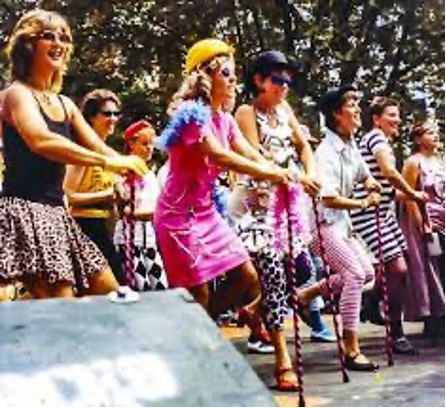
Despite these differences there was still a sense of a woman’s community or communities that contributed to a belief that all things were possible and provided a home for a broad church of political perspectives. We remember women’s cabarets the Freda Stares tapdancing group, the Women’s Choir and a multitude of community festivals and theatre events.

Freda Stares tapdancing group – photo from personal album of Jan Breckenridge

There were actions such as International Women’s Day marches, Reclaim the Night, Women against Rape in War and Women for Survival – Close Pine Gap.

For the first time, women loudly and with passion broke their silence about their experiences about a range of important issues, including gendered violence and abuse. The demand for equal rights was central to feminism and increasingly activists, many of whom spoke from their own lived experience, argued that men’s treatment of women was a central weapon of their subjugation. Again, opinions were divided with liberal feminists arguing that the state was central to any response and other feminist groups arguing that the state was complicit in maintaining structures, attitudes and beliefs that supported the perpetration of gendered violence and did little to address the root concerns.

Collective actions of any kind are never linear or sequential but there are certain issues which benefit from other political actions. Differences were unpacked in working class and middle-class women’s groups.

The focus on child sexual assault as we called it then, followed on from successful collective actions establishing domestic violence and rape as prevalent and serious concerns requiring a response to directly address women’s lived experiences. Women shared their experiences in consciousness raising groups and child sexual assault was raised as an issue that many women had also experienced but felt they could never disclose. When they had tried to tell many of them were not believed or pathologized.

When women started talking, they broke a silence that only gained in momentum. In 1980, The Australian Women’s Weekly, a normally conservative magazine known to reinforce traditional gender roles and stereotypes of women, invited its readership to write in and tell of any unwanted childhood sexual experiences. It was a shock when they received 30,000 responses from their female readers. Feminists in refuges, and rape crisis centres had also been capturing the childhood experiences of women in surveys and groups. This evidence was used to demand changes to legislation, service delivery and even ways of understanding CSA – aligning the impacts with the effects of trauma rather than psychiatric disorders as had previously been the case.

The results of this work were tangible with a proliferation of speakouts, women’s health centres, government policy development, community based incest services, sexual assault services within health systems and as non-government organisations, taskforces, state plans and survivor groups. All of this is documented in one of the first edited books, Crimes of Violence focussed on rape and child sexual assault in Australia.

There is no doubt that these changes established child and adult sexual assault as a serious and prevalent issue. But is our world a safer place?

Between 2013 – 2017 the Commonwealth Royal Commission into Institutional Responses to Child Sexual Abuse provided the opportunity for over 8000 survivors to tell of their experiences of child sexual abuse in institutions. Their Final Report made 409 recommendations to better protect children from institutional child sexual abuse and progress is being made to implement these. These recommendations are no doubt, important.

But survivors of child sexual abuse perpetrated in families have not experienced the same attention. Their stories remain untold publicly – despite the family being recognised as a central institution in all cultures. We now have a renewed set of social movements in the digital age including #MeToo and the public disclosures from individual advocates such as Brittany Higgins and Grace Tame, both of whom at some personal expense, have spoken publicly about their unwanted sexual experiences. Some others have produced memoirs to raise the profile of the issue.

Are we at another crossroads? To date the government’s response to these public disclosures has not inspired hope and we are still circling around silences within the institution of the family.

How many more experiences do we need to hear before silence is a thing of the past? When will speaking out put perpetrators on notice and achieve real safety for all?

Authors’ bios:

Jan Breckenridge is a Professor and Head of School of Social Sciences and the Co-Convenor of the Gendered Violence Research Network, UNSW Sydney. She has undertaken extensive work in the areas of gendered violence, with her research oriented towards maximum impact in innovative social policy development, best practice service provision and outcome measurement of effectiveness.

Mailin Suchting is the Manager of the Gendered Violence Research Network, UNSW Sydney. She has extensive practice, management and research experience in the fields of domestic and family violence, sexual assault and child protection.