DAY THREE: Can victim-survivors of violent crimes find justice through true crime podcasts?

Lili Pâquet discusses how Trace and The Teacher’s Pet can act as informal justice beyond police and courts.

Lili Pâquet

Featured image ‘Albert V Bryan Federal District Courthouse – Alexandria Va – 0016-2012-03-10’ by Tim Evanson is licensed under CC BY-SA 2.0

True crime podcasts investigating historical ‘cold’ cases where women and children are victims of gender-based violence are increasingly popular. Two recent Australian true crime podcasts, Trace and The Teacher’s Pet, discovered new witnesses in unsolved murder cases, which led to arrests and coronial inquests.

My research aims to discover if these kinds of podcasts can offer informal justice to victims who feel dissatisfied with the formal police and court systems of Australia. These podcasts have similarities to true crime podcasts from countries around the world with adversarial justice systems, like the USA, the UK, and Canada.

Trace

Trace Season 1 (2017-2018) is a seven-episode podcast narrated by Rachael Brown for the Australian Broadcasting Corporation (the free national broadcaster). The podcast reinvestigates the unsolved 1980 murder of single mother, Maria James.

During the podcast, it is revealed that the local parish priest, Father Bongiorno, was sexually abusing James’s youngest son and that James was murdered the day she confronted the priest. A witness saw Bongiorno covered in blood. Police told James’s sons that Bongiorno was ruled out by DNA evidence. The podcast reveals that the exculpating DNA was from an unconnected police investigation and had been mistakenly mixed into the evidence from James’s murder. Following the podcast, the coroner opened a new inquest into James’s murder. James’s two sons state on the podcast that their voices had finally been heard, in a way they weren’t during the investigation.

Video above: ‘Invasion of the Pod People: Trace’ with Myf Warhurst, Rachel Brown, Ron Iddles, and Mark James at The Wheeler Centre, Melbourne.

The Teacher’s Pet

The Teacher’s Pet (2018), narrated by Hedley Thomas for The Australian, was downloaded over 28 million times. Over 16 episodes, Thomas investigates the 1982 disappearance of Lynette Dawson from Sydney. Thomas explicitly suggests Dawson’s husband killed her and buried her on their property. Chris Dawson’s teenage girlfriend, a student at the high school where he taught, then moved in with him and his two daughters. During the podcast, Thomas uncovers new witnesses and a disturbing culture of sexual abuse by teachers at the school, which led to a police strike force and the 2018 arrest of Chris Dawson. He is currently on trial for Lynette Dawson’s murder and the podcast has been removed for download while the case is before the courts.

Informal Justice

Definitions of ‘justice’ within formal institutions are based on successful convictions and punishment of offenders. However, this form of justice may not give victim-survivors and secondary victims a sense that justice has been achieved. Informal justice occurs outside police, courts, and legislation. According to Bianca Fileborn’s research, victim-survivors achieve a sense of justice if they have:

  • real participation
  • an active voice
  • vindication of harm they experienced
  • accountability by the offender.

Ideas of ‘justice’ should extend beyond outcomes in law and policy to include changes in social attitudes and representations of violence. Clare McGlynn and Nicole Westmarland argue that victim-survivors and secondary victims seek validation from their communities, which could include validation by podcast audiences. Academics such as Tanya Serisier argue that narrators of media about violent crime shape its representation and audience’s understanding of it.

By speaking about their victimisation to a public audience, some victim-survivors may feel they have achieved justice through true crime podcasts and, importantly, have been vindicated and validated by their communities.

Limitations of podcasts

While some podcasts allow victim-survivors or secondary victims to narrate their own stories, other podcasts have harmful representations of women. The Teacher’s Pet is empathetic toward Lynette Dawson, but its depiction of Joanne Curtis—a teenager groomed by her teacher into an unequal and controlling relationship—is problematic.

The language used, such as naming her ‘a teacher’s pet,’ is harmful. Thomas also uses audio recordings of her interviews by police, without any clear consent, replicating the abusive relationship she discloses in those interviews for the titillation of a public audience. Often, true crime podcasts also focus on certain kinds of victims: female, white, middle class, and heterosexual. Podcasts such as Bowraville challenge this stereotype in a promising way.

Some people might argue that true crime podcasts could cause unfair trials, which concerned some listeners of The Teacher’s Pet, but it is doubtful that these investigations would be reopened without the interest caused by the podcasts.

Trace and The Teacher’s Pet are examples of how true crime podcasts can act as informal justice beyond police and courts, but there are limitations. If the podcasts attempt to offer victim-survivors a sense of justice, they should give those people a chance to describe their experiences in their own voices and to feel vindicated through connection with their communities. In future, true crime podcasters could work in tandem with police, giving them access to community grapevines.

Author’s Bio:

Lili Pâquet is a Lecturer in Writing at the University of New England, Australia. Her research is in the areas of rhetoric, crime, environment, and digital media.

To get in contact:

Facebook: https://www.facebook.com/UniNewEngland/

Twitter: https://twitter.com/UniNewEngland

Instagram: https://www.instagram.com/uninewengland/

LinkedIn: https://au.linkedin.com/school/uninewengland/

DAY THREE: Voices of Resistance: Women’s Folksongs and Response to Domestic Violence

Garima Singh engages with the everyday resistance posed by women’s folk songs to the dominant social structure and their response to domestic violence in their own melody. 

Garima Singh

Featured image: A group of women assembling to sing together

Ek chup sau sukh

Silence can yield hundredfold happiness

This popular North Indian idiom is often employed to curb women’s free voices. I remember this coming from my mother and my aunts, to my habitually defying objections against patriarchal conduct. Time and again they reminded me and other women around of being subservient to the dominant order and finding happiness as dictated by patriarchal forces.  The memories of this idiom have compelled me to scrutinize the patriarchal world as a seemingly stubborn and in-flexible mechanism but at the same time an easily threatened order that finds risks in women’s free expressions and often works to silence them.  

The motivation of the patriarchal values placed on women’s silence often impelled me to look at women’s voices that the social structure has been so fearful of. In my attempt to recover such voices of rural North Indian women, particularly Haryana, I was driven to recognize the power of women’s voices contradicting the submissive and repressed images that they are often portrayed in. While silence may be a conscious or a non-conscious strategy of self-representation deployed when it is expedient to do so, resistance often comes at multiple avenues.

Far from representing themselves in ways dictated by the dominant, women often imaginatively analyze and critique the social order that they experience and give voice to it in subversive expressive traditions or actions, some more blatantly defiant than others.  

James Scott in his work Weapons of the Weak: Everyday Forms of Peasant Resistance’ (1985) highlighted the relevance of everyday hidden resistance posed by the dominated Malay Peasants by often inoffensive behaviour such as false compliance, clandestine sabotage, slander, and other hidden ways that ultimately posed restraints on dominant structures and debilitated their ability to extract resources from the oppressed.

In my analyses of finding women’s resistance against the patriarchal order, it was interesting to discover that women in their everyday life extend their limited boundaries and challenge the patriarchal society in their own melody.

Women voices can be heard unhesitantly offering firm criticisms to social structure in the local folklores. These collective voices may not pose an apparent threat or an overt rebellion against the dominant but they are the lens to find the women’s deeper consciousness and willingness to lament or resist the patriarchal order in its own way. 

While there is ample evidence of women being subjected to violence within the home and more so coming from a hegemonic masculine society like Haryana, it is exciting to note that women’s voices are not muted to the injustices that they so receive.

Resiliently recognising the wrongs and countering them, women’s songs are a way to understand how instances of domestic violence are often spoken about and addressed in solidarity, with a warning message, although in a different tone. One such song, where a woman resists against the advancements of her brother-in-law, highlights her assertion to respond to such household threats.  

Aadhi raat sikar mein ae mera jeth jiman aaya,

Roti ghal k deyan lag gyi, ae I tedi nazar lakhaya,

Thali bhi mari ae , mane bela bhi marya,

Gail patila uthaya,Rota rota gya bhai dhore, bolya teri bahu ne dhamkaya

My brother-in-law came to have food in the middle of the night,

I served him the food, but he had malign intentions,

I threw plates at him, I threw a rolling pin at him,

And I also picked up another big utensil, Crying he went to his brother to complain against me.

Addressing violence within these melodies not just hints at the women’s domestic miseries, but the voices of revolt show that such responses are registered individually as well as collectively. 

Image above: women assembled together to sing songs during wedding ceremonies

Another such song is sung like a crying narration by a woman who, besides being compliant to the patriarchal expectations, has to face regular violence by her mother-in-law. After her husband leaves for work, she duly performs all the duties expected out of her, but is treated with violence at home. Lamenting over her destiny, she finally lashes out at the mother-in–law and wishes for her family to be cursed.

Hey aape tahe jala naukari digar gaya chodh saas k bharose

Hey saanjhe te mere jetha keh gaya, tadke einkh nalana

Hey neend fikar mein aai kona, saanjhe chaakki jhoyi

Hey atharan ser maine gehun pise, fir makki piswai

Hey pis khot ke gayi khet mein, suraj mandare aai

Hey saara te maine einkh nalaya, pher mirch nalwai

Saanjh hui jab ghar ne aai, saasu ne kari pitai

Eb lagte sasu teri sunu thi, eb sunle tu meri

Sare te thare danger Mario, bhaisayan ne leja kasai

Charo te tere bete Mario, Mario tera jamaiBuddi ri tera Buddha Mario, huio rand lugai

My husband left for his job leaving me under my mother-in-law

My elder brother-in-law in the evening told me to go for weeding of sugarcane

I was not able to sleep due to tension, I started grinding from the evening itself

I grinded 18 kg wheat and then I grinded the corn

After grinding I went to the field, sun was on my head

First I weeded the sugarcane, and then I weeded the Chillies

In the evening when I returned home, my mother-in-law hit me,

It’s enough of you, now you listen to me my mother-in-law,

May all your animals die and may butcher takes away your buffaloes,

May all your four sons die, may your son-in-law die too.

These lamenting voices of women against violence inflicted on them signifies how women have been conscious of their everyday struggle and time and again, consciously and unconsciously, individually and in solidarity, pose a potent threat to the dominant.

These small acts of rebellion may not count as open revolts, but are still visible and loud enough protests to mark women’s expression in a society where voices are given to man alone.

Author’s bio:

Garima Singh is an Assistant Professor at the Vivekananda Institute of Professional Studies, Vivekananda School of Law and Legal Studies in Delhi. She has a keen interest in gender studies, particularly gender and language. She has published on the topics of caste and exclusion and has undertaken ethnographic work on the folk culture of Haryana. Her PhD awarded by the University of Delhi was entitled, The Gender and Politics of Language: Voice of Jat women in Rural North India.

DAY TWO: Where it all began

Almost 50 years on, Anne Summers writes about the opening of Elsie Women’s Refuge in 1974 (Australia).

Anne Summers

It is almost impossible to fathom that in just 27 months it will be 50 years since we opened Elsie Women’s Refuge. In March 1974 a rowdy group of feminists in the inner-Sydney neighbourhood of Glebe broke into an abandoned house, which serendipitously bore the nameplate Elsie (many houses in Australia used to have names). We changed the locks, declared squatters’ rights, and opened Australia’s first modern women’s refuge. As luck would have it, the adjoining house was also unoccupied, so we smashed our way in there as well, giving us two tiny cottages to operate from. It took three nerve-wracking days before the first woman and her kids showed up. We had opened the refuge under the most precarious of circumstances: our tenancy legally questionable, no funds, very little support from other sections of the women’s movement which questioned whether feminists should be providing services. And now, after much media fanfare on the need for safe housing for women and kids escaping domestic violence, no one had shown up.

Video above: Excerpt from the film ‘Brazen Hussies’ featuring Anne Summers. Reproduced with permission from writer and director Catherine Dwyer.  

We learned later of the women who had written down the phone number after hearing me interviewed by Sydney’s most notorious shock-jock radio host (who turned out to be amazingly sympathetic and kept repeating the number long after I had left the studio). After our first ‘client’ arrived, a Scottish woman and her three little boys who, to her astonishment, was given an extremely effusive welcome, we were never not full to overflowing.  

By June 1975, just fifteen months later, there were eight women’s refuges around the country, all operating on uncertain future funding. A friendly feminist who worked in the Office of Women’s Affairs in Canberra urged us to ring around the other refuges and “get some figures on how many families had come through”.

Diana Beaton, one of the volunteers who kept Elsie going for many years after that shaky start, made the calls: “Over that period, we’d sheltered 13,500 women and children. Even we were gob-smacked,” she said in a magazine interview many years later. 

Image above: Photograph taken inside a women’s refuge at Glebe, Sydney, New South Wales 1975. Source: National Archives of Australia, A6180, 2/6/75/11 

For years after I was no longer involved, I would hear stories from women who had sought sanctuary at Elsie.  Mandy Sayer, a well-known Sydney writer, tells of her mother piling into a cab with she and her brother, wearing only their pajamas, and asking to be taken to Elsie. It was a $50 cab ride. Her mother had no money but at Elsie they were welcomed, the cab was paid for, and Mandy and her family began the reset of their lives. 

Back on that first day, in March 1974, I had given countless radio and television interviews, to (always) male and often patronizing interviewers. A famous ABC journalist informed me that “nagging wives” invited such violence. Fortunately, such views were not commonly expressed (at least not to our faces). 

Our daring act in announcing that we – a bunch of 20-something students and others – were going to provide safety, succor and help in finding a new life for women and kids escaping violence, attracted scorn, curiosity, applause and a huge amount of overt sympathy and support. We were both astonished and gratified when a local men’s charitable organization, Rotary, turned up and offered practical help. They spent a weekend securing our back fence and building a playground for the kids. Joyce Mayne, a large Sydney whitegoods retailer, got on the phone – herself! – and asked what we needed. The next day a truck delivered a refrigerator, washing machine, and dryer. The locals in Westmoreland Street started dropping off clothes and other useful items. 

Image above: Women’s Liberation Calendar 1985, Women’s refuges opened 74/74. Source: Sybylla Cooperative Press and Publications Ltd

Our struggle back then was to secure funding just so we could keep going, and we did not think too much about the future.  I am certain that none of us could have contemplated a time fifty years on when there would be almost 100 refuges in NSW. Or that in 2021 a conservative state government would announce funding for a further 75 refuges designed to replace the communal style housing we started with the more appropriate ‘core and cluster’ model. This style of accommodation gives women more privacy, enables them to bring teenage boys, and pets, with them while still being able to access the support services provides by refuges.

Image above: Poster for a concert to raise money for the Elsie Refuge, 1975 featuring the women’s liberation band, Clitoris. Source: Toni Robertson and Julie Bishop / National Gallery of Australia Collection

Women’s shelters, as many prefer to call them these days, are now mainstream, supported across the political spectrum. It seems they are here to stay.

Is this what we intended? That we would have to accept that domestic and family violence would be with us forever? We probably did not articulate it clearly at the time, but I think that what we wanted was for the violence to end. Refuges were part of the plan, but they were a means to an end, never the end itself.

I don’t want to see it as failure that are almost doubling the number of shelters in NSW because we need those safe places. We need the services that help women and kids reset their lives. We need those brave and selfless shelter workers who have devoted their lives to helping other women try to leave violence behind them.

But as we move towards marking – celebrating? – 50 years since we opened Elsie, maybe we should once again be brave, break the rules, dare to imagine a future without domestic and family violence. And plan how to make it happen.

Image above: Anne Summers at Elsie Women’s Refuge

Author’s bio:

Anne Summers is an Australian feminist with a long involvement in the women’s movement. She is the author of nine books, including the ground-breaking Damned Whores and God’s Police (1975), and is currently involved in a project on how to reduce domestic and family violence.  She was one of a group of Sydney feminists who established Elsie, Australia’s first women’s refuge.

16 Days of Activism 2021: Histories, legacies, myths and memories

Our annual 16 Days of Activism against gender based violence will be back soon with a new theme – Histories, legacies, myths and memories – this year. Here’s an exclusive sneak peek on our vision statement for the year.

Image above: Montage of posts from 16 Days Blogathon 2020

Coming Very Soon! We are one week away from the beginning of our annual 16days blogathon campaigning against Gender-Based Violence (November 25-December 10). We are excited to announce that 2021’s focus will be on histories, legacies, myths and memories, led from Edinburgh by the Histories of Gender and Sexualities Research Group. As always, during our 16 days marathon of blogposts, we will feature posts from academics, students, activists, practitioners, artists and survivors (noting that these categories are not exclusive).

We will explore the connection between past and present, highlighting the historical and longitudinal dimensions that have shaped narratives, experiences and activisms surrounding gender-based violence today. In doing so, we hope to draw attention to voices and perspectives from multiple geographies and time periods (from antiquity to the very recent past) accessed through the formal archive and oral history as well as through literature and the creative arts, including traditional music, poetry and storytelling.

Through legend, myth and collective memory, the past shapes contemporary understandings and narratives of gendered violence but can also be used as a resource in cultures of resistance.

The residues and traces of the past connect us through common humanity and through women’s shared though not identical experiences of living in patriarchal societies.

Ultimately, we hope that this year’s theme will help us to identify what is unique and distinct about the ‘where’ and ‘when’ we inhabit, what came before, and how to get to where we want to be.

Here are some of our contributions for this year:

Anne Summers, Where it all began – Almost 50 years on, Anne Summers writes about the opening of Elsie Women’s Refuge in 1974. 

Maha Krayem Abdo OAM, Bringing back hope – In working towards a domestic and family violence free Australia, Muslim Women Australia (MWA) use faith as a tool for empowerment. 

Claire E Aubin and Emily Rose Hay, Duties of care – The Emotionally Demanding Histories Group asks, how do we ensure emotionally engaged researchers are not harmed during the process while bringing justice to past stories?

Tanuja Kothiyal – While we expect oral traditions which provide voice to marginal communities and groups, to create space for women’s voices, even in these traditions women’s locations remain marginal and mostly with respect to the male figures.

Monimalika Day – Sometimes, apparently simple words such as respect and trust open a Pandora’s box, the answers to these uncomfortable questions about human relationships cannot be found in the curriculum…can we assume that family is a safe space? Can we assume any relationship to be safe?


You can read the full vision statement for this year’s 16 Days Blogathon below.

The 2021 curators:

University of Edinburgh: Prof. Fiona Mackay (genderED), Dr. Zubin Mistry (lead, Histories of Gender and Sexualities Research Group), Prof. Louise Jackson, Prof. Diana Paton, Dr Hatice Yildiz, Aerin Lai (PhD web and editorial assistant) for genderED and Histories of Gender and Sexualities Research Group

Dr B R Ambedkar University Delhi: Prof. Rukmini Sen (Director, Centre for Publishing), Dr Rachna Mehra (School of Global Affairs)

University of New South Wales: Prof. Jan Breckenridge (Co-Convenor), Mailin Suchting (Manager) and Georgia Lyons (Research Assistant) for the Gendered Violence Research Network.

DAY FIFTEEN: Playing politics to get sex workers’ rights on the agenda

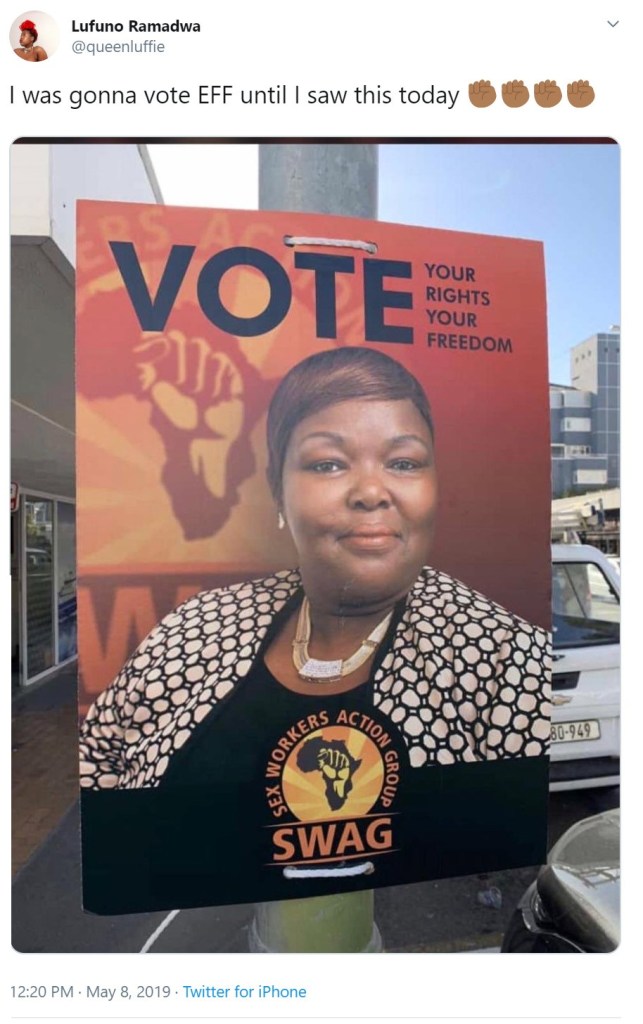
Playing politics: so what do you do to get your voice heard – as a small South African sex workers rights advocacy organisation -during an election campaign? Run for President!

Picture above: ‘Campaign’ materials for SWAG. Reproduced by permission

Ishtar Lakhani

Studies show that female sex workers are 18 times more likely to be murdered than other women. As a result of criminalisation, stigma and discrimination, sex workers are unable to report violence perpetrated against them by clients, law enforcement officials and members of the community. Criminalisation also increases risk of violence as sex workers have to work in isolation far from the reach of healthcare and justice services and have no access to labour protection for the work that they do. As sex worker rights activists in South Africa we decided that the best way to ensure that sex workers and their issues are represented in political spaces, was to create our own sex worker-led party, as the saying goes, nothing about us, without us. 

It is 2019, time for South Africa’s general election. The media is bloated with the usual pre-election diet of scandal, corruption, and political statements. I am in a meeting having the usual vent about the state of our nation with a collection of social justice activists. Many of the organisations represented in the room have decided to lay low until the election is over, reasons being: “trying to get the media to cover anything that isn’t election related right now is useless” and “what’s the use of lobbying, in 3 months’ time we’ll have start again with new people?”. I understand these approaches. Given the serious lack of resources experienced by social justice organisations, it is essential to pick your battles wisely. It is necessary to be strategic on when, where, how and on what you deploy your ever-shrinking reserves of energy, time and money.

However, we at the Sex Workers Education and Advocacy Taskforce (SWEAT) saw the 2019 South African National Elections as a prime opportunity to deploy our creative activism. 

At SWEAT (a South African based human rights non-profit), a core part of the work is advocating for the full decriminalisation of sex work in South Africa. This position is supported by rigorous research, international human rights frameworks, and most importantly, by people who sell sex themselves, so I will not dive deeply into why you should support decriminalisation. Merely to say, if you support human rights, you should support decriminalisation. Now back to the elections. 

We asked ourselves: in a pre-election context, how do little-old-us gain access to these influential spaces and people? We certainly did not have access to the kind of money needed to buy a plate at political fundraisers. None of us had any desire to learn how to play golf. And we did not have the patience or moral ambiguity to implement the long-game strategy of joining a political party, rising through the ranks and eventually become president. So, we thought: if we can’t beat them, join them. 

The idea of a sex worker for president is not new. Emboldened by the story of Gabriela Leite, the first sex worker to run for Brazilian Congress in 2010, we decided to start our own sex worker-led political party. SWAG, the Sex Worker Action Group (to be perfectly honest, we chose the acronym before we chose the name because who doesn’t like a good acronym?). Now that we had a name, we could really start organising. But when we looked at what it would take to formally register SWAG, the wind was quickly taken out of our sails. None of us had the stamina to climb Mount Bureaucracy. We looked back on our campaign objective: to put sex workers rights on the political agenda. Surely we didn’t have to have an “officially” recognised political party to do that? And so we decided to confidently ignore and navigate ourselves around Mount Bureaucracy. We created a logo and campaign badges, t-shirts and posters (a campaign isn’t a campaign until you have SWAG). We placed our realistic political party posters up on lamp posts directly under our oppositions. With the help of social media we only needed a handful of posters strategically placed and photographed at multiple angles to give the illusion we had national coverage. We even filmed a low budget but surprisingly convincing campaign video, complete with our candidate shaking hands with hard working people, kissing babies, and saying inspiring one-liners like “Your Rights, Your Freedom, Your SWAG”. 

Video above: SWAG campaign 2019. Source: Youtube.

So, what did all this “fun and games” really achieve one might ask? Firstly (and importantly), it was enormous fun. When you are involved in the serious work of human rights activism, there is very little frivolity and burnout is common. This campaign gave us and our organisation a much needed energy boost. Secondly, people believed the campaign!

We were caught off-guard at the amount of support we received. This led to conversations, platforms and events where we could talk about the rights of sex workers in South Africa.

It became abundantly clear that South Africans were hungry for something different and more progressive than we had given them credit for. Finally, one of the biggest impacts of our SWAG Campaign was that the 2 largest opposition political parties both included the rights of sex workers as an issue that needs addressing in their election manifestos, something that has never been done before.

Image reproduced by permission of SWEAT (Sex Workers Education and Advocacy Taskforce)

This Campaign showed us what we could really achieve with a passion for human rights, a little bit of money, and a lot of SWAG. 2024, watch this space! 

Ishtar Lakhani is a feminist, activist and trouble maker in the field of social justice advocacy. Her passion lies in using creative activism to advocate for the rights of sex workers and the full decriminalisation of sex work in South Africa.

You can find her on twitter @IshtarLakhani