DAY FOURTEEN: No Problem, I understand : digital antagonism and the algorithm

Zelda Solomon discusses the problems of digital discrimination and the racist underpinnings of algorithms, through the incident with An Nguyen, a Vietnamese curator due to exhibit at the Affordable Arts Fair, only to be rejected because of the Covid-19 pandemic and its associations with ‘Asianness’.

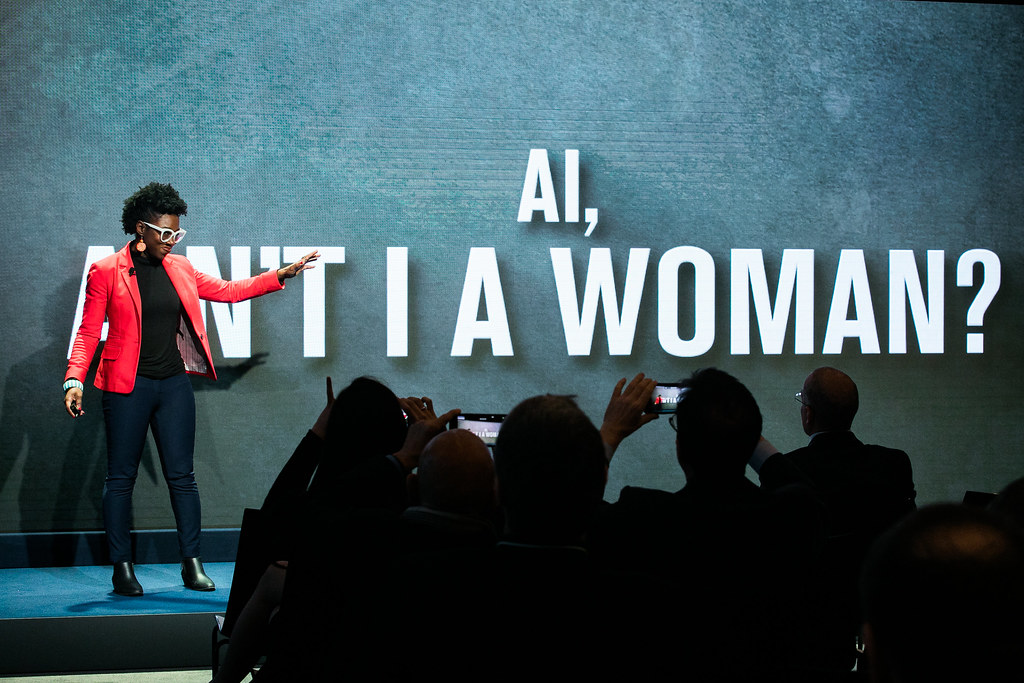
Picture above: “Compassion through Computation: Fighting Algorithmic Bias.” Credits: World Economic Forum. Source: Creative Commons.

Zelda Solomon

One of the first examples I saw of anti-Asian discrimination in response to corona-virus was that of An Nguyen, who is a Vietnamese curator that was due to exhibit an installation at the Affordable  Arts Fair in Battersea, UK last March. In a screenshot of an email posted to her social media, dealer Raquelle Azran wrote to her:

“The corona virus is causing much anxiety everywhere, and fairly or not, Asians are being seen as carriers of the virus. Your presence on the stand would unfortunately create hesitation on the part of the audience to enter the exhibition space”

and cancelled Nguyen assistance at the event. 

In her caption, An Nguyen wrote in response:

“It is the systematic structure of knowledge production that informs some of us that normalising non-aggressive discrimination is acceptable which needs to chang.e”
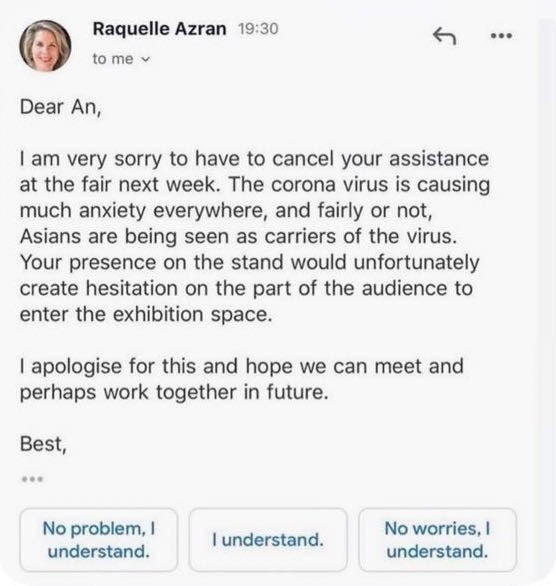
Picture above: Screenshot of the email sent by Raquelle Azran to An Nyuyen.

Re-reading these lines, I find myself turning to the suggested prompts. 

The phrases “No Problem, I understand.” “I understand.” “No worries, I understand” are written in inoffensive blue, padding the screen in discreet boxes. These are the outputs of an algorithm that likely recognised the phrases “sorry” and “cancel” in Azran’s email and generated the pre-written responses. I didn’t notice them on my first reading, which I assumed was due to my eclipsing outrage and identification with Nguyen. However, technology’s ability to evade suspicion is partly by design; input technologies like predictive text are built to optimise user efficiency, marketed as objective, neutral tools that serve only productivity. We are not meant to see any motive or meaning in them. 

In the bygone age of digital utopianism, Nguyen’s predictive text might be excused as a simple glitch. However, as theorists such as Ruha Benjamin and Saifya Noble have made clear, encoded bias is part of a larger, and growing, industry of control. 

One case study Benjamin references in her book “Race After Technology,” (2019) explores the racial weighting behind selective encoding, citing how Google Maps read the name “Malcom X Boulevard” as “Malcom 10 Boulevard.” She explains how from an industry perspective, the translation of roman numerals is a feat, revealing the racial biases behind technological ideals of progress. As Benjamin writes, the glitch is not an “aberration, but a form of evidence illuminating underlying  flaws in a corrupted system.”  

Women of colour are often found in the intersections of oppression in the new digital world.

Saifya Noble

Noble opens her text “Algorithms of Oppression” (2018) with a Google search experiment she conducted in 2014, where she found the search terms “Black girls” “Latina girls” and “Asian girls” resulted in pornography pages, while then same is not found when searching “white girls”. Noble outlines that the prioritisation of racist and sexist content when searching for women of colour is not solely reflective of user-desire, but a product of bias engineering masquerading as objective coding.
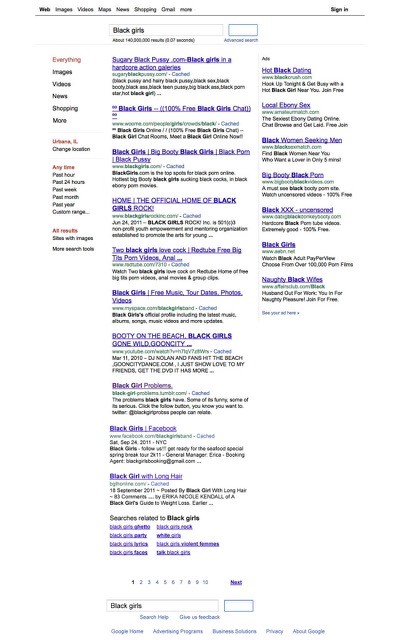
Noble, Safiya Umoja. 2018. “Google has a Striking History of Bias Against Black Girls” From Algorithms of Oppression: How Search Engines Reinforce Racism, ​Reprinted with permission by NYU Press, in TIME Magazine, MARCH 26.

The fact Nguyen’s device could interpret something as complex as human interaction but failed to recognise racism reveals what is categorised as valuable information. Nguyen’s exclusion is thus two-fold; the first at the hands of a gallerist who deemed her Asianness threatening, and the second at the hands of an algorithm that failed to recognise it. 

As Jennifer M. Piscopo eloquently outlined in last year’s blogathon, we are witnessing an age where women, and more-so women of colour, are receiving an onslaught of abuse online to the extent it is re-shaping what it means to be a woman in public life. Theorists such as Benjamin and Noble are building on this research, looking to the encoded systems that facilitate and reproduce oppression online. They encourage us to approach advancing technology with a critical eye, and refuse to greet the sexist or racist glitch with the predicted : “No problem, I understand.

References

Benjamin, Ruha. 2019. Race after Technology : Abolitionist Tools for the New Jim Code. Newark: Polity Press.

Noble, Safiya Umoja. 2018. Algorithms of Oppression : How Search Engines Reinforce Racism. New York: New York University Press.

Zelda Solomon is a 4th year History of Art student at Edinburgh University. She is on the Edinburgh College of Art Board for decolonising the curriculum and was previously the Black and Minority Ethnic Liberation Officer for Edinburgh University Students Association (EUSA). She co-founded the SexyAsiansInUrArea theatre company that recently released a short film on preforming Asian identity for RUMAH festival. She is currently focusing on how race is represented in the digital age. 

You can follow her on Instagram @zeldasolo

DAY THIRTEEN: A Women’s Trauma Recovery Centre: A Call to Action

While domestic and family violence is prevalent across Australia with a murder rate of one woman per week, there remains an absence of centres that offer support to women survivors over the long term. This post focuses on the establishment of a Women’s Trauma Recovery Centre, by the UNSW School of Public Health and the Illawarra Women’s Health Centre and their partners.

Picture above: Flyer for the Photographic Exhibition #voicesforchange

Patricia Cullen and Sally Stevenson 

Domestic and family violence is a public health emergency and occurs in epidemic proportions in Australia. One woman a week is murdered. One in three have experienced physical violence since the age of 15. One in six have experienced emotional abuse by a current or former partner. 

But what is so often missed in the reporting of domestic violence, the reporting of cold-blooded murders, of vicious assault, of long-term abuse – all acts of violence akin to crimes of war is what happens after. What happens over time, in the years and decades after the abuse has stopped, or the women and children have managed to escape their own private conflict zone. 

Vicki Roach – survivor and advocate. Photograph by Sylvia Liber. Reproduced by permission

Research shows – clearly and without doubt – that left untreated, the traumatic consequences of domestic and family violence can have lifelong physical and mental health consequences. They are significant, long lasting and evidence-based; impacting women, children, future generations, our community, our economy and ultimately, our country. 

Research shows – clearly and without doubt – that left untreated, the consequences of domestic violence result in increased rates of heart disease, diabetes and chronic pain, increased rates of mental health disorders including anxiety, depression, post-traumatic stress and substance use, and are overrepresented in prison.

Research shows  – clearly and without doubt – that it has a devastating impact on the development and wellbeing of children. 

But we don’t talk about that. And we certainly don’t provide adequate and accessible publicly-funded services that support women who continue to suffer the trauma and pain that the violence and abuse has embedded in their bodies and their minds – that remains long after the violent hands, the abusive and demeaning words and all the controlling behaviours of their intimate partners has stopped. We’d rather not think about it, we’d rather not pay for it, in fact as a society we’d really rather not be bothered about it. 

Women recovering from complex trauma and PTSD caused by family or intimate partner abuse require a range of support services depending on their circumstances: counselling, social support, parenting support, financial advice and support, and/or legal support. These services are most efficiently and effectively provided in one -safe- place, from a case managed team of professionals. 

There is no such service or centre available anywhere in Australia. 

There is nowhere in the public health system, or across the community service sector, where women can access integrated, comprehensive long-term support to recover from the health impact of complex trauma. 

And that’s why we – the UNSW School of Public Health and the Illawarra Women’s Health Centre – with our partners are campaigning to establish a Women’s Trauma Recovery Centre

This specialised Centre will offer a whole-of-organisation trauma sensitive approach that enables recovery from domestic and family violence trauma and helps to break the intergenerational cycle of violence. A range of holistic, and free, health, legal and psychosocial services will be provided. The Centre represents an investment that will provide significant financial and social returns to both the Commonwealth and NSW Governments, and the community. As a first of its kind in Australia, and designed to be easily replicated across the country, it will transform domestic, family and sexual violence response and recovery services

As part of our campaign during the 16 Days of Activism, we are holding a photographic exhibition: Resistance, Resilience and Recovery

‘Women resist violence, are fundamentally resilient – and have the right to recover from domestic and family abuse. We are calling on the community to support this right to recover.’

The exhibition is a community ‘call to action’ to support the establishment of Women’s Trauma Recovery Centre. The images here are from that exhibition, taken by award winning photographer Sylvia Liber.  

For more information, visit the Womens Trauma Recovery Centre’s website and Facebook

Dr Patricia Cullen is a Research Fellow and Co-lead Child and Adolescent Health Theme Early Career Fellow, at the National Health and Medical Research Council Population Health, UNSW. Sally Stevenson AM is the General Manager of the Illawarra Women’s Health Centre.

DAY TWELVE: City Lights for Social Change

To mark 2020 16 Days of Activism theme ‘Orange the World: Fund, Respond, Prevent, Collect!’ Australian academics worked with local authorities to turn their City orange.

Picture above: Civic Park in Newcastle, New South Wales being lit orange to mark 16 Days of Activism. Photo by Eddie O’Reilly, UON Marketing and Communications. Reproduced with permission.

Effie Karageorgos and Kcasey McLoughlin

In 1991 the Center for Women’s Global Leadership instituted the 16 Days of Activism against Gender-Based Violence, which has now spread to over 187 countries. It begins on 25 November, the International Day for the Elimination of Violence against Women, and ends on 10 December, Human Rights Day. In 2020, the University of Newcastle’s Gender Research Network has responded to the 2020 16 Days of Activism theme ‘Orange the World: Fund, Respond, Prevent, Collect!’ by turning Newcastle orange.

The Gender Research Network, established and led by Associate Professor Trisha Pender, has embarked on a Program in Gender-Based Violence research and activism in 2020, aided by a $70,000 University of Newcastle Faculty of Education and Arts Pilot Grant. Spanning sociology, history, law, literary, gender and cultural studies, the Gender Research Network aims to collaborate with local frontline services to tackle the urgent issue of gender-based violence.

The academic research funded by the project will cover legal conceptualisations of family violence, male clergy perpetration of sexual violence, media presentations of gendered and sexual violence in mainstream television and French and Australian media, the #MeToo movement and the relationship between historical Australian archetypes of masculinity and media representations of male violence.

Associate Professor Trisha Pender at the launch of the Newcastle 16 Days of Activism campaign to end violence against women, held in Civic Park, Wednesday 25 November 2020. Photo by Eddie O’Reilly. Reproduced with permission.

The impetus for this program has emerged from the alarming scale of gendered violence in Australia, with one woman murdered each week by an intimate partner. Gender-based violence is a pressing social and human rights issue that causes long-term physical and psychological effects and costs the Federal Government billions of dollars every year.

It is also a contentious issue in Australian society, with proposed legal reforms such as Victoria’s move to ban the public disclosure of names of sexual violence victims and New South Wales Labor’s push to criminalise coercive control causing widespread and impassioned debate from victims, victim advocates and researchers. The Program in Gender-Based Violence will not only address male perpetrators of violence against women, but also violence affecting LGBTIQ communities and children. It seeks to define how gender-based violence is reported and conceptualised within society.

A central facet of the Gender Research Network’s program in gender-based violence is the 16 Days of Activism to End Violence Against Women campaign. The Network was awarded a Newcastle City Council SBR (Special Business Rates) grant for ‘City Lights for Social Change’, which has created a permanent lighting infrastructure for Civic Park. This turned the park orange for the 16 Days in 2020, but will also create a safer public space at night for Newcastle residents and will be available for use by other social change campaigns in the future. In 2020, the University of Newcastle also committed to turning the NUspace building on its city campus orange, and the Newcastle City Hall’s Clock Tower will also turn orange for the 16 Days of Activism from 25 November to 10 December.

NUspace at University of Newcastle being lit orange to mark 16 Days of Activism, a campaign focusing on preventing violence against women. Photo by Eddie O’Reilly. Reproduced with permission.

The launch and vigil of 25 November took place at 8-9pm, featuring Associate Professor Trisha Pender, with the support of the New South Wales Police Force. Pender was joined by a range of speakers from community organisations, including ACON Health and Warlga Ngurra Women and Children’s Refuge, as well as Federal Member for Newcastle Sharon Claydon and City of Newcastle Councillor Carol Duncan. During the vigil, the names of the 45 women killed by violence in Australia in 2020 was read out by a group of domestic violence researchers and activists.

Image from the Newcastle launch of 16 Days of Activism campaign to end violence against women, held in Civic Park, Wednesday 25 November 2020. Photo by Eddie O’Reilly. Reproduced with permission.

The Gender Research Network’s contribution to the 16 Days campaign also included a webinar on the current push to criminalise coercive control in New South Wales. The session was facilitated by Dr Kcasey McLoughlin, Senior Lecturer in Law, and featured Laura Richards, prominent activist and behavioural analyst from the United Kingdom, Hayley Foster, Chief Executive of Women’s Safety NSW, and State Member for Shellharbour Anna Watson, who was responsible for introducing the bill to criminalise coercive control to the New South Wales Parliament.

The recording of the Coercive Control seminar of 30 November 2020 is available online.

Effie Karageorgos is a historian and member of the Gender Research Network at the University of Newcastle. Her research is in the social history of war, and specifically histories of masculinity and trauma. Her monograph Australian Soldiers in South Africa and Vietnam: Words from the Battlefield was published in March 2016. 

Kcasey McLoughlin is a Senior Lecturer in Law at Newcastle Law School and a member of Gender Research Network at the University of Newcastle. She is currently a visiting Scholar at the Australian Human Rights Institute (UNSW). Her research, broadly defined, concerns the gendered values that shape political and legal institutions and the extent to which law can be used as a tool for achieving equality.  

DAY TWELVE: Violence Unseen Reimagined – arts activism in the time of COVID-19

When the pandemic curtailed the travelling exhibition Violence Unseen, the organisers had to reassess. And they re-imagined and ‘digitally painted’ the images onto cityscapes.

Jo Zawadzka

Violence Unseen Re-Imagined is an online photography exhibition that aims to put unacknowledged and often unseen forms of violence against women on the map.  

The images used in this exhibition were originally created by the photographer Alicia Bruce, then re-imagined and ‘digitally painted’ onto the city landscapes by the visual artist Szymon Felkel.  

Before the pandemic curtailed the Violence Unseen exhibition’s travels, it was displayed in around 40 locations across Scotland, and seen by around 2000 people.  

However, with COVID-19 measures forcing a mass shift to online campaigning in recent months, our travelling Violence Unseen exhibition has taken on new significance and moved online. The Re-imagined exhibition features the Violence Unseen images in public spaces to convey the message that, whilst often hidden, violence against women hasn’t disappeared. In fact, it has been exacerbated by the pandemic.  

The forms of violence against women featured in the exhibition are not new, but some groups of women are more vulnerable to certain types of violence. This is especially true for women who face other forms of discrimination, such as women with learning disabilities, women who sell sex, lesbian, gay, bisexual, trans women, and minority ethnic women. Moreover, we know that lockdown has acted as an enabler for perpetrators and made violence against women even less visible to the public eye, making getting this campaign seen by the public, even more important.  

Alongside the re-imagined images, we will be sharing links to research, articles and projects to help to broaden understanding of the impact of COVID-19 on violence against women. I would therefore like to spotlight three of our images here, as examples of our informative campaign. 

Picture above: Diane by Alicia Bruce/Szymon Felkel. Reproduced by permission of Zero Tolerance

Our first image features Diane Abbott with the backdrop of the houses of Parliament. This image is a significant representation of Violence Against Women in Politics and Elections (VAWIE). VAWIE was extremely prevalent during the run up to the 2017 snap election in which 45.14% of all abusive tweets were directed at Abbott, largely focussed on her gender and her race, largely in the form of threats of sexual violence.

Understanding intersectional discrimination is essential to understanding Violence Against Women and Girls, the different ways violence is enacted, and the varied impacts it can have on people who are multiply marginalised. 

Picture above: Margaret by Alicia Bruce/Szymon Felkel. Reproduced by permission of Zero Tolerance

The second image I want to focus on is of Margaret, very powerfully superimposed onto a Princes Street bus stop. This image discusses disabled women and carer abuse. Disabled women are twice as likely to experience men’s violence as non-disabled women, and 73% of disabled women have experienced domestic abuse. This image is captioned “How are you supposed to get anyone to believe you if everyone thinks he is a ‘Saint’ because of how he helps you?”, emphasising how much abuse towards disabled women goes unseen, diminished, and un-prosecuted.  

Picture above: Mridul by Alicia Bruce/Szymon Felkel. Reproduced by permission of Zero Tolerance

Mridul Wadhwa’s image has been ‘digitally painted’ onto the side of the Scottish Parliament building, thus placing a trans, migrant woman who describes how she is seen by the world as “outsider everywhere”, straight into the political sphere. 83% of trans women have experienced a hate crime, whilst migrant women’s experience of ‘No Recourse to Public Funds’ can leave them more vulnerable to violence. This demonstrates another way multiple marginalisation can lead to increased exposure to violence. 

Visit virtual exhibition here

An accessible version can be found here

See also Day 10 Blog by Alicia Bruce

Please note that some of the content in this exhibition deals with sexual violence, abuse and exploitation which some people might find upsetting. Some of the women featured in the pictures are models. 

List of helplines for anyone who lives in Scotland is available here:

Jo Zawadzka is Campaigns and Engagement Office for Zero Tolerance, the Scottish charity that works to end men’s violence against women by promoting gender equality and challenging attitudes which normalise violence and abuse. Their work began in 1992 with a series of mass media campaigns designed to raise awareness and challenge attitudes about violence against women. Today their work continues to challenge the social attitudes and values which permit violence to occur. They take a practical, evidence-based approach targeting primary prevention of violence and promoting change. 

Throughout the 16 Days of Activism, Zero Tolerance will be sharing our seven images across their social media platforms. They will also be available for campaigning purposes – if you are interested in accessing their Violence Unseen Re-imagined resources, please contact Jo at jo.zawadzka@zerotolerance.org.uk.  

You can find Zero Tolerance Scotland on Twitter @ZTScotland, and on Facebook and Instagram @ZeroToleranceScotland. Their website is www.zerotolerance.org.uk

The photographer, Alicia Bruce can be found on twitter @picturemaking, instagram @aliciabrucephoto and her website at www.aliciabruce.co.uk. Szymon Felkel, the arts activist, can be found on instagram @szymon_felkel and at their website at www.saymoonstudio.com.

DAY TEN: ‘My pain became my beautiful testimony’: breaking the silence on the sexual abuse of girls

“There is great power in our voice.”
Nigerian author and activist Fatima Ishiaku turned her traumatic past into a memoir – and a beacon of hope for young girls like her.

Fatima Ishiaku

In our society, a lot of youthful and defenseless adolescents are victims of malicious rape. 

These streaks of sexual brutality affect them substantially, physically, psychologically and otherwise.

Such acts of violence and sexual harm turns into a route that contributes to so many other social vices and often a path to the self-destruction of these unprotected young girls if they don’t find help.

If these acts of brutality don’t get nipped in the bud, it will shatter the fabric of our society and the world at large.

Often, victims are forced and intimidated to stay mute in the face of a vicious series of violent rape. 

These threats and coercion makes it a struggle for victims to open up to anyone about such issues. And when victims finally open up, they get bullied by the people they confide in to tell their stories, an act that renders them psychologically and emotionally traumatized.

These adolescents end up getting impregnated by their rapists, a condition they find themselves unprepared for, bearing a child at an early age. Some opt for abortion and often die in the process.

For those that survive, it becomes a psychological disorder that makes these youthful and defenseless girls find comfort in alcohol, drugs, and other social vices. Some of them even end up as school dropouts due the effect of rape and the consequences become endless.

Victims most times are very vulnerable, rude, disrespectful, and aggressive. Because of what they’ve been through their lives becomes miserable. They live in fear, hardly trusting anyone and often becoming wild. 

Look around you today – there are so many vulnerable children on our streets, many of them are drug addicts and a substantial number of them are victims of sexual abuse. As humans, we need to understand that the abused child is fighting a battle caused by a terrible experience.

Therefore, I believe “they need love not hate, help not bully and a confidant they can trust.” We need to help them discover their inner strength and God-given talent, because the event of rape makes them regard themselves as weak, useless and vulnerable. These helpless girls need the inner strength to help them fight their fears and weaknesses.

My story is a precedent of what defenseless young girls go through.

As a victim of sexual abuse, I was molested from the age of seven till I was fourteen. This is the most awful experience of my life. 

I grew up with a man I thought was my dad, not knowing he wasn’t. And he took advantage of my innocence at a very tender age.

He made my mum despise me so much that we became enemies. To him, that was the only way to make my mum not to listen to me whenever I tried telling her what I was going through.

My mum hated me so much that she had broken my head with a rod so many times, cut my vagina, and put hot chili pepper on the cuts.

She didn’t find out why a calm child like me became so stubborn or why I started running away from home from the age of 10. Whenever I returned home, she would beat me and put hot chili pepper in my eyes and on my private parts.

She only believed what her husband told her. 

When I turned 14 years old, she found out that I had been sexually assaulted by her husband. Around this time, I found out that her husband wasn’t my dad. Two years after my mum discovered her husband molested me, she couldn’t deal with it. She died, and the rape continued.

I remember trying to commit suicide so many times. 

I dropped out of school and most of the men that got to know my story called off our engagement. Whenever these men find out about my story, they say they “can’t be with a lady like me”, that I’m a “cursed child.”

This is a cross I still carry till today.

In the year 2016, in the United States of America, an American Professor heard my story and advised me to write a book about my life. 

It wasn’t a straightforward thing to do, but finally I had the courage to publish my book, which I entitled “I Called Him Dad” by Fatima Ishiaku – a book that was published in the United States.

I had to tell my painful story in my book so that society will see what abused girls go through in our society, mostly In Nigeria. 

My book is about saving the girl child and breaking the silence. It’s a very educational book based on my true-life story. “I Called Him Dad” is my painful story.

The best part is me using my painful story to help victims like myself.

There’s light at the end of the dark tunnel. 

My pain became my beautiful testimony.

Today I run a registered non-governmental organization “House of Fatima for Abused Girls Foundation”. This foundation caters to the needs of sexually abuse girls and boys in our society. I finally went back to school and now I am a graduate of Sociology from one of the best Universities in Nigeria. 

I’m using my story to help victims, to educate mothers on how they can protect their children from sexual abuse and help parents identify the signs to look out for. I emphasise the need for parents to listen to their children whenever they want to talk to them. To read the complete version of my story you can pick up my book on Amazon. Use this link: https://amzn.to/3mz5JeW

As I conclude, everyone, both old and young needs to understand that there is power in their voice and that they should never allow anybody to silence them. Speaking out will make a difference. It will expose the intent of rapists and bring to justice those that are into these acts.

  • “We say No to any kind of abuse.”
  • “We stand against gender-based violence.” 
  • “We stand against child marriage.”

Every girl child deserves an education and it is her fundamental right to be happy.

There is great power in our voice. 

You can visit our social media for more information:

Website: houseoffatima.org

Instagram: @houseoffatima_ng

Twitter: @houseoffatimang

Facebook: House of Fatima for Sexually Abused Girls