Welcome to the 16 Days Blogathon 2021. From November 25 – December 10 we will be posting voices, stories and insights to raise awareness of the 16 Days of Activism Against Gender-based violence.
Today is the International Day for the Elimination of Violence Against Women and the beginning of the 16 Days of Activism Against Gender-Based Violence which runs from 25 November to 10 December, Human Rights Day. Welcome to Day One of our annual blogathon bringing together voices from academia, activism, art and media to raise awareness of this ongoing struggle. The blogathon marks a continuing collaboration between the University of Edinburgh, Dr B.R. Ambedkar University, Delhi, and the University of New South Wales.
This year our theme is Histories, Legacies, Mythsand Memories. It is 30 years since the 16 Days of Activism campaign was first launched by the-now Center for Women’s Global Leadership at Rutgers University in the States, and more than 50 years since feminists of the so-called Second Wave women’s movement began mobilising to expose, confront, and campaign for the elimination of violence against women. We reflect upon these contemporary histories and lessons, including reflections from Australia and the UK. But we also take the longer view with posts exploring manifestations of gender-based violence – sometimes hiding in plain sight – through the centuries. Listening as past voices surface — from the archive, or through myth, traditional songs and stories, or via truth-telling criminal and media investigation — highlights striking continuities of lived experience and feeling, of societal and cultural stigma, and of strategies of resistance.
There has sometimes been a reluctance by scholars and curators to fully acknowledge the historical traces of gender-based violence, whilst others struggle with the ethical dilemmas and emotional costs of recovering these marginalised stories of trauma, injustice and agency.
Over the next 16 Days we will travel from Australia to India, Scotland to the Caribbean, and Mexico to England. Our contributors take us from Ancient Rome to a squat in 1970s Sydney; from Scotland in the 1500s to the partition violence of 1940s India. We meet women seeking justice through medieval courts and modern true crime podcasts; we hear stories of abuse and survival from epic myths and traditional songs from India and Europe; we share the dilemmas of educators and curators; we learn about the struggles of marginalised and racialised women for justice and support both within their own communities and wider societies; and we reflect on lessons to be learned from both contemporary and ancient histories.
Ultimately, a focus on histories, legacies, myths and memories gives us a very important tool. It helps us to identify more lucidly what is unique and distinct about the moment and location we inhabit. It reinforces our understanding of the ubiquity of gender-based violence as well as the ways that the modes and experiences of gender-based violence are shaped by intersecting structures and identities of difference and inequality.
It helps us to understand where we have come from, and the continuing resonances of the past over the long haul of time. And it helps us to imagine where we want to go.
We launch our 2021 Blogathon with a powerful contribution by award-winning Scots singer and composer Karine Polwart who surfaces stories of sexual and gender-based violence in traditional music and oral traditions and their contemporary relevance.
Content note: posts inevitably address distressing experiences and issues around sexual and gender-based violence. We hope they also provoke, energise and sometimes uplift.
The 2021 curators:
University of Edinburgh: Prof. Fiona Mackay (Director) and Aerin Lai (PhD web and editorial assistant) for genderED; Dr. Zubin Mistry (Lead), Prof. Louise Jackson, Prof. Diana Paton, Dr Hatice Yildiz, for the Histories of Gender and Sexualities Research Group.
Dr B R Ambedkar University Delhi: Prof. Rukmini Sen (Director, Centre for Publishing), Dr Rachna Mehra (School of Global Affairs).
University of New South Wales: Prof. Jan Breckenridge (Co-Convenor), Mailin Suchting (Manager) and Georgia Lyons (Research Assistant) for the Gendered Violence Research Network.
Our annual 16 Days of Activism against gender based violence will be back soon with a new theme – Histories, legacies, myths and memories – this year. Here’s an exclusive sneak peek on our vision statement for the year.
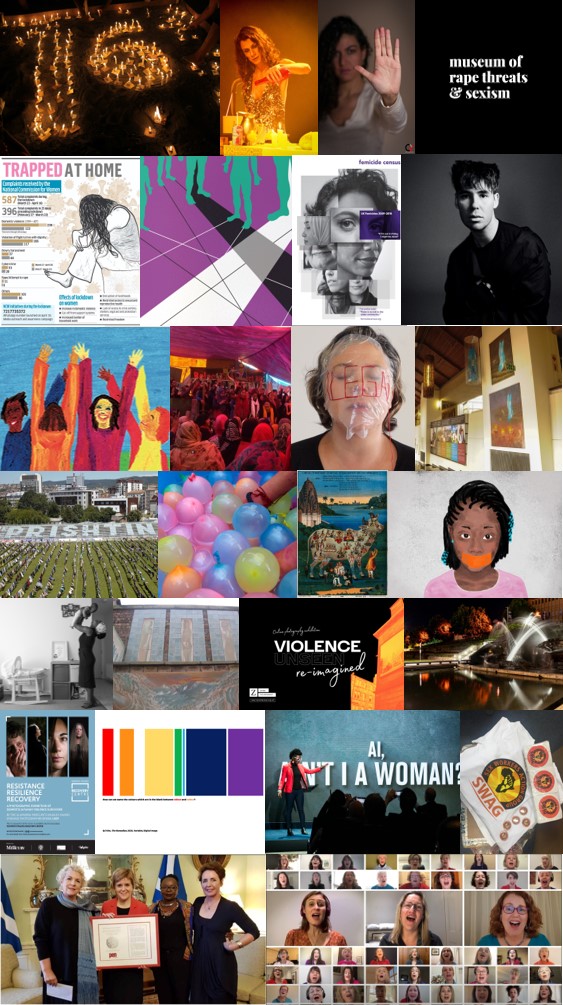
Image above: Montage of posts from 16 Days Blogathon 2020
Coming Very Soon! We are one week away from the beginning of our annual 16days blogathon campaigning against Gender-Based Violence (November 25-December 10). We are excited to announce that 2021’s focus will be on histories, legacies, myths and memories, led from Edinburgh by the Histories of Gender and Sexualities Research Group. As always, during our 16 days marathon of blogposts, we will feature posts from academics, students, activists, practitioners, artists and survivors (noting that these categories are not exclusive).
We will explore the connection between past and present, highlighting the historical and longitudinal dimensions that have shaped narratives, experiences and activisms surrounding gender-based violence today. In doing so, we hope to draw attention to voices and perspectives from multiple geographies and time periods (from antiquity to the very recent past) accessed through the formal archive and oral history as well as through literature and the creative arts, including traditional music, poetry and storytelling.
Through legend, myth and collective memory, the past shapes contemporary understandings and narratives of gendered violence but can also be used as a resource in cultures of resistance.
The residues and traces of the past connect us through common humanity and through women’s shared though not identical experiences of living in patriarchal societies.
Ultimately, we hope that this year’s theme will help us to identify what is unique and distinct about the ‘where’ and ‘when’ we inhabit, what came before, and how to get to where we want to be.
Here are some of our contributions for this year:
Anne Summers, Where it all began – Almost 50 years on, Anne Summers writes about the opening of Elsie Women’s Refuge in 1974.
Maha Krayem Abdo OAM, Bringing back hope – In working towards a domestic and family violence free Australia, Muslim Women Australia (MWA) use faith as a tool for empowerment.
Claire E Aubin and Emily Rose Hay, Duties of care – The Emotionally Demanding Histories Group asks, how do we ensure emotionally engaged researchers are not harmed during the process while bringing justice to past stories?
Tanuja Kothiyal – While we expect oral traditions which provide voice to marginal communities and groups, to create space for women’s voices, even in these traditions women’s locations remain marginal and mostly with respect to the male figures.
Monimalika Day – Sometimes, apparently simple words such as respect and trust open a Pandora’s box, the answers to these uncomfortable questions about human relationships cannot be found in the curriculum…can we assume that family is a safe space? Can we assume any relationship to be safe?
You can read the full vision statement for this year’s 16 Days Blogathon below.
University of Edinburgh: Prof. Fiona Mackay (genderED), Dr. Zubin Mistry (lead, Histories of Gender and Sexualities Research Group), Prof. Louise Jackson, Prof. Diana Paton, Dr Hatice Yildiz, Aerin Lai (PhD web and editorial assistant) for genderED and Histories of Gender and Sexualities Research Group
Dr B R Ambedkar University Delhi: Prof. Rukmini Sen (Director, Centre for Publishing), Dr Rachna Mehra (School of Global Affairs)
University of New South Wales: Prof. Jan Breckenridge (Co-Convenor), Mailin Suchting (Manager) and Georgia Lyons (Research Assistant) for the Gendered Violence Research Network.
It’s a wrap! We’ve reached the end of #16daysblogathon! It’s December 10th, Human Rights Day and the final day of the global 16 Days of Activism 2020
The 16 Days Blogathon Team
Today is International Human Rights Day and the final day of the 16 Days of Activism Against Gender-based Violence for 2020. We have been sharing daily blog posts to raise awareness in our annual 16 Days Blogathon as part of our commitment to the ongoing struggle to put an end to gender-based violence around the world, once and for all.
How often have you heard the phrase ‘Due to #COVID19…’ this year? In 2020, the global COVID-19 pandemic has loomed large – exposing and exacerbating deep and intractable social, political and economic inequalities and vulnerabilities to gender-based and intersectional violence for women and members of marginalised groups. Lockdowns and restrictions on movement have thrown the spotlight on the ‘shadow pandemic’ of domestic violence and underlined the grim reality of “home” for many women and LGBTQ people.
This year, our main theme has been arts-based and creative responses to gender-based violence and we’ve been honoured to share the blogathon with a wonderful array of artists, writers, musicians, playwrights and performers. They join activists, academics, students, and survivors – noting that the boundaries between all these categories blur.
We’ve posted stories, reflections and performances from around the world. From Scotland to Brazil, from Australia to Nigeria, and from South Africa to India. Through images, video and text we have shared ideas, experiences and acts of remembrance and resistance that have been sometimes harrowing and challenging but always illuminating and, ultimately, hopeful.
On Day Eight, we explored art installations that play a role in transitional justice efforts. The Blue Dress in South Africa and Thinking of You in Kosovo (and travelling) provide alternative ways to remember and address women’s experiences of sexual and gender-based violence in conflict situations.
Gender-based violence still exists everywhere and in multiple forms
Gender-based violence and abuse is still happening across the world, in private homes, workplaces, and in public spaces. And it is comes in many different forms, a number of which we have covered in the last 16 days including domestic violence , psychological abuse, femicide, and mass conflict related sexual violence . The Covid-19 pandemic has forced much of our lives online, and has exposed the rise and variety of gender-based and intersectional violence and abuse online.
On Day Four of the 16 Days Blogathon, the UK Femicide Census released its ground-breaking report analyising ten years of men’s fatal violence against women and girls in the UK. Karen Ingala Smith, co-founder and Director of the UK Femicide Census, gave an in-depth look at the findings of the report and what it outlines for the future.
On Day Eleven, Scottish lawyer Claire Mitchell QC – who fights contemporary miscarriages of justice in her day job – together with author Zoe Venditozzi shared their campaign The Witches of Scotland. Claire and Zoe hope their campaign will highlight historic miscarriages of justice and the persecution and murder of women during the witch hunts of the 16th-18th centuries in Scotland. The campaign also hopes to expose the accusations of witchcraft that continue to be used to persecute women and girls in other parts of the world.
Speaking out and speaking up has always carried risks for women, whether in the real or the virtual worlds. On Day Fifteen, Margie Orford traced how old and how deadly this taboo is on women’s free speech and their safety. The International PEN Women’s Manifesto takes stand against the vilification and censorship of women activists, artists, writers and journalists – and provides a powerful tool to fight for women’s right to free speech and creative expression.
Focussing on online abuse: on Day Two, we read a personal account from interdisciplinary artist and activist Megan Bellatrix Archibald who attracted persistent online misogynistic threats after going public with a campaign, and quickly realised there is much progress to be made surrounding technology and the law. The Museum of Rape Threats and Sexism post on Day Three provides inspiration in terms of sharing and resisting online abuse. Through a digital installation, Isha Yadav is bringing the experience of digital harassment, usually suffered by women as individuals in private, into the public space in an act of collective reckoning.On Day Fourteen, Zelda Solomon outlined more subtle violence and the difficulties we face in fighting bias when it is encoded into algorithms; where “women of colour are often found in the intersections of oppression in the new digital world.”
Creative acts of resistance are happening everyday
Small and large acts of defiance continue to take place across the world. On Day One Jo Clifford wrote about her transgressive and transformative play Jesus, Queen of Heaven which continues to change lives in the face of transphobic hate and violence from Scotland to Brazil. Delhi is one of the most unsafe cities in the world for women but also a site of creative resistance: on Day Nine, Meenakshi Nair shared three stories of young women speaking out against gender-based violence and harassment through challenging impunity, spoken word videos and public dance performances. In Australia, two academics turned their park orange, in support of the 16 Days campaign, creating a safer public space for residents and paving the way for future social change campaigns. And the Zero Tolerance Unseen Violence Campaign projected powerful images on public buildings in Scotland. Meanwhile a group at UNSW School of Public Health are campaigning to establish of a Women’s Trauma Recovery Centre, the first of its kind in Australia. In South Africa – where criminalisation of sex workers increases their vulnerability to gender-based violence, a small advocacy group literally ‘played politics’ – intervening in the presidential elections to put the rights of sex workers on the agenda (Day Fifteen).
The voices of survivors have been central to the blogathon and their stories of courage and creative agency have been inspiring: from the Scottish young survivors (Day Six) to Australian Musician Jack Colwell’s haunting new work aired on Day Five which addresses the childhood trauma of domestic abuse from the vantage point of a young man. In conversation with award-winning photographer Alicia Bruce, the Scotland-Gambia anti-FGM campaigner Fatou Badeh talks about the image they co-created: “That year was one of the most difficult years in my life. But that picture for me shows; I see a defiant woman who refuses to give up, who refuses to be defined by her experience.” (Day 10) And as Fatima Ishiaku, author and founder of a shelter for sexually-abused girls, describes her act of memoire: “My pain became my beautiful testimony.” (Day Ten).
The blog posts in a nut shell
Every #16daysblogathon post is summarised below. While there is a long way to go before gender-based violence becomes an abuse of the past, there are many powerful and effective initiatives underway designed to protect, empower and centre the survivors of gender-based violence. This gives us reason to hope.
By Jo Clifford, Scottish playwright, performer and activist
In Brazil – a country that kills more trans women than anywhere else – performing trans art as resistance can be a matter of life and death. Jo Clifford, acclaimed author of plays and internationally known trans performer and activist, shares the story of actress Renato Carvalho’s experience performing in Brazil.
By Megan Bellatrix Archibald, interdisciplinary artist and Masters student at Edinburgh College of Art
Megan gives a powerful personal account of being threatened online after speaking out about the laws on hysterectomies in the UK, and being faced with an unhelpful police force when she sought help. She discusses the lag in progress between technology and the law in Scotland, and the difficulties faced by someone who experiences online abuse.
By Isha Yadav, Founder and Curator of Museum of Rape Threats and Sexism and PhD candidate in Women and Gender Studies at Ambedkar University Delhi
Isha Yadav introduces her curated art installation, The Museum of Rape Threats and Sexism, and her experience creating it with crowd-sourced screenshots of rape threats and sexist comments that women have received online for raising their voices for social justice. The installation brings the digital artifact (screenshot) into the physical space of the exhibition, making something normally experienced privately, public.
By Rukmini Sen, Professor of Sociology, Ambedkar University Delhi
What does the home mean to us? Rukmini focuses on India in her post, and while engaging with some of the reasons around the rise of domestic violence, she looks into the multiple meanings and metaphors associated with home that the pandemic has made us confront. In her writing she covers increased gender-based household work, access to technology, space, privacy, domestic violence, the implications for migrant workers and students.
By Natasha Chandhock, graduate student at the School of Design, Ambedkar University, Delhi
Natasha explores the ways in which dialogue-based design, or discursive design, can create safe spaces for Trans Binary and Trans Non-Binary identities – a need which has been significantly worsened in the Covid-19 pandemic. She suggests design has the capacity to produce triggers or nudges to make individuals reflect or realign their thinking, that journey mapping exercises could encourage empathetic ways of engaging with others, and design can be key in bringing the concept of non-binary into the everyday life.
By Karen Ingala Smith, co-founder and Director of the UK Femicide Census
This week the Femicide Census released a ground-breaking report analysing ten years of men’s fatal violence against women and girls in the UK. Karen Ingala Smith, co-founder and Director of the UK Femicide Census, gives an in-depth discussion of the report’s findings.
By Jack Colwell, Australian singer/composer and activist
Singer/composer Jack Colwell’s new work The Sound of Music addresses the childhood trauma of domestic abuse. It is ‘a dialogue between three people: myself at 28, myself as a child and the idea of my father.’ In his moving piece, Jack shares his experience of domestic abuse while growing up, and how he used music to work through childhood trauma.
By Ruth Friskney and Claire Houghton, University of Edinburgh.
This piece shares a range of innovative and creative projects young survivors in Scotland have organised to reach out to others experiencing domestic violence while mobilising support for domestic violence survivors, including websites, films, training videos and resources for professionals.
By Shwetha Gopalakrishnan, National Law University Delhi
Shwetha, a member of the Zanana Ensemble, tells the story of the Ensemble’s performance of ‘Zanana ka Zamana’ (The Era is Feminine), a collective act of resistance against the Citizenship Amendment Act in India through expressions of solidarity using songs, poetry and conversations.
ByMaria Adela Diaz, Guatemalan native and international performance artist
Performance Artist Maria Adela Diaz discusses her performance piece tackling psychological abuse of women during Covid-19. She gives an insight into what prompted her to create, and how she hopes the work will inspire women who may be trapped in an abusive situation to speak up.
By Eliza Garnsey, British Academy Postdoctoral Fellow in International Relations, University of Cambridge.
In this post, Eliza Garnsey explores how the powerful South African artworks ‘The Blue Dress’ provide an alternative record of women’s experiences of sexual and gender-based violence (SGBV)
By Maria Alina Asavei, Assistant Professor at the Institute of International Studies, Charles University Prague.
Maria’s piece focuses on women survivors of violence from war and conflict, centring artist Alketa Xhafa-Mripa’s Kosova installation, Thinking of You. She asks how the experiences of women affected by sexual violence from war can be highlighted through art, without further reproducing and perpetuating trauma.
By Meenakshi Nair, a student at SOAS, University of London
Delhi as one of the most unsafe cities in the world for women but it is also a site of creative resistance. In this piece, Meenakshi explores three acts of resistance by young women in Dehli against gender-based violence, including by filing police complaints, through spoken word videos, and performing in public spaces.
By Anisha Palat, PhD student at the Edinburgh College of Art
Anisha’s post focuses on the India artist-activist Sujatro Ghosh’s recent project Cow Mask project which highlights that, in India, women are seemingly less safe and less protected than cows.
This post shares a conversation between photographer Alice Bruce and Fatou Baldeh, an FGM campaigner providing space spaces for survivors of Female Genital Mutilation (FGM). Alicia photographed Fatou as part of the Zero Tolerance ‘Violence Unseen’ campaign launched in 2018. They reflect on the image they created together.
By Claire Mitchell QC , Scottish lawyer and author Zoe Venditozzi
The Witches of Scotland Campaign, set up in 2020 by Scottish lawyer Claire Mitchell QC, seeks pardons, memorials and apologies for the women who died in witch trials in Scotland between the 16th and 18th century. It is hoped that this campaign can shed also light on allegations of witchcraft and gender-based persecution that still occur in communities around the world.
By Jo Zawadzka, Campaigns and Engagement Office for Zero Tolerance
When the pandemic curtailed the travelling exhibition Violence Unseen, the organisers had to reassess. And they re-imagined and ‘digitally painted’ the images onto cityscapes.
By Effie Karageorgos and Kcasey McLoughlin, University of Newcastle
To mark 2020 16 Days of Activism theme ‘Orange the World: Fund, Respond, Prevent, Collect!’ Australian academics worked with local authorities to turn the city of Newcastle orange for the 16 days.
By Patricia Cullen, Research Fellow, National Health and Medical Research Council Population Health, UNSW, and Sally Stevenson, General Manager of the Illawarra Women’s Health Centre.
While domestic and family violence is prevalent across Australia with a murder rate of one woman per week, there remains an absence of centres that offer support to women survivors over the long term. This post focuses on the campaign to establish a Women’s Trauma Recovery Centre, by the UNSW School of Public Health and the Illawarra Women’s Health Centre and their partners.
By Qri Kim, PhD candidate at Edinburgh College of Art
How do we encapsulate the experiences and voices of those who occupy liminal spaces in society? Qri Kim writes about her project ‘Due To’, and the reconceptualisation of the Nomadian in her art.
By Zelda Solomon, History of Art student at Edinburgh College of Art
Zelda Solomon discusses the problems of digital discrimination and the racist underpinnings of algorithms, through the incident with An Nguyen, a Vietnamese curator due to exhibit at the Affordable Arts Fair, only to be rejected because of the Covid-19 pandemic and its associations with ‘Asianness’.
By Ishtar Lakhani, feminist and activist, South Africa
On day fifteen, this piece from Ishtar Lakhani outlines how she, and SWEAT, an advocate group for the health & human rights of sex workers and the Decriminalisation of Sex Work in South Africa, used politics to bring sex worker issues to the public stage, by running for president.
Silencing and censoring women’s free expression date back to ancient times. In this piece, Margie examines the impact of the PEN International Women’s Manifesto in the struggle for women to speak and write freely without censorship or violence.
The Hummingsong Choirs in New South Wales build “community”, bringing together women of all backgrounds and stages in life to sing, laugh, nourish their souls and build close-knit connections. The other important purpose is to extend support to those most vulnerable in the community, women and children escaping domestic violence.
It’s a wrap!
That’s the end of the blogathon to honour the 16 Days of Activism campaign for another year – but the struggle for women’s human rights and the end to all gender-based violence continues. Thanks to our wonderful contributors and to all of you who have read and shared these stories. Please keep reading and sharing, and we will be back in 2021!
The 16 Days Blogathon team:
Fiona Mackay, co-curator, Director of genderED, University of Edinburgh
Louise Chappell, co-curator, Director of the Australian Human Rights Institute, University of New South Wales
Rukmini Sen, co-curator, Director of the Centre for Publishing, Dr B.R. Ambedkar University Delhi
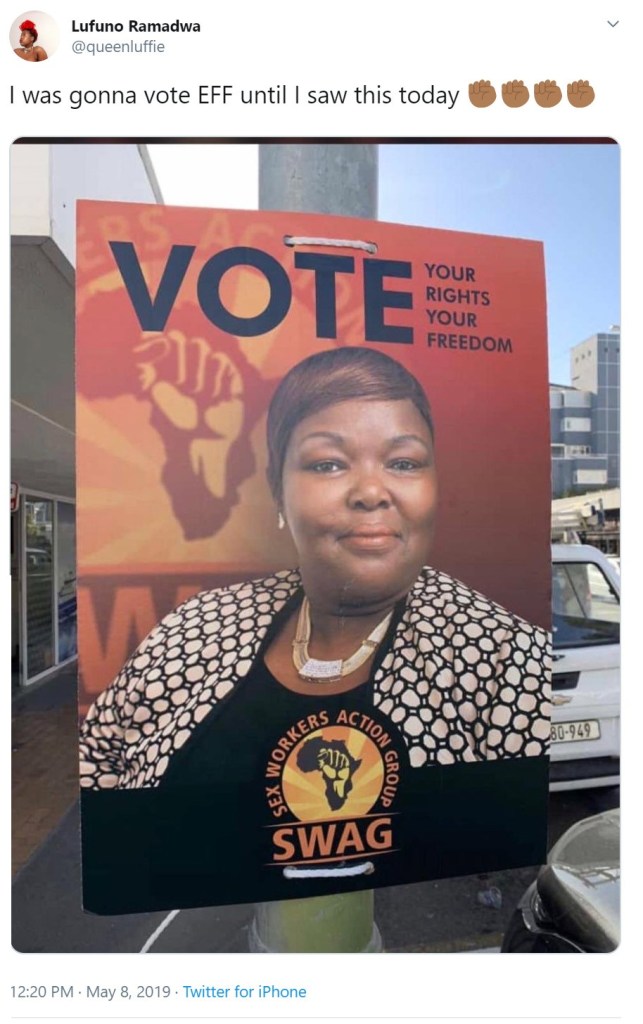
Playing politics: so what do you do to get your voice heard – as a small South African sex workers rights advocacy organisation -during an election campaign? Run for President!
Picture above: ‘Campaign’ materials for SWAG. Reproduced by permission
Ishtar Lakhani
Studies show that female sex workers are 18 times more likely to be murdered than other women. As a result of criminalisation, stigma and discrimination, sex workers are unable to report violence perpetrated against them by clients, law enforcement officials and members of the community. Criminalisation also increases risk of violence as sex workers have to work in isolation far from the reach of healthcare and justice services and have no access to labour protection for the work that they do. As sex worker rights activists in South Africa we decided that the best way to ensure that sex workers and their issues are represented in political spaces, was to create our own sex worker-led party, as the saying goes, nothing about us, without us.
It is 2019, time for South Africa’s general election. The media is bloated with the usual pre-election diet of scandal, corruption, and political statements. I am in a meeting having the usual vent about the state of our nation with a collection of social justice activists. Many of the organisations represented in the room have decided to lay low until the election is over, reasons being: “trying to get the media to cover anything that isn’t election related right now is useless” and “what’s the use of lobbying, in 3 months’ time we’ll have start again with new people?”. I understand these approaches. Given the serious lack of resources experienced by social justice organisations, it is essential to pick your battles wisely. It is necessary to be strategic on when, where, how and on what you deploy your ever-shrinking reserves of energy, time and money.
However, we at the Sex Workers Education and Advocacy Taskforce (SWEAT) saw the 2019 South African National Elections as a prime opportunity to deploy our creative activism.
At SWEAT (a South African based human rights non-profit), a core part of the work is advocating for the full decriminalisation of sex work in South Africa. This position is supported by rigorous research, international human rights frameworks, and most importantly, by people who sell sex themselves, so I will not dive deeply into why you should support decriminalisation. Merely to say, if you support human rights, you should support decriminalisation. Now back to the elections.
We asked ourselves: in a pre-election context, how do little-old-us gain access to these influential spaces and people? We certainly did not have access to the kind of money needed to buy a plate at political fundraisers. None of us had any desire to learn how to play golf. And we did not have the patience or moral ambiguity to implement the long-game strategy of joining a political party, rising through the ranks and eventually become president. So, we thought: if we can’t beat them, join them.
The idea of a sex worker for president is not new. Emboldened by the story of Gabriela Leite, the first sex worker to run for Brazilian Congress in 2010, we decided to start our own sex worker-led political party. SWAG, the Sex Worker Action Group (to be perfectly honest, we chose the acronym before we chose the name because who doesn’t like a good acronym?). Now that we had a name, we could really start organising. But when we looked at what it would take to formally register SWAG, the wind was quickly taken out of our sails. None of us had the stamina to climb Mount Bureaucracy. We looked back on our campaign objective: to put sex workers rights on the political agenda. Surely we didn’t have to have an “officially” recognised political party to do that? And so we decided to confidently ignore and navigate ourselves around Mount Bureaucracy. We created a logo and campaign badges, t-shirts and posters (a campaign isn’t a campaign until you have SWAG). We placed our realistic political party posters up on lamp posts directly under our oppositions. With the help of social media we only needed a handful of posters strategically placed and photographed at multiple angles to give the illusion we had national coverage. We even filmed a low budget but surprisingly convincing campaign video, complete with our candidate shaking hands with hard working people, kissing babies, and saying inspiring one-liners like “Your Rights, Your Freedom, Your SWAG”.
Video above: SWAG campaign 2019. Source: Youtube.
So, what did all this “fun and games” really achieve one might ask? Firstly (and importantly), it was enormous fun. When you are involved in the serious work of human rights activism, there is very little frivolity and burnout is common. This campaign gave us and our organisation a much needed energy boost. Secondly, people believed the campaign!
We were caught off-guard at the amount of support we received. This led to conversations, platforms and events where we could talk about the rights of sex workers in South Africa.
It became abundantly clear that South Africans were hungry for something different and more progressive than we had given them credit for. Finally, one of the biggest impacts of our SWAG Campaign was that the 2 largest opposition political parties both included the rights of sex workers as an issue that needs addressing in their election manifestos, something that has never been done before.
Image reproduced by permission of SWEAT (Sex Workers Education and Advocacy Taskforce)
This Campaign showed us what we could really achieve with a passion for human rights, a little bit of money, and a lot of SWAG. 2024, watch this space!
Ishtar Lakhani is a feminist, activist and trouble maker in the field of social justice advocacy. Her passion lies in using creative activism to advocate for the rights of sex workers and the full decriminalisation of sex work in South Africa.
Today’s post examines the impact of the PEN International Women’s Manifesto in the struggle for women to speak and write freely without censorship or violence.
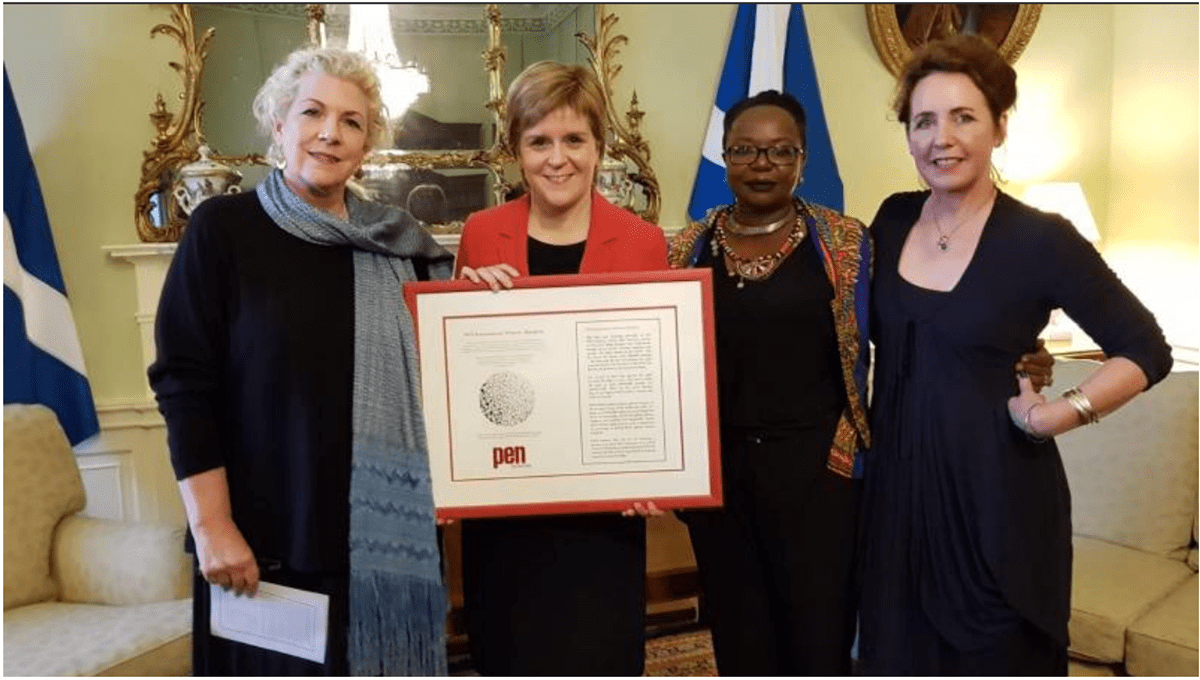
Image above: PEN International President Jennifer Clement, First Minister of Scotland Nicola Sturgeon (holding Women’s Manifesto), Publishing Director and manifesto advisor Ellah Wakatama Allfrey OBE, and PEN International board member Margie Orford
Margie Orford
No advanced step taken by women has been so bitterly contested as that of speaking in public. For nothing which they have attempted, not even to secure the suffrage, have they been so abused, condemned and antagonised.’
Susan B. Anthony, American civil rights campaigner, 1900.
In 2016 as the PEN International Women’s Manifesto to protect freedom of speech and of creative expression for women writers, poets, and journalists was being collectively drafted, those words rang chillingly true. That was the year when Donald Trump, riding a right-wing, anti-feminist wave, swept to power in the United States. Four years later Trump is on his way out but the global political stage is crowded with so-called strongmen – Putin in Russia, Erdogan in Turkey, Bolsinaro in Brazil, Orban in Hungary, Modi in India – who centralise power around themselves. This power, patriarchal in nature, is premised on the lethal binaries of race, religion and, above all, gender and has resulted in attacks on and the curtailment of women’s freedoms in both the domestic and the public sphere. This is most visible on the internet, where many of us conduct parts of if not most of our public and professional lives, where the attacks on the free and authoritative speech of women are frequent and vicious and often have lethal effects in women’s off-line lives. These are attempts to silence women, to expel them from the public sphere – the realm of free speech, politics, decision and authority that is gendered as masculine, and to sequester women in the domestic or private sphere, which is gendered as feminine. As Jennifer Clement, President of PEN International – the first woman to hold that position, writes,
In drafting the PEN International Women’s Manifesto, we needed to acknowledge women’s inequality in the world and how the violence against women was also a censorship issue. It needed to have a humanist position, which addressed that lack of knowledge or, more to the point, missing knowledge. We don’t even know what the world has lost.
Jennifer Clement, President PEN International
The particular remit of PEN International is literature so let us turn to literature to understand how old and how lethal this prohibition is on women’s free speech: to The Odyssey byHomer. Mary Beard, in her astute analysis of women and power, brought to our attention the scene where Penelope, the faithful weaving wife of the wandering Odysseus, comes down from her private quarters to the public part of her own home. There she addresses her adolescent son, Telemachus, and the suitors and adult warriors. Telemachus, both threatened and threatening, tells his mother that because she is a woman she has no right to speak. That she has no right to what he calls muthos, the ancient Greek word that means ‘public speech’. He orders her to return to the woman’s quarters and she obeys. Why?
Put yourself in Penelope’s place. To speak publicly is to speak with authority. To claim an authority that has been, and in many quarters still is, fiercely defended as a masculine domain and she is in a room filled with armed men. In front of her is a son whose very authority, whose ‘honour’, whose masculinity depends on his ability to silence a woman. To expel her from the public sphere, to defend with violence if necessary, that as a domain for men only. It is – a dangerous moment and Penelope, wise and politically astute, falls silent. Censured – a woman speaking in public of turn. Censored – a woman who is ‘spoken for’, not a woman with a right to speak for herself. Hers is the silence of half of history, half of humanity. What would she have said? How different might literature and history have been if she had spoken and written? How can we end this deathly silence?
Activism, like art, is an act of imagination.
So let us return to that scene of Homer’s and to the confrontation between Penelope and Telemachus. Let’s imagine that when Telemachus ordered Penelope back to her quarters, when he denied her the right to muthos– public speech – that she refused to go. Let’s imagine that Penelope insisted on speaking and that when she spoke she was not alone. Let’s imagine that the wiser, more confident men had intervened. Let’s imagine they said:
Telemachus, be silent. Listen to the words of this woman. This space of public speech is one that is to be shared. She is wise and will have good counsel for she has experienced the pointless slaughter of the Trojan wars too. Listen to her.
Shifting the social balance of gender, power and speech is at the heart of what the Women’s Manifesto addresses – opening up ways of imagining and working for a different future, an equal future.
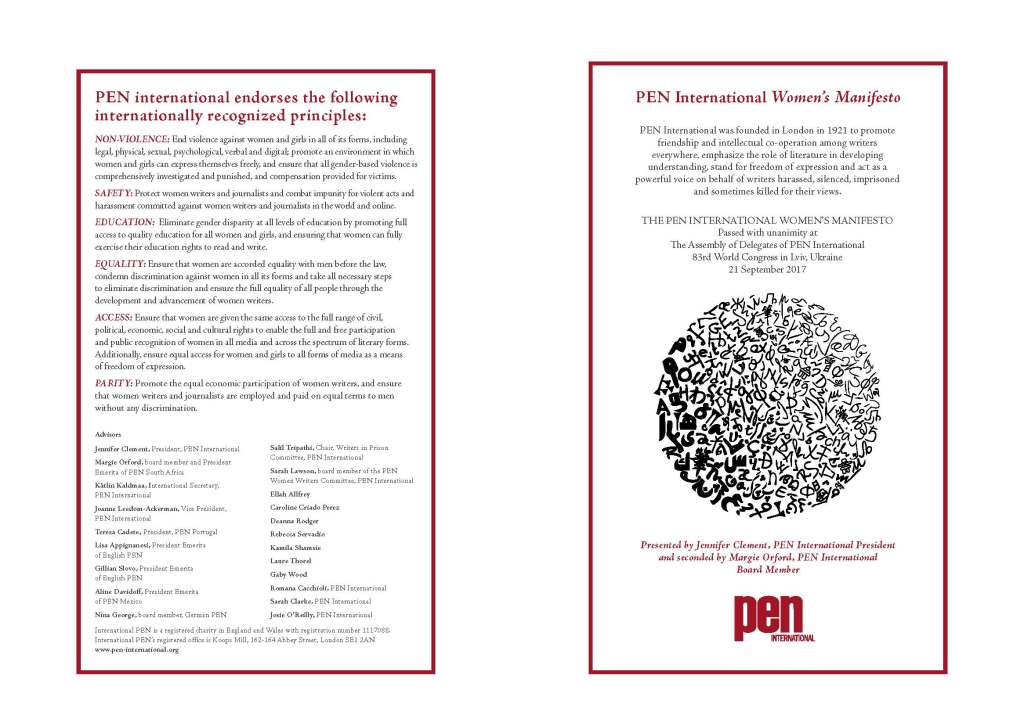
PEN International Women’s Manifesto. Reproduced with permission
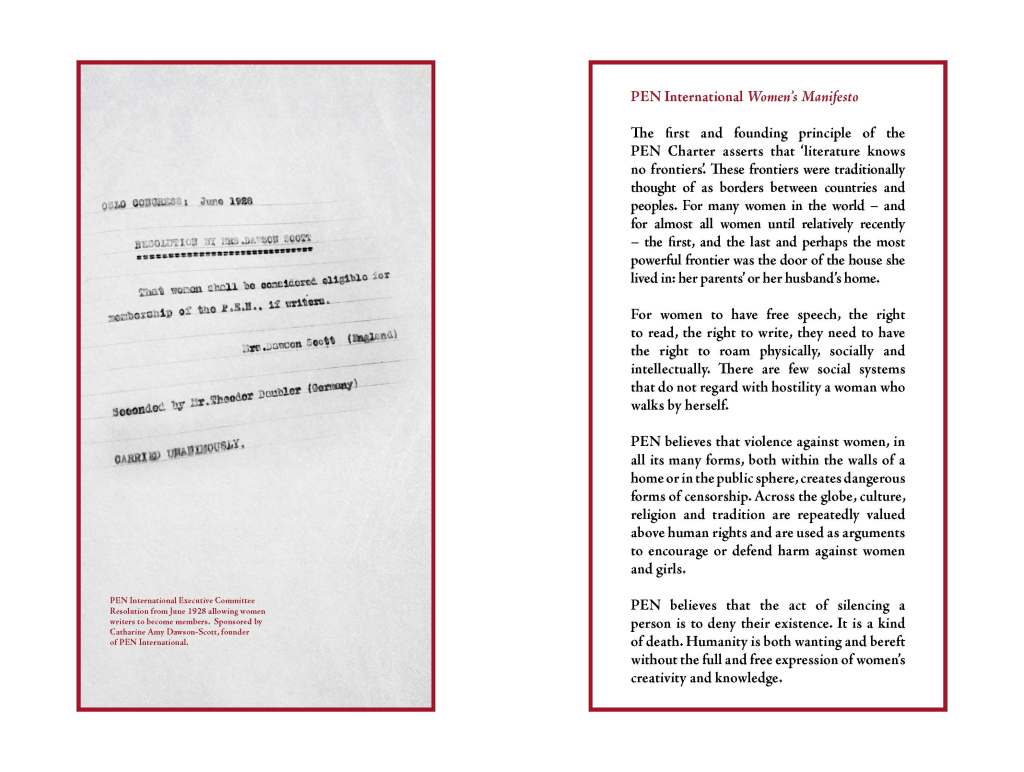
The first and founding principle of the PEN Charter asserts that ‘literature knows no frontiers’. These frontiers were traditionally thought of as borders between countries and peoples. For many women in the world – and for almost all women until relatively recently – the first, and the last and perhaps the most powerful frontier was the door of the house she lived in: her parents’ or her husband’s home.
For women to have free speech, the right to read, the right to write, they need to have the right to roam physically, socially and intellectually. There are few social systems that do not regard with hostility a woman who walks by herself.
PEN believes that violence against women, in all its many forms, both within the walls of a home or in the public sphere, creates dangerous forms of censorship. Across the globe, culture, religion and tradition are repeatedly valued above human rights and are used as arguments to encourage or defend harm against women and girls.
PEN International Women’s Manifesto. Reproduced with permission
PEN believes that the act of silencing a person is to deny their existence. It is a kind of death. Humanity is both wanting and bereft without the full and free expression of women’s creativity and knowledge. As Salil Tripathi, chair of PEN’s Writer’s in Prison Committee, writes:
Women who defend human rights, women who speak in public, and women who engage in controversial debates have been subjected to insults by latter-day Telemachuses all the time. Some have been vilified, like Priyamvada Gopal in the UK when they speak on race and colonialism, some have been attacked for campaigning to have a British currency note with the image of a woman, like Caroline Criado Perez, some have seen their morphed images spread on the Internet, like Rana Ayyub in India, some have been insulted by heads of state, like Maria Ressa in the Philippines. Some, like Nasreen Soutedeh in Iran, remain in jail, some, like Asli Erdogan in Turkey, face prosecution, and some, like Svetlana Aleksiyevich in Belarus, are questioned by those with power because they speak truth to those with power. And then some, like Daphne Caruana Galizia in Malta and Gauri Lankesh in India have been murdered.
Amnesty International has shown, through detailed research, how mobs on the Internet seek to silence women who engage in the public sphere. Recognising the Women’s Manifesto is but the starting point in understanding the restraints being placed on women. It is incumbent on all those who care for free expression to make sure that their voices are not silenced; that their access is not withdrawn; that they are not shouted down; and to do that, the world needs to read more women, and listen more to women, and on all issues, not only about issues that the patriarchy decides as ‘women’s issues.
Salil Tripathi, chair of PEN’s Writers in Prison Committee
The Women’s Manifesto endorses the internationally recognised human rights principles: non-violence, safety, education, equality, access, parity. This provides the frame for action and activism, has been widely used for PEN’s advocacy for the rights of imprisoned women writers and has, as Jennifer Clement says, been widely taken up.
Within months of the Women’s Manifesto passing by unanimity at the PEN congress in Lviv, Ukraine, many organisations asked if they could sign on as supporters. These included United Nations Women, the International Publishers Association (IPA), Ana Ida Gannon Centre for Women and Leadership at Loyola University, VIDA: Women in Literary Arts, Moomin Characters Ltd, as well as several literary festivals. At present, UNESCO has taken the manifesto as the heart of its global work on gender with pilot programmes, which include PEN VIDA UNESCO Counts, in several countries in South America.
Jennifer Clement, President PEN International
In addition, prominent women endorsed the document such as First minister of Scotland Nicola Sturgeon, Her Royal Highness Princess Nandi of the Zulu Royal House. Noma Dumezweni, Sofi Oksanen and Dareen Tatour, who says of the Women’s Manifesto:
This document is about me. It represents me as a woman, as a human being. It represents the pain that I feel as part of the women’s community… It summarizes in a real way the things I have faced
Dareen Tatour, Palestinian poet, photographer and social media activist
The Women’s Manifesto has been crucial for a number of PEN’s cases. Here are some that you, as readers, can become involved in:
PEN has advocated for Tsitsi Dangarembga, shortlisted for this year’s Booker prize, who is currently facing trial in Zimbabwe, and has campaigned successfully with many African PEN centres for the justice for the Ugandan writer, Dr Stella Nyanzi
Video above: Ugandan academic activist and poet Dr Stella Nyanzi. Source: Youtube.
The Manifesto is used by PEN Centres all over the world for advocacy but it is also used for the creating new ways of thinking about writing as Nadia Davids, President of PEN South Africa, where the Women’s Manifesto is widely used writes,
I used the manifesto for a suite of third year English lectures at the University of Cape Town and it always prompts a really generative conversation among the students- allowing them to carefully consider the relationship between freedom, creativity, the ownership of the self, our inalienable rights over our own bodies and how that may connect to creating a body of work… We read the Manifesto in relation to two other texts: Woolf’s A Room of One’s Own and Alice Walkers response to Woolf, In Search of Our Mother’s Gardens and this invites us to consider the relationship between the psychic and the physical, and how the right to roam uninterrupted allows for the mind to wonder and make.
Nadia Davids, President of PEN South Africa
Dr Margie Orford is an independent scholar and the author of the internationally acclaimed Clare Hart novels, a literary crime series focused on gendered violence that has been widely translated and is currently being developed as a television series. A Civitella Ranieri fellow and a Fulbright scholar, Dr Orford is an honorary fellow at St Hugh’s College, Oxford and Community Fellow at the Institute for Advanced Studies in the Humanities at University of Edinburgh. She was the patron of Rape Crisis in South Africa, president of PEN South Africa, a member of the executive board of PEN International and is a co-author of the PEN International Women’s Manifesto.



 16 Days Blogathon