Day Seven: Beyond Consultation: Meaningful Student Engagement in University Gendered Violence Governance

Angela Griffin weaves together a personal account of university life with her research and consultation work around student activism and sexual violence.

Image credit: Angela Griffin

Angela Griffin

Universities are places of learning and, for most of us, they are places where we learn to be adults. While I was at university, I lived out of home for the first time, learned to cook for myself, learned to make friends, I explored volunteering opportunities, first jobs, and I discovered who I was. A lot of these important life firsts came with their own difficulties as it turns out finding yourself can be a painful process, but facing these difficulties are an important part of growing up. However, one difficulty no university student should have to face is sexual violence.

Unfortunately, sexual violence is a sad reality for a huge number of university students. The National Student Safety Survey (NSSS) conducted in 2021 found that one in twenty students had experienced sexual assault and one in six students had experienced sexual harassment since starting university. For students living on campus, these rates were even higher with 25.8% of sexual assaults recorded in the NSSS occurring in university residences. 

When I first came to study at UNSW, I was 19 years old and was social justice minded. I threw myself into feminist spaces getting involved in groups such as my university’s women’s collective, and Sydney’s Reclaim the Night rally. In the time that I was involved in these groups, I heard story after story from my women and queer friends who had experienced sexual violence, and activists who had been burned out by the monumental trek uphill toward societal change. At this same time, in 2017, the Australian Human Rights Commission (AHRC) released the ‘Change the Course’ report (the AHRC report). This report investigated Australian university student experiences of sexual violence and made nine recommendations for universities to prevent and respond to sexual violence. 

In 2021 I completed an honours thesis for which I asked student activists like me how they felt their universities had implemented the recommendations included in the AHRC report. This thesis found that students involved in sexual violence activism in 2017/18 were more likely to express satisfaction with their universities implementation of the AHRC report recommendations than those involved more recently. Students involved in activism and advocacy in the years immediately following the release of the AHRC report expressed that their universities were shocked into action and that their universities explicitly prioritised including student representatives in decision-making processes. Therefore, many students involved in 2017/18 felt a level of ownership over the subsequent changes made. 

Students involved in 2020 and 2021 however were more likely to express disenfranchisement with, or a lack of knowledge about, their university’s approach. One student was a Women’s Officer in 2020 and stated that: 

“I personally had very little contact with the University regarding the implementation of the Change the Course report… The minimal contact I had with the University was related to providing feedback on other projects unrelated to the topic of sexual misconduct.”

Many students also felt their universities had quietly discontinued a prominent focus on sexual violence during the pandemic. This sentiment was supported in the recently released Senate Inquiry into current and proposed sexual consent laws in Australia conducted by the Legal & Constitutional Affairs References Committee. The Committee was tasked with reviewing current and proposed consent laws in Australia and it particularly highlighted high rates of sexual violence occurring at Australian universities. In the report, the Committee found that: “…despite these efforts [actions taken by universities in the aftermath of the AHRC report], the committee heard that the university sector’s commitment has, at best, waned and, at worst, stalled.” 

Universities, like many slow moving institutions, need external pushes to continue efforts toward sexual violence prevention and response. In 2017, this push was the release of the AHRC report and associated student activism. Today, the push is coming from the findings of the Senate Inquiry. When it came to making recommendations for change, recommendations 15-17 related to universities. These final three recommendations were that:

  1. Universities Australia conduct a second NSSS with results made publicly available no later than 2025.
  2. The Commonwealth Government implements an independent taskforce overseeing universities’ policies and practices to prevent and respond to sexual violence.
  3. The Commonwealth Government commissions an independent review of the Tertiary Education Quality and Standards Agency.

In recent years, I have noticed a drop in university engagement on the issue of sexual violence. The Covid-19 pandemic and associated economic concerns pushed the issue off the university agenda and it is in universities’ best interests to keep this up and to ignore the problem. I implore Universities Australia and the Commonwealth Government to implement the three university related recommendations in the Senate Committee report and I hope that this report can act as a fire to ignite the issue of sexual violence on university campuses once again. Students deserve better. It’s time to do better.

Author bio: 

Angela Griffin (she/her) is a Research Assistant at the Gendered Violence Research Network, UNSW Sydney, and has a background completing research and consultation with university students. In 2021 she completed her Bachelor of Social Research & Policy (Honours First Class). As part of this degree, she completed a thesis exploring student activist experiences of their universities implementation of the recommendations included in the Australian Human Rights Commission’s 2017 ‘Change the Course’ report.


Day Six: Sexual violence in universities – an opportunity for substantive, systemic reform?

If there has been so much talk and activism around sexual violence in universities, why has there been so little progress in reducing the violence itself? Allison Henry offers some answers from the Australian context.

Image source: Shutterstock.

Allison Henry 

Decades of inaction

Student leaders, survivors, sexual violence advocates and feminist activists have campaigned for decades to raise awareness of sexual assault and sexual harassment in Australian university settings and agitated for improved institutional responses. 

The release of the first comprehensive national survey data in the landmark Australian Human Rights Commission’s 2017 Change the Course report, released just a month before the #MeToo movement exploded globally, shocked the Australian university sector into action. Over the past six years many universities and residential colleges have reviewed and refreshed their sexual violence policies and response pathways. 

Yet a second survey – the National Student Safety Survey (NSSS) released in 2022 – demonstrated that this heightened institutional attention on sexual violence had failed to reduce the incidence of sexual assault and sexual harassment in Australian university settings. Furthermore, there had been no increase in student awareness of university support and complaints policies, no improvement in reporting rates, and continuing high levels of dissatisfaction with university complaint processes.

My doctoral research focused on student peer-to-peer experiences and took a system-wide structural approach to interrogate why there had been so little progress in reducing campus sexual violence over the past decade. My thesis critically examined the regulatory initiatives and oversight mechanisms adopted by various actors between 2011 and 2021, arguing that substantive progress in tackling sexual violence in Australian university settings had stalled due to a combination of factors including an over-reliance on the self-regulating university sector to lead the reform effort, as exemplified in Universities Australia’s Respect.Now.Always campaign; the failure by the national higher education regulator TEQSA to hold institutions accountable; and the indifference of governments. 

My research found that the legislative and regulatory levers available in Australia’s higher education system had not been effectively activated – political disinterest and the absence of even a latent threat of genuine and enforceable institutional accountability were critical factors in allowing universities and residential colleges to adopt tokenistic responses. 

“The actions universities have taken to address this to date have not been good enough. We have the research. We have the evidence. We know the scope of the problem. We have to act.” 

Commonwealth Education Minister Jason Clare

Fortunately, one of these factors has now shifted markedly, and had ripple effects. The Albanese Labor government’s University Accord process has signalled that student and staff safety is an area of urgent concern, with the Accord Panel acknowledging in their July 2023 Interim Report that “Sexual assault and harassment on campus is affecting the wellbeing of students and staff, and their ability to succeed.”

“Our universities should be places of learning, not rape factories.”

Senator Larissa Waters

On a parallel front, parliamentarians from across the political spectrum have begun speaking out about the crisis of campus sexual violence. 

The Senate Legal and Constitutional Affairs References Committee tabled a unanimous cross-party report on sexual consent laws in September 2023. The scathing report described the university sector and TEQSA’s response to sexual violence as “unacceptable” and “a shameful state of affairs”, with the committee chair Liberal Senator Paul Scarr stating in parliament that the committee “lacks confidence that the university sector as a whole will respond appropriately to the crisis without strong intervention”

This long-overdue political interest has provided media opportunities for student leaders and advocacy groups to highlight the experiences of student survivors and push for reform.

A fresh approach

In response to the Accord Panel’s interim recommendation a cross-jurisdictional Working Group, informed by a Stakeholder Reference Group, was established to address improvements in university governance, with a particular focus on recommending immediate measures to improve student and staff safety and address gender‑based violence in university settings. 

draft action plan addressing gender-based violence in higher education has now been released for further consultation and detailed design work. Centring the voices and needs of victim-survivors, it proposes several promising accountability and transparency measures: 

  • a new National Student Ombudsman aimed at ensuring students have access to an effective, trauma-informed complaints mechanism; 
  • a new National Higher Education Code to Prevent and Respond to Gender-Based Violence, detailing expectations around critical incident management, provision of support to students and whole-of-institution data collection and transparent reporting, amongst other issues;
  • the establishment of a new unit in the Department of Education to oversight the new National Code and undertake targeted compliance activities, removing these responsibilities from TEQSA; 
  • annual reporting by higher education providers through the Commonwealth Minister of Education to Parliament; and
  • a commitment to enhance the oversight, standards and accountability of student accommodation providers regarding their gender-based violence prevention and response. 

The draft action plan is open for consultation until the end of January 2024. Meanwhile, the Accord Panel’s final report is due in December. The final outcomes won’t be clear for a while, but after decades of inertia it feels like we may be on the verge of a massive shift: meaningful institutional accountability and transparency in the management and prevention of campus-based sexual violence is within reach.

Author Bio

Dr Allison Henry is a Research Fellow and Associate with the Australian Human Rights Institute at UNSW. She completed her PhD on ‘Regulatory responses to sexual assault and sexual harassment in Australian university settings’ in May 2023, for which she received the Dean’s Award for Outstanding PhD Thesis.  Dr Henry was a member of the Commonwealth Department of Education’s Gender-based Violence Stakeholder Reference Group. Previously, Dr Henry was the Campaign Director of The Hunting Ground Australia Project from 2015-2018, a collaborative impact campaign that was instrumental in raising awareness of sexual violence on Australian university campuses.

Day Five: Increasing Visibility of Staff Experiences of Sexual Violence and Sexual Harassment in Universities

We’ve examined the object of violence and the notion of consent. Today, Jan Breckenridge widens our understanding of who is susceptible to sexual assault and harassment in university settings.

Featured image: WordPress stock images

Jan Breckenridge

Gendered violence in universities 

Sexual assault and sexual harassment are prevalent in universities and carry a profound impact for students, faculty, and staff. Since 2016, there has been a significant number of policy and prevention initiatives to respond to sexual assault and sexual harassment in Australian universities. In February 2016, Universities Australia (the national peak body for universities) launched Respect. Now. Always., an initiative designed to prevent sexual assault and sexual harassment in universities and improve university response and support to those affected. 

In 2017, the Australian Human Rights Commission’s Change the Course report found that 1 in 5 university students experienced some form of sexual harassment in a university setting. The report recommended ways that university staff can support students affected by gendered violence, as students often disclose their experiences to a staff member. This included ensuring that relevant staff members receive training in responding to disclosures of sexual assault and sexual harassment. Similarly, the 2021 National Student Safety Survey (NSSS) identified ways in which university staff can support the wellbeing of students affected by sexual assault and sexual harassment, including preparing staff to appropriately respond to disclosures. 

What these reports did not do is focus on university staff experiences of sexual assault and sexual harassment and appropriate responses to staff. 

What is the role of university staff in supporting students affected by sexual violence and sexual harassment? 

There is a lack of any definitive empirical evidence of how university staff can be involved in changing the culture of universities. This should not be confused for a lack of importance. UNSW currently employs over 7,000 staff members, who may themselves experience gendered violence or may play a support role for students and/or colleagues. As demonstrated by the Change the Course findings and recommendations, university staff are positioned to play a key role in culture change and support for those affected. As such, the role of university staff in combating sexual misconduct and gendered violence on campus cannot be ignored.

It is vital that universities provide clear information about how staff can seek support and support those affected by gendered violence. Staff may impact a university’s culture by engaging in governance arrangements and participating in education and training designed to increase knowledge of gendered violence, as well as university-specific triage pathways. Most universities see staff as a key first responder to student disclosures of gendered violence and set up processes for staff to respond to disclosures competently and compassionately. 

What about responses to staff who are affected by sexual violence and sexual harassment? 

Unfortunately, university sexual violence including sexual harassment is often framed as a student only issue. This cannot be the case. In 2023, the Australian National Tertiary Education Union (NTEU) conducted a survey of university staff experiences of sexual harassment, sexism and gender-based bias. The survey found that 1 in 3 university staff had experienced sexual harassment in their workplace. This highlights the need to respond to both staff and students affected by sexual violence and sexual harassment. 

The impact of Respect@Work on organisational responses, including universities 

Respect@Work: Sexual Harassment National Inquiry Report (2020) recommended the adoption of new framework to more effectively prevent, and respond to, workplace sexual harassment in Australia. The new framework recognises that a more holistic approach is necessary for organisations, which includes universities. The framework looks beyond policies, training and complaint-handling procedures to recognise that sexual harassment is primarily driven by gender inequality and power imbalance. It provides guidance about steps that can be taken within workplaces to better prevent and respond to sexual harassment.

UNSW Sydney leadership in responding to staff and students 

UNSW Sydney is leading through the development of a Gendered Violence Strategy and Action Plan that focuses on prevention and response to gendered violence for staff and students. Universities not only have the responsibility to make their campuses safe and welcoming places for all students, staff and visitors, but they must be catalysts for cultural change throughout society. With this Gendered Violence Strategy and Action Plan, UNSW is taking a whole-of-organisation approach to achieve their bold vision to Stop. Empower. Support. in our community. 

UNSW, Sydney has committed to: 

Stop gendered violence on our campuses through prevention and education. 

Empower our people to create a safe and respectful community by calling out inappropriate behaviour where it is safe to do so, and with the expectation that students and staff model respectful behaviour. 

Support our students and staff to raise their concerns, report incidents, and seek support when they need it.

The success of any responses to sexual violence and sexual harassment in universities requires leadership and appropriate resources being made available to support every person affected.  

Author bio:

Professor Jan Breckenridge is the Head of the School of Social Sciences and the co-convenor of the Gendered Violence Research Network (GVRN) at UNSW. In 2021, she was appointed to the National Sexual Harassment in the Workplace Working Group of the National Women’s Safety Alliance. In 2022, she was appointed to the Research Advisory Committee of the National Centre for Action on Child Sexual Abuse. In 2023 she was appointed to National Women’s Safety Alliance –Sexual Violence Working Group. She has always oriented her research towards maximum impact in innovative social policy development, best practice service provision and outcome measurement of effectiveness.

Day Four: ‘Asking the right questions’- Reducing Technology Facilitated Gender Based Violence

As sexual violence on campuses increasingly muddle the distinctions between ‘online’ and ‘offline,’ Mahima Kaul reminds us to take into account the surrounding technological worlds in which the violence is embedded.

Featured image from UN Women: https://www.unwomen.org/en/what-we-do/ending-violence-against-women/faqs/tech-facilitated-gender-based-violence

Mahima Kaul

Headlines recounting incidents of assault on Indian college campuses often report on physical violence mixed with technology facilitated gender based violence [TFGBV] – for example, a woman stripped in order for the assailants to take pictures and videos. Can one truly distinguish between “offline” and “online” crimes anymore? 

There has been an instinct to view these incidents purely from the prism of takedown – and indeed it is very important for non-consensual images and videos to be removed from the assailants device, the internet, and any other places the content has ended up. Current work amongst lawyers and policy experts focus on examining the available language under the Information Technology (IT) Act and Indian Penal Code (IPC) to see if laws adequately and accurately cover these offences.

But the narrow focus on takedown (requiring content to be taken off the internet) misses a larger opportunity to question the root causes of the rising instances of TFGBV. In a recent policy framework published by Delhi-based think tank, The Dialogue, the proposition is to look at addressing TFGBV through a number of domains which should adequately and holistically address the issues. These are: access, prevention, intervention, response and remediation, recovery and research.

Let’s look at a practical way in which this is applied. Taking the same incident cited above – “a woman stripped in order for the assailants to take pictures and videos”. In the current context, the most likely questions will be: were the assailants caught, and which sections of the law were they booked under?      

Perhaps, “we” as journalists, academics, and even victim-survivors can expand the scope of investigation. So, we could ask: did the assailants take away the woman’s phone during the assault, so that she could not contact anyone for help? We could ask, who are the assailants and what is their motivation for this crime – is it personal, financial or is there some other incentive? Have they done this before? We can investigate the takedown mechanisms that are in play with regards to the device and apps where the content has been transferred is. We can ask if the police were helpful to the victim, and respectful, and if she has the legal help she needs. We can further ask if the victim has any desire or resource to mental health services as she recovers from this violent incident. And finally, we could look at statistics on crime against women, cross checked by TFGBV, to understand the rate at which these crimes might be rising.

What does asking different questions do? We expand the points of success and failures from a single focus – in many cases arrests and content takedowns – to ask for better solutions from society on the whole. Additionally, when we start asking questions about the perpetrator’s motivations for the victim’s access to healing services we automatically bring into the conversation questions about research on perpetrators (and not just an account of incidents), prevention programs that can be deployed to deter youth from indulging in these crimes, and non-profits and mental health services that work with victim survivors.

For too long, the lack of evidence-based questions has resulted in coverage and response around TFGBV that is dominated by scandalous or patriarchal responses which question the victim, not the perpetrator. Wide ranging discussion and shifting our analysis can help to move conversations towards accountability. Even as institutions grapple with “new” crimes and fast moving technology, such as new concerns over AI enabled TFGBV, by asking the right questions that keep the focus on root causes, we do not assign societal judgement and blame onto victim-survivors.

We need a global conversation on the impact of TFGBV on women and minorities today. The only way it can have a positive impact is we structure the conversation around a policy framework. 

AUTHOR BIO

Mahima Kaul is the Director of Public Policy for Bumble across Asia-Pacific. Her work includes talking to regulators, academics, NGOs working on online safety issues, including gender based violence. Previously she headed Twitter’s public policy work in India and South Asia where she worked across a range of issues including their regulatory concerns, philanthropy and governance partnerships. She also led the new media initiative at the Observer Research Foundation, a prominent Indian think tank, focusing on free expression and internet governance. She has also worked as a journalist, and has been published widely on these issues. Views are personal. 

Day Three: Sexual Consent – Nodding Your Head but Meaning No

Sexual consent is taught in educational institutions as a direct question of ‘yes’ and ‘no’ but, as Ngozi Anyadike-Danes writes, definitions often lack the context of the culture and society they are embedded within.

Ngozi Anyadike-Danes

Sexual consent is commonly presented as the defining concept of sexual violence and, thus, often seen as the differentiating factor between consensual and non-consensual sexual activity

(Munro, 2008).

Yet, what sexual consent means and how this meaning is applied appears to result in some degree of discord, particularly in the context of university based sexual violence. 

Sexual consent is best understood as an agreement between those wishing to engage in sexual activity. Each core concept is associated with some conditions: 

  • The agreement must be informed, freely given and can be taken back at any time. 
  • Each person must agree and have the capacity to agree (e.g., be of legal age, not excessively intoxicated) and understand what they’re agreeing to.
  • The sexual activity is specific to the sexual act.

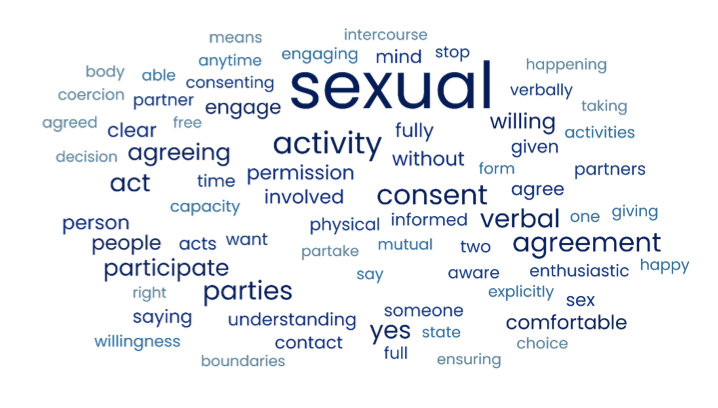
Stripped back, sexual consent is relatively straightforward. But definitions of sexual consent merely highlight construct and conceptual structure, they lack the context of culture and society. When we consider students, for example, research suggests that their sexual consent definitions, generally, accord with the above (Wignall et al., 2022; Brady et al., 2018) – an agreement to engage in sexual activity with some awareness of factors that might mitigate consent (e.g., age, intoxication, coercion). Similar results were identified during my PhD research (Anyadike-Danes, 2023) when university students were asked to define sexual consent (Figure 1). Yet, consent definitions, understanding and behaviour are not necessarily the same (Beres, 2014; Marg, 2020). 

Sexual consent understanding supplements definitions with contextual information like societal norms, cultural attitudes, and adherence to religious beliefs (Muehlenhard et al., 2016). This could mean that there are situations where students think sexual consent is not necessary (e.g., married, certain sexual acts). Though research seems to suggest that certain gendered and victim-blaming beliefs are reducing in students (Yapp & Quayle, 2018), students’ responses may also reflect their awareness of social desirability and suggest that our measures require updating (Zidenberg et al., 2022). 

Figure 1. Word cloud of university students’ sexual consent definitions.

Sexual consent understanding also influences how individuals communicate consent – whether that’s their communication to/with someone, or their interpretation of someone else’s consent communication. Affirmative consent (Friedman & Valenti, 2019), or ‘yes means yes, no means no’, means that anything other than a ‘yes’ (often a verbal ‘yes’) is non-consent. The verbal ‘yes’ has been heralded as the ‘gold-standard’ of consent communication because it limits the risk of miscommunication (Beres, 2014). Yet, putting such expectation on the word ‘yes’ means that other cues that refute that ‘yes’ might be missed. For example, if someone consents after having said ‘no’ several times throughout the night, is that consent? 

A group of white speech bubbles with blue text

Description automatically generated

Figure 2. Awareness raising campaign from Geelong (Australia) Sexual Assault & Family Violence Centre.


Figure 2 features a campaign message from an Australian support centre that highlights the reality that ‘no’ may not always be literal, it can take different forms. Just like we understand that ‘yes’ can be non-verbal, so too can be said for ‘no’. From research, studies suggest that students may understand the importance of verbal communication, but that is not how they communicate (Muehlenhard et al., 2016). Rather, they prefer non-verbal or more implicit means of communication (Jozkowski & Peterson, 2014). And, expectedly, this introduces a greater likelihood of miscommunication. If we expand sexual consent beyond a binary conceptualization and view it as a spectrum – yes, no, and somewhere in between – then we should also reimagine communication the same way: verbal, non-verbal and nothing at all. Especially as we consider what drives whether someone consents (or not). 

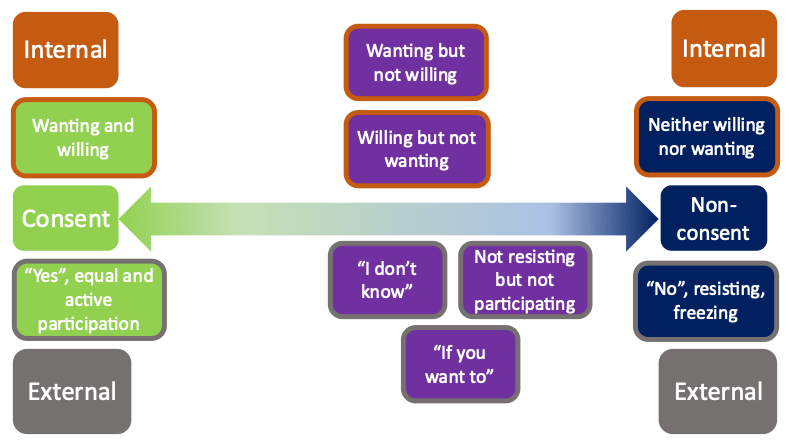
Figure 3. Visualizing sexual consent as a spectrum.

To some, sexual consent is an internally motivated desire or willingness to engage in sexual activity. This is more in keeping with when someone is asked how they knew someone wanted to have sex and they say that “you just know” (Wignall et al., 2022; Willis & Jozkowski, 2019). In research terms, this is known as ‘tacit knowing’ (Beres, 2010). Rather than solely an external or internal manifestation, sexual consent is more than likely a blend of both. Figure 3 seeks to visualize different consent concepts and behaviours across that spectrum.

But how does this all relate to gender-based violence? 

Research suggests that secondary school students do not receive sufficient education on sexual consent and what that means for their relationships

(Pound et al., 2016; Setty, 2023).

Understanding sexual consent is just as much about learning definitions as it is about empowering young people to know their boundaries and feel confident voicing what they like and what they do not like. Not only might this education impact the prevalence of gender-based violence but it may also provide those victimized with the language to report their experiences (Rousseau et al., 2020). Conceptualizing sexual consent as yes or no may be a catchy slogan but it is merely a conversation starter – we must follow up these catchphrases with in-depth learning discussions about the breadth of sexual consent and what that means for relationships. 

The importance of sexual consent cannot be overstated: it determines whether a sexual act is criminal. But in reality, it can mean so much more.

REFERENCES

Anyadike-Danes, N. (2023). Sexual consent within unwanted/non-consensual sexual experiences: exploring definitions, understanding and impact amongst university students in Northern Ireland [Unpublished doctoral thesis]. Ulster University.

Beres, M. (2010). Sexual miscommunication? Untangling assumptions about sexual communication between casual sex partners. Culture, health & sexuality12(1), 1-14. https://doi.org/10.1080/13691050903075226

Beres, M. A. (2014). Rethinking the concept of consent for anti-sexual violence activism and education. Feminism & Psychology, 24(3), 373-389. https://doi.org/10.1177/0959353514539652

Brady, G., Lowe, P., Brown, G., Osmond, J., & Newman, M. (2018). ‘All in all it is just a judgement call’: issues surrounding sexual consent in young people’s heterosexual encounters. Journal of Youth Studies21(1), 35-50. https://doi.org/10.1080/13676261.2017.1343461.

Friedman, J. & Valenti, J. (2019). Yes means yes! Visions of female sexual power and a world without rape. Seal Press.

Jozkowski, K. N., & Peterson, Z. D. (2014). Assessing the validity and reliability of the perceptions of the consent to sex scale. The Journal of Sex Research51(6), 632-645. https://doi.org/10.1080/00224499.2012.757282

Marg, L. Z. (2020). College men’s conceptualization of sexual consent at a large, racially/ethnically diverse Southern California University. American Journal of Sexuality Education15(3), 371-408. https://doi.org/10.1080/15546128.2020.1737291

Muehlenhard, C. L., Humphreys, T. P., Jozkowski, K. N., & Peterson, Z. D. (2016). The complexities of sexual consent among college students: A conceptual and empirical review. The Journal of Sex Research53(4-5), 457-487. https://doi.org/10.1080/00224499.2016.1146651

Munro, V. E. (2008). Constructing consent: Legislating freedom and legitimating constraint in the expression of sexual autonomy. Akron L. Rev.41(4), 923-955. https://ideaexchange.uakron.edu/akronlawreview/vol41/iss4/5

Pound, P., Langford, R., & Campbell, R. (2016). What do young people think about their school-based sex and relationship education? A qualitative synthesis of young people’s views and experiences. BMJ open6(9), e011329. https://doi.org/ 10.1136/bmjopen-2016-011329

Rousseau, C., Bergeron, M., & Ricci, S. (2020). A metasynthesis of qualitative studies on girls’ and women’s labeling of sexual violence. Aggression and violent behavior, 52, 1359-1789. https://doi.org/10.1016/j.avb.2020.101395

Selwyn, N., & Powell, E. (2007). Sex and relationships education in schools: the views and experiences of young people. Health Education107(2), 219-231. https://doi.org/10.1108/09654280710731575

Setty, E. (2023). Co-designing guidance for Relationships and Sex Education to ‘transform school cultures’ with young people in England. Pastoral Care in Education, 1-19. https://doi.org/10.1080/02643944.2023.2228804

Wignall, L., Stirling, J., & Scoats, R. (2022). UK university students’ perceptions and negotiations of sexual consent. Psychology & Sexuality13(3), 474-486. https://doi.org/10.1080/19419899.2020.1859601

Willis, M., & Jozkowski, K. N. (2019). Sexual precedent’s effect on sexual consent communication. Archives of Sexual Behavior48(6), 1723-1734. https://doi.org/10.1007/s10508-018-1348-7

Yapp, E. J., & Quayle, E. (2018). A systematic review of the association between rape myth acceptance and male-on-female sexual violence. Aggression and violent behavior41, 1-19. https://doi.org/10.1016/j.avb.2018.05.002

Zidenberg, A. M., Wielinga, F., Sparks, B., Margeotes, K., & Harkins, L. (2022). Lost in translation: A quantitative and qualitative comparison of rape myth acceptance. Psychology, Crime & Law28(2), 179-197. https://doi.org/10.1080/1068316X.2021.1905810

AUTHOR BIO

Ngozi Anyadike-Danes is a postdoctoral researcher within Ulster University’s School of Psychology. Currently, she’s working on a Shared Island Initiative funded project: Consent, Sexual Violence, Harassment and Equality in Higher Education (COSHARE). This project aims to produce an all-island strategy in response to consent, sexual violence and harassment (C-SVH) in HE and facilitate knowledge exchange between academics and professionals (COSHARE Network). In January 2024, Ngozi will begin a lectureship within Ulster University’s Criminology and Criminal Justice program. Ngozi’s research interests concern sexual consent knowledge and understanding, unwanted/non-consensual sexual experiences, rape myth acceptance and designing measurement tools that explore sexual victimization.

Contact e-mail: n.anyadike-danes1@ulster.ac.uk