Day Eleven |Democracy’s Promise Unfulfilled while Violence against Women in Politics Persists

photo credit: Eric.Parker DSC07415_ep via photopin (license)

Written by Dr. Gabrielle Bardall

In October 2018, the Office for the High Commissioner on Human Rights’ Special Rapporteur on Violence against Women and Girls presented a report to the UN General Assembly recognizing violence against women in politics (VAWP) as a human rights violation and calling upon all UN member states to take action. In less than a decade, this issue went from an unnamed and unnoticed fact-of-life to an internationally-recognized threat to democracy and violation of human rights.

What is “VAWP” and why is it so significant? Political violence during elections and democratic processes is a common occurrence in many countries, especially states undergoing regime transitions. Likewise, the global and pervasive presence of gender-based violence (GBV) is well-established. VAWP exists at the crossroads of political violence and GBV, targeting women who participate in public or political life either specifically because they are women, or in distinctly gendered ways. Sadly, there is no shortage of examples and no boundaries — from Zimbabwean women experiencing genital mutilation in retribution for engaging in politics, to women legislators across Western democracies denouncing sexual harassment within the halls of their parliaments, to the bombing of a busload of female election workers in Afghanistan.

VAWP is not only a manifestation of inequality or a harm against an individual. It is a mechanism that formally institutionalizes women’s subordinate position in society by coercively excluding them from state governance. Just as VAWP terrorizes and degrades its individual victims, it undermines democracy by enforcing patriarchal control of democratic institutions and impedes the economic growth potential associated with greater women’s political participation. VAWP is the ultimate expression of the patriarchy and until it is eradicated, democracy’s promise remains unfulfilled.

VAWP occurs in multiple locations, including private and domestic spaces, and online. It is often perpetrated by someone known to the victim – indeed, in many cases we have encountered, women experience violence at the hands of other elected officials as well as by their intimate partners as a result of their political or public engagement. Women overwhelmingly experience psychological and sexual forms of political violence, compared to men who are more often targeted by physical harm. VAWP has been documented in all parts of the world, regardless of regime-type or socio-economic status, although it takes different forms in different places. Emerging statistical research suggests a very high prevalence. One recent of 45 countries found that over 85 percent of women parliamentarians had suffered psychological violence, while 58 percent had been attacked online. Our research at IFES finds that in some countries, political women are targeted with online threats, degrading attacks and other forms of digital harassment at up to three times the rate of their male counterparts. These attacks largely reflect anger with a woman’s decision to run for office or otherwise engage in public affairs because of the break with traditional gender roles, and the content of online vitriol – from Zimbabwe to Sri Lanka to Ukraine to the USA – is riddled with sexual threats, manipulated images and video, and threats of physical harm to the woman herself or to her children and partner. We also know that VAWP has an intersectional dimension and that women who also identify with marginalized religious, ethnic, racial groups have a distinct experience.

The path to ending VAWP has turned into a highway over the decade since the issue of VAWP began to be recognized as a distinct threat to democracy and human rights. The SRVAW’s report in October 2018 unified the vision, action and research of many global activists and researchers, and provided direction and momentum. Responses to mitigating and ending VAWP once and for all are manifold and include education, awareness, improved data, personal security, law enforcement training, and monitoring. One response in particular is of vital importance, no less because it is reflective of a deep and abiding inequality that crosscuts global democracies: the issue of ending impunity for VAWP.

With only a handful of exceptions in Latin America, VAWP is not explicitly addressed in national legal frameworks. However, most frameworks do address the most egregious manifestations of VAWP, including physical and sexual violence and many forms of harassment and discrimination. Yet, laws protecting victims of VAWP and punishing its perpetrators are systematically overlooked and unenforced worldwide. More challenging still, legal frameworks are often murky or absent for the types of violence women most frequently experience in politics, including online and many forms of psychological violence. So long as we fail to recognize VAWP when it occurs and to prosecute its perpetrators, permissive norms and attitudes will remain.

This is a fundamental issue because it goes to the heart of how we judge the quality of democracy itself. A double-standard for electoral standards operates in democratization processes today. In practice, some laws simply count more than others when it comes to determining how democratic a democracy is, regardless of the hierarchy of law. The trouble is, the laws that end up in the second-tier are often those laws designed to defend women’s participation and security in the course of the exercise of their civil and political rights. Recently, Kenya and Haiti have, respectively, annulled national elections and undergone upheaval over electoral irregularities. Yet in both cases, blatant violations of Constitutional law were not the issue behind the turmoil – because those violations pertained to the protection of women’s space in state institutions.

Understanding VAWP provides a vehicle that compels us to re-evaluate the fundamentals of how we define and defend democracy. There can be no gender-exceptions to the hierarchy of law. Electoral integrity does not exist where the rule of law is not applied to protect and defend all citizens equally. Democratization remains incomplete where half the population is subject to discrimination and political violence, in all its forms. Until violence against women in politics is systematically addressed, many electoral processes remain at risk of reproducing the patriarchal structures that exclude and silence women’s voices. Adapting a feminist approach to democracy and democracy assistance is vital to overcoming this fundamental human rights challenge.

Dr. Gabrielle Bardall is the Gender Advisor at the International Foundation for Electoral Systems and Research Fellow at the Centre for International Policy Studies, University of Ottawa. Bardall was an American Political Science Association Congressional Fellow (2016) and a Pierre Elliott Trudeau Foundation doctoral scholar (2012).

Twitter handles: @gabrielleB17 @IFESGender

Day Ten | Gender-based Violence as a Form of Genocide

photo credit: Shutterstock

Written by Rosemary Grey

Gender-based violence can be a form of genocide, and has been recognised as such since Polish jurist Raphael Lemkin first coined the term ‘genocide’ in the aftermath of World War II.

Today the issue of genocide continues to loom large.

In 2018, the international community marks the 70th anniversary of the Convention on the Prevention and Punishment of the Crime of Genocide, which defines the crime of genocide under international law and obliges states parties to prevent and punish this crime. It also marks the 20th anniversary of the International Criminal Tribunal for Rwanda handing down the first international conviction of an individual for genocide. Furthermore, it marks the 10th anniversary of the International Criminal Court Prosecutor’s request for an arrest warrant against Sudanese President Omar Al-Bashir on charges of genocide and other crimes against ethnic groups in Darfur.

It is the year that the UN Human Rights Council found that there were serious grounds to believe that Myanmar’s Rohingya people have been subject to genocide, just two years after concluding that Iraq’s Yazidi people had likewise been subjected to that crime. And it is the year that the Khmer Rouge Tribunal – a joint initiative of the Cambodian government and the UN – convicted two surviving leaders of Pol Pot’s regime for war crimes, crimes against humanity and genocide.

Continue reading “Day Ten | Gender-based Violence as a Form of Genocide”

Day Nine | Disability Gender Violence: Time for a Human Rights-based Approach

Written by Rosemary Kayess

December 3rd is International Day of Persons with Disabilities and 2018 marks the 10th anniversary of the entry into force of the Convention on the Rights of Persons with Disabilities (CRPD). The CRPD is the first human rights treaty of the 21st Century, setting out a contemporary agenda of human rights and fundamental freedoms in the context of disability.

The fundamental premise of CRPD is that disability is just one aspect of the human condition. Acknowledging that people are not defined by just one personal characteristic, that we all experience discrimination in a multiplicity of ways. A fundamental tenet of the CRPD is its universalism, that of modification of the social norm to reflect human diversity. It is a normative frame that is representative of the actual lived experience of the human condition. The CRPD sets standards for society where politics, policy, and law need to be fashioned around a complete, comprehensive vision of the human experience. It is only through such a vision that we are to meet the needs of real-life subjects and address human rights violations such as violence against women.

The CRPD’s approach is a significant shift away from the prevailing social conceptualisation of disability that reflects a deficit approach; where disability is viewed as a problem, an individualised issue where vulnerable individuals require care, treatment and protection within a social welfare regime as a way of dealing with their ‘special needs’. This individual deficit approach to disability has reinforced notions of disability as difference thereby ‘othering’ these individuals and has included the standard response of law and public policy to focus on separate parallel institutions and services in isolation to mainstream systems, such as residential care facilities, special education, sheltered employment and justice diversion measures. These policy responses have been central to inherent systemic disadvantage and ongoing violations of fundamental human rights. People with disability are stripped of legal personhood, institutionalised in closed facilities and exposed to violence and abuse.

It is time to bring a human rights approach to disability gender violence – a type of violence that is routinely ignored or downplayed. Regardless of setting or context, it is often conceptualised as abuse, neglect or service incidents, or a workplace issue to be dealt with administratively – rather than as violence or a criminal act. This is particularly the case in institutional and service settings where violence is continually excused or covered up, or at worst, normalised. Critically, the effect is a lack of recognition of disability gender violence across the legal and service systems, resulting in women and girls with disability having less legal protection and access to justice.

It is currently estimated that the incidence of violence against people with a disability is at least 3 times higher than the general population. This violence is less likely to be reported, investigated or prosecuted with much higher rates for women with disability, particularly more marginalised women such as Aboriginal and Torres Strait Islander women with disability.

There is a growing body of evidence of the nature and extent of disability gender violence. Violence against women and girls with disability in Australia is far more extensive than violence among the general population, and violence perpetrated against women and girls with disability is significantly more diverse in nature and more severe than for women in general. Compared to their peers, women with disabilities experience significantly higher levels of all forms of violence more intensely and frequently, and by a greater number of perpetrators. Women with disabilities experience violence over a longer period of time, resulting in more severe injuries, and have limited pathways to safety.

In the Australian context, evidence shows that more than 70% of women with disabilities have been victims of violent sexual encounters. Data suggests 90% of women with an intellectual disability have been subjected to sexual abuse, with more than two-thirds (68%) having been sexually abused before they turn 18 years of age. The rates of sexual victimisation of women with disability range from four to 10 times higher than for other women. More than a quarter of rape cases reported by females are perpetrated against women with a disability. Women with a disability are 40% more likely to be the victims of domestic violence than women without disability. One in four women with disability who access support services experienced violence. Eighty-five (85%) of women with mental health impairment report feeling unsafe during hospitalisation, 67% per cent report experiencing sexual or other forms of harassment during hospitalisation

The multiple forms and complex nature of disability gender violence in Australia currently sits in a legislative, policy and service response vacuum. It is not afforded the same protections and responses as others forms violence and women and girls with disability have little or no avenues for recourse. Disability gender violence is significantly more diverse in nature and more severe than for women in general. Their experiences of violence last over a longer period of time, and more severe injuries result from that violence.

A young woman sits in silhouette on an open window ledge. Her hands rest on her slightly raised knees. She looks outwards into an urban landscape.
Source: WWDA Human Rights Toolkit for Women and Girls with Disability

Narrow conceptual understandings of domestic and family violence as spousal and/or intimate partner violence obscures disability gender violence, marginalising the violence experienced by women with disability from policies and service responses designed to address and prevent violence against women. These narrow policy frameworks for domestic violence, ignore the experience of disability and fail to encompass the range of settings in which women with disability live and access.

Disability gender violence traverses traditional domestic settings including private and family dwellings but large numbers of women with disability reside in and receive support in a range of institutional and/or service settings, such as group homes, supported residential facilities, boarding houses, psychiatric and mental health community care facilities, residential aged care facilities, hostels, hospitals, prisons, foster care, respite facilities, cluster housing, congregate care, special schools and out-of-home care services. Further policy definitions fail to capture the range of relationships and various dimensions of disability gender violence, which may include the relationships they have with support workers and co-residents with disability.

Australia is far from unique. Like gender-based violence generally, disability gender violence is a widespread persistent devastating human rights violation across the world. It is only when we use normative frameworks such as the CRPD that embrace disability as an inherent part of the human condition to inform policy will we have the recognition and understanding of disability gender violence that we can eliminate violence against all women regardless of personal characteristics.

I would like to knowledge work of Women with Disability Australia and Disabled People’s Organisations Australia who’s extensive, comprehensive and rigorous work has informed much of my analysis for this blog.

Rosemary Kayess is a Committee member, UN Committee for United Nations Committee on the Rights of Persons with Disabilities, and Interim Director Disability Innovation Institute, UNSW, Sydney.

Day Eight |EU-UN Spotlight Initiative; A New Global Solution to a Global Challenge

Credit: UN Women Guatemala. Pictured: Ana Maria Pivaral Hernandez is 60 years old and lives in Zone 7 of Guatemala City. In 2017, the Guatemala Safe City and Safe Public Spaces programme conducted a survey of women in seven zones of Guatemala City as part of a baseline study. Every woman surveyed reported experiencing sexual harassment in public at some time during her life. At least 44 percent said it happens daily.

Written by Adekoyejo Adeboye

Violence against women and girls is one of the most widespread, persistent and devastating human rights violations in our world today. It cuts across all generations, nationalities, communities and spheres of our societies, irrespective of age, ethnicity, disability or status.

The facts

One out of three women worldwide have experienced physical or sexual violence in their lifetimes.

Domestic violence, including intimate partner violence, remains the most prevalent form of violence against women and girls, reportedly causing more deaths than in civil wars.

More than 700 million women alive today were married as children (before the age of 18), with more than one third married before their 15th birthday.

An estimated 200 million women and girls have experienced the human rights violation known as female genital mutilation.

Across the globe, the #MeToo movement has brought attention to the fact that millions of women and girls still face the threat of sexual harassment and violence in public spaces, the workplace, in school and at home.

 A barrier to realizing the world we want

If the current rates and trends for gender inequality and violence persist, it will be impossible for the world to achieve the Sustainable Development Goals – the global commitment to end all forms of poverty, inequality and tackle climate change by the year 2030.

To achieve the world we want, all women and girls must fully enjoy their human rights and live free from violence and harmful practices such as child marriage and female genital mutilation.

In fact, eliminating all forms of harmful practices and violence and against women and girls are specific targets under the Sustainable Development Goal 5 to achieve gender equality and empower all women and girls.

 The good news

There is now an unprecedented and global effort to remove this primary obstacle to achieving a sustainable world free from poverty, hunger and inequality.

I work for the Spotlight Initiative – a new global multi-year partnership between the European Union and United Nations to eliminate all forms of violence against women and girls.

Launched last year with a five-year funding commitment of €500 million from the European Union, the Initiative represents the single largest global investment in gender equality and women’s empowerment as a precondition and driver for the achievement of the Sustainable Development Goals.

Over the next few years, we will invest in innovative programmes and projects that respond to all forms of violence against women and girls, with a particular focus on ending domestic and family violence, sexual and gender-based violence, harmful practices, femicide, trafficking in human beings and sexual and economic (labour) exploitation.

A comprehensive response

While many different efforts to confront these issues exist, the Spotlight Initiative’s comprehensive programme design, theory of change and its high-level political and financial commitments promise to deliver meaningful results on a large scale.

Programmes funded by the Initiative will simultaneously address legislative and policy gaps, strengthen institutions, promote gender-equitable attitudes, provide quality services for survivors and reparations for victims of violence and their families. Interventions will also strengthen systems for collecting data on violence and empower women’s movements.

A pivotal year ahead

By the first quarter of 2019, we will have invested €325 million – 65% of our overall funding envelope – to fund programmes to eliminate violence against women and girls reaching 170 million people in 24 countries.

In Latin America, we will fund initiatives to end femicide – when a woman or girl is killed based on gender – in Argentina, El Salvador, Guatemala, Honduras and Mexico. 12 women are killed because of their gender every day in the region.

In Africa, we will begin implementing interventions to end sexual and gender-based violence, child marriage, female genital mutilation, and promote access to sexual and reproductive health in Liberia, Mali, Malawi, Mozambique, Niger, Nigeria, Uganda and Zimbabwe.

In Asia, we are already funding a regional programme to strengthen rights-based and gender-responsive approaches to labour migration. The “Safe and Fair” programme will address vulnerabilities to violence and trafficking and the support the delivery of essential services for women migrant workers in Brunei Darussalam, Cambodia, Indonesia, Lao PDR, Malaysia, Myanmar, the Philippines, Singapore, Thailand, and Viet Nam.

New programmes to end domestic violence in the Caribbean and the Pacific are currently under development.

Demonstrating change

One of our goals at Spotlight is to demonstrate to the world that significant, concerted and comprehensive investments in gender equality can make a transformative difference in the lives of women and girls.

We want to show that the United Nations and its agencies, national governments, civil society, donors, academia and the private sector can work closely together and join resources to solve an issue affecting half of the world’s population.

While €500 million is the largest investment ever made to end violence against women and girls, much more resources and commitments will be needed to improve the lives of girls and women everywhere.

We want to work hand-in-hand with everyone from world leaders to local communities to end violence against women and girls. Learn more about us and our work at spotlightinitiative.org. Follow us on Twitter @GlobalSpotlight.

Day Seven | Epidemic of Violence against Transgender Women in Indonesia: When the Government Fails to Protect its Vulnerable Citizens

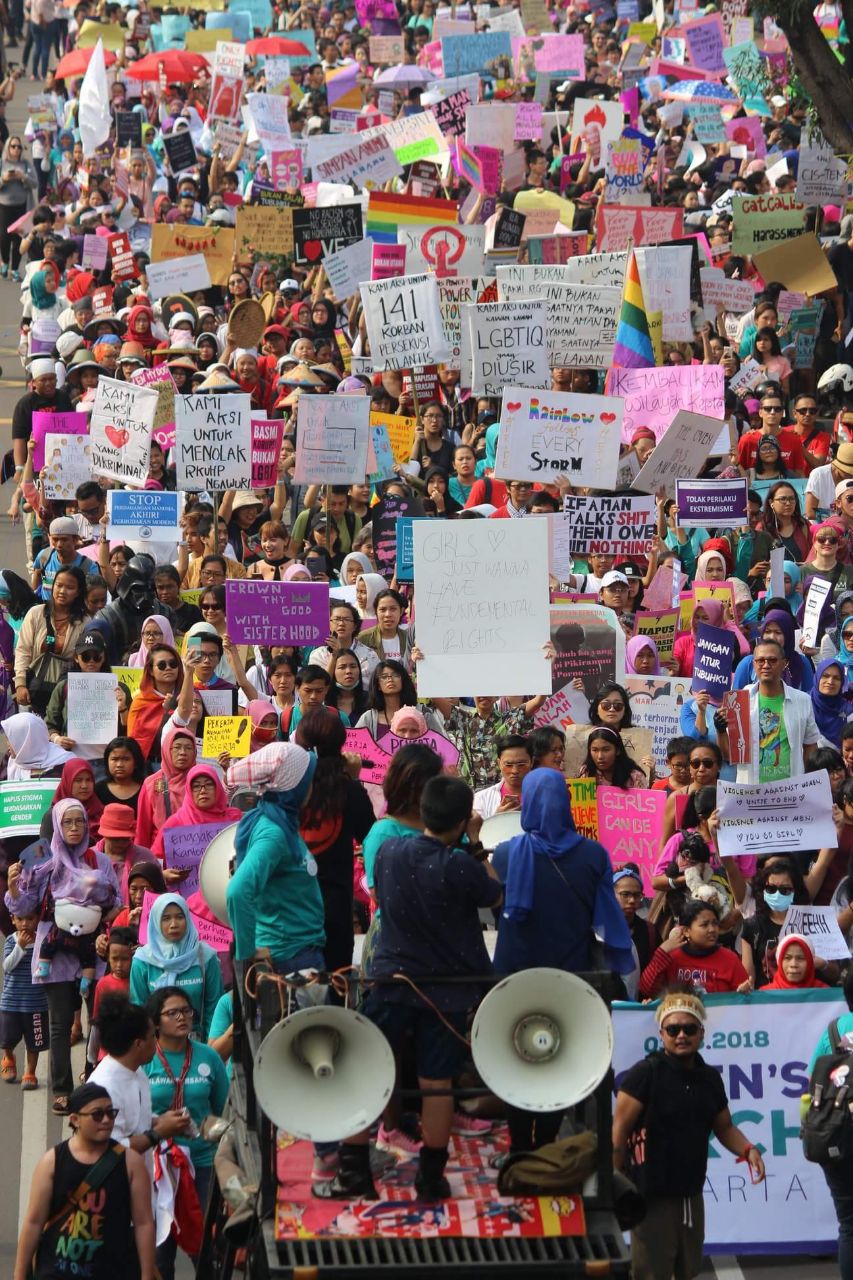
photo credit: 2018 Women’s March Jakarta

Written by Firmansyah Sarbini and Naila Rizqi Zakiah

The rise of anti-LGBT sentiment in Indonesia has led to the exclusion of LGBT groups from society, which has caused their persecution. More and more cases are emerging of banning academic discussions, discrimination in the workplace and educational institutions, through to efforts of criminalisation through courts and legislation.

In 2016, the Support Group & Resource Center on Sexuality Studies Universitas Indonesia became the centre of a media storm in Indonesia. The organisation was launching an LGBT Peer Support Network, a project-based collaboration with the LGBT online forum melela.org. Since then, an unexpected wave of bigotry hit Indonesia.  The Love Family Alliance (ALIA), a conservative group in Indonesia, has requested the Constitutional Court to change the definitions of adultery and child molestation in the criminal code which would criminalise homosexual sex.  By a margin of five to four judges, the Constitutional Court ruled against the effort to revise the country’s criminal code on the grounds that such a move was the responsibility of parliament. But this statement only inspired the conservative group to lobby lawmakers for the changes.

LGBT people are a marginalised segment of Indonesian society.  In a survey of 1,520 respondents, conducted by the Wahid Foundation and Lembaga Survey Indonesia during March-April 2016 the LGBT group was the most disliked (26.1%), compared to other groups like Communists (16.7%) and Jewish people (10.6%). This was reinforced by the findings of Saiful Mujani Research & Consulting (SMRC) during November 2016, which showed that lesbian, gay, bisexual, and transgender people (16.6%) were more hated than Communists and Jews, and second only to ISIS (25.5%). LGBT rights in Indonesia have also been politicised in every election campaign since Indonesia’s 2014 presidential election, when Musdah Mulia, an Indonesian Islamic theologist and research professor at the Ministry of Religious Affairs who irked many conservative Muslims with her LGBT-friendly perspective, was in the team of experts of now president Joko Widodo (known as Jokowi). Many politicians endorse the rising hatred against LGBT people and often give biased statements and opinions about the LGBT community to gain majority votes, as well as promote anti-LGBT laws and bylaws. In early November 2018, a so-called ‘war against LGBT communities’ was started by Hidayat Nurwahid from Prosperous Justice Party (PKS), who demanded President Jokowi issue an anti-LGBT law. The 2019 presidential election will be yet another battleground for politicians against the LGBT community; it is highly likely that most affected group in this war will be already vulnerable transwomen.

 In Silence: Violence against Transwomen in Indonesia

Throughout 2017, based on the data collected by LBH Masyarakat (Community Legal Aid), there were 973 individuals who were victims of stigma, discrimination and violence based on sexual orientation, gender identity and expressions outside the heteronormative binary. Based on their observations, transwomen ranked first as victims of violence at a rate of 715 out of 973 people. The vulnerability of transgender groups is caused by the visibility of their gender expression, making them more identifiable to society and the public at large. For transgender people who are evicted from their homes, these risks are amplified due to not only their loss of housing, but also their loss of support groups, be it family or friends.

From LBH Masyarakat’s observations, throughout 2017 there were at least three incidents of murder of transwomen. A transwoman in Bone, South Sulawesi, was murdered by two men who pretended to befriend her. When she was asleep, they murdered and robbed her. This modus operandi of larceny also happened in Semarang, Central Java, where after dating a transwoman, the perpetrator murdered her and took off with her belongings. The third incident happened in South Lampung, Sumatra. This time there was no robbery, but there was the same pattern where the perpetrator had sexual relations with the transwoman and then killed the victim. These killings, targeting transwomen, follow a similar pattern to murders targeting women, also known as femicide. They are done merely on the basis that the victim is a woman or a transwoman, by perpetrators who view women as weak and gullible, and transwomen particularly so.

Additionally, in 2018 transwomen have been identified as the most frequent victims of police violence in Indonesia. At the start of 2018, police in the province of Aceh detained 12 transwomen, shaving or cutting their long hair with the justification that they were teaching them how to act like “real men”. In November 2018, three transwomen were subjected to a raid by Satpol PP (a regional police force concerned with morals and order) in Lampung province. In this raid, the three transwomen were brought to the Satpol PP office and hosed down with water at the firefighter building. Adding insult to injury, a Satpol PP officer also proudly recorded and shared the torture and humiliation on social media.

Despite the fact that transwomen have become the most vulnerable group in Indonesia, the government tends to deny the violence against transwomen happens. It is also difficult to document the violence against transwomen because victims are often intimidated and oppressed, both by law enforcement agencies and society at large when they try to report their cases. Violence continues, justice is delayed.

The violence experienced by transwomen and LGBT groups in general is caused by rising intolerance and the lack of understanding of gender and sexuality in society. Widespread discrimination seems to be here to stay in the long-run. Most worryingly, many academics, politicians, and even governmental authorities have stated that they support legal discrimination of LGBT people in Indonesia. LGBT people’s basic civil rights are, at the end of the day, just unfulfilled promises. Their requests are simple: equal access and an opportunity to live. However, the government seems adamant to deny that wish.

Firmansyah Sarbini (SGRC Indonesia) and Naila Rizkqi Zakiah (LBH Masyarakat) are the Australian Human Rights Institute’s first Visiting Human Rights Defenders.