DAY EIGHT: South Africa’s Blue Dress: art as an alternative record of sexual and gender-based violence

In this post, Eliza Garnsey explores how the powerful South African artworks “The Blue Dress” provide an alternative record of women’s experiences of sexual and gender-based violence (SGBV).

Picture above: Fig.1: Installation view of Judith Mason, The Man Who Sang and the Woman Who Kept Silent (The Blue Dress) (1998), triptych, inside the Constitutional Court of South Africa. Photography by Akona Kenqu (2014). 

Eliza Garnsey

Inside the Constitutional Court of South Africa hangs Judith Mason’s The Man Who Sang and the Woman Who Kept Silent, more commonly known as The Blue Dress (Fig. 1). The Court is a unique space by international comparison because it houses a large visual art collection developed by the court, and for the court.

In this post I explore The Blue Dress as an alternative record of women’s experiences of sexual and gender-based violence (SGBV); experiences which are largely absent from the official record of the South African Truth and Reconciliation Commission (SATRC).[1] [MF1] 

Mason created The Man Who Sang and the Woman Who Kept Silent (The Blue Dress) to commemorate Phila Ndwandwe and Harold Sefola who were members of the African National Congress (ANC) fighting for freedom from apartheid. They were murdered by security branch officers of the South African Police in the late 1980s. The stories of their deaths emerged during the amnesty hearings of the SATRC . 

Sefola was an ANC activist, who—along with two of his colleagues, Jackson Maake and Andrew Makupe—was abducted, tortured and murdered. During his interrogation, Sefola requested to sing Nkosi Sikelel’ iAfrica (God Bless Africa). Maake, Makupe and Sefola were electrocuted to death. Nkosi Sikelel’ iAfrica is now the national anthem of South Africa. Sefola was the man who sang. 

Ndwandwe was a member of uMkonte weSizwe (spear of the nation, also known as MK) which was the armed wing of the ANC. She was exiled to Swaziland after being arrested in South Africa. From Swaziland, Ndwandwe was the acting commander of Natal MK activities. Ndwandwe disappeared in 1988. The SATRC investigation into her disappearance uncovered evidence against seven security branch officers who were responsible for Ndwandwe’s abduction, detention, and murder. Their testimonies led to Ndwandwe’s remains being located; her body was found with remnants of a blue plastic bag, most often cited as being fashioned into a pair of underwear, wrapped around her body. Ndwandwe was the woman who kept silent; who was silenced. 

Fig 2. Judith Mason, 1998, The Man Who Sang and the Woman Who Kept Silent I (The Blue Dress), found plastic bags, thread, white paint, approx. 200 × 70 × 45 cm. Constitutional Court Art Collection, Johannesburg. Photography by Ben Law-Viljoen. © Succession Judith Mason | DALRO

In response, Mason sewed a dress from blue plastic bags (Fig. 2) on the hem of which she wrote a letter to Ndwandwe: 

Sister, a plastic bag may not be the whole armour of God, but you were wrestling with flesh and blood, and against powers, against the rulers of darkness, against spiritual wickedness in sordid places. Your weapons were your silence and a piece of rubbish. Finding that bag and wearing it until you were disinterred is such a frugal, commonsensical, house-wifely thing to do, an ordinary act… At some level you shamed your captors, and they did not compound their abuse of you by stripping you a second time. Yet they killed you. We only know your story because a sniggering man remembered how brave you were. Memorials to your courage are everywhere; they blow about in the streets and drift on the tide and cling to thorn-bushes. This dress is made from some of them. Hambe kahle. Umkhonto [Go well, Spear of the Nation]. 

Judith Mason, artist

Mason uses plastic bags to emphasize Ndwandwe’s resistance to the violation of her bodily autonomy, and ultimately her life. In contrast to their material fragility, plastic bags become markers of Ndwandwe’s defiance. They are transformed from refuse into powerful sacred objects.

The form of the dress and the way in which it gestures to women’s experiences in anti-apartheid struggles is critical. The SATRC has been widely critiqued for failing to address the experiences of many women, especially in relation to the politics of SGBV. By focusing on the direct victims of gross human rights violations, the SATRC resulted in a blindness to the types of abuse predominantly experienced by women. This was compounded by the Commission’s determination that in the context of their mandate to grant amnesty for politically motivated violence, rape was not considered to be political. Although this determination was “motivated by an interest in heightened accountability for rape” it sent a problematic message about the recognition of the politics of SGBV.

The SATRC report emphasizes Ndwandwe’s modesty, dignity, and nakedness at the time of her death over and above her role as a trained political operative and her resistance to torture and rape. The Blue Dress points towards the suspected sexual violence experienced by Ndwandwe which the SATRC record failed to acknowledge; violence represented in the paintings by the imagery of the hyena tearing the dress in the dirt (FIGs. 3 and 4).

In the letter on the dress, Mason describes the plastic bag as a weapon; one which shamed Ndwandwe’s captors. The implication is that the plastic bag prevented further violence. The focus is on Ndwandwe’s resistance to victimhood, rather than her victimization—a contrast to the official record.

Fig. 3. Judith Mason, 1998, The Man Who Sang and the Woman Who Kept Silent II, oil on canvas, 190 × 160 cm. Constitutional Court Art Collection, Johannesburg. Photography by Ben Law-Viljoen. © Succession Judith Mason | DALRO 
Fig. 4. Judith Mason, 1998, The Man Who Sang and the Woman Who Kept Silent III, oil on canvas, 166 × 122 cm. Constitutional Court Art Collection, Johannesburg. Photography by Ben Law-Viljoen. © Succession Judith Mason | DALRO 

The Blue Dress comes to symbolise the many victims and survivors of SGBV whose stories remain absent from the official record. The artwork imbues plastic bags and their ubiquitous presence with symbolic meaning about “the pervasive violence enacted on women’s bodies”. Taken together, the materiality of the plastic bags and the gendered symbolism of the dress, create the possibility of an alternative record. 

The presence of The Blue Dress at the centre of South Africa’s constitutional democracy is a critical reminder of what is missing elsewhere. 

[1] The post draws on six months of participant observation fieldwork at the Court, which involved 54 interviews with people associated with the Court, including judges, law clerks, staff members, artists, and visitors, as well as visual and archival research. 

This post draws on ideas explored in The Justice of Visual Art: Creative State-Building in Times of Political Transition(CUP, 2020) and in ‘South Africa’s Blue Dress: (Re)imagining Human Rights through Art’, Angelaki 24/4 (2019) 38-51 (published here with the permission of Taylor and Francis). Free copies of the article are available here

Eliza Garnsey is a British Academy Postdoctoral Fellow in International Relations at the University of Cambridge and a Junior Research Fellow at Wolfson College Cambridge. She is currently an Honorary Associate at the Centre for International Security Studies, University of Sydney. Eliza’s research focuses on art and visual culture in international relations and world politics, particularly in relation to human rights, transitional justice, and conflict. Her book, The Justice of Visual Art: Creative State-Building in Times of Political Transition (CUP, 2020), explores how art can engage and shape ideas of justice in ways which have the capacity to address identity divisions and exclusions in nations emerging from conflict.

You can follow her on Twitter @Eliza_Garnsey

DAY SEVEN: We can’t breathe!

Performance Artist Maria Adela Diaz discusses her performance piece tackling psychological abuse of women during COVID 19.

“Crazy”: Image from Maria Adela Diaz performance We Can’t Breathe. Photo by Frank Sunseri. Reproduced by permission

Maria Adela Diaz

Have you ever felt like you can’t breathe? Not because you ran a 5K marathon, but because you are tired of hearing what’s happening around the world? Or perhaps because your intimate partner’s insulting words are cutting your breath away and maintaining you in isolation from others?

This abusive and controlling behavior is used to gain power and control over you! Domestic violence affects women and men but happens mostly to women, regardless of their racial, ethnic, age or economic group. It happens all around the world, and if you are aware that you are suffering from it, have the course to denounce it! Tell your best friend, your parents or take it to court. We can’t keep accepting degradation from anyone. It is time for change.

“Illegal”: Image from Maria Adela Diaz performance We Can’t Breathe. Photo by Frank Sunseri. Reproduced by permission

Physical abuse is the most easily recognized form of abuse, but domestic violence is not only physical. Victims that suffer at the hands of their intimate partner can suffer violence by way of emotional, psychological and verbal abuse. In fact, these three types of abuse are often more damaging and difficult to heal from than physical abuse. These types of abuse can also include sexual abuse, financial, technological, legal abuse, threats of physical harm, destruction of property and abuse of loved animals at home.

During periods of health crisis such as COVID-19, the risks of domestic violence and exploitation against women and girls increases due to tension at home, and the uncertainty generated in families by the decrease of income, as well as coexistence for longer periods of time. Furthermore, women and girls who are survivors of violence face additional obstacles in fleeing risky situations or in accessing protection mechanisms and essential services that can save their lives, due to factors such as restrictions on movement or quarantine requirements. 

  • An incident of abuse happens more frequently than every 3 seconds around the world.
  • In the US, 1 of 3 women and 1 of 4 men have experienced some form of abuse by 
      an intimate partner.
  • Women with disabilities, undocumented migrants, and victims of trafficking are most at risk of domestic violence, which can start with verbal abuse and develop as far as murder.

A UN expert noted that, for many women, the emergency measures necessary to fight COVID-19 have increased their burden with respect to domestic work and the care of children, elderly relatives and sick relatives. This economic crisis has created additional barriers as well as an increased risk of sexual exploitation within the household. 

WE CAN’T BREATHE!

This is a video performance art piece that talks about the very starting point of domestic violence. It sheds light on the fact that domestic violence can start with a single word. Vulnerable women are often the receptors of this abuse, particularly as women have less resources to defend themselves due to an imbalanced economic system that allows men to be paid more and have more access to education. 

My motivation to create this performative video was that during COVID-19 women I know were getting attacked by their intimate partners during quarantine. I also have lived it myself and I wanted to shared a very common abuse that sometimes remains invisible. Women don’t denounce this type of psychological abuse and it becomes suffocating internally, damaging women’s self esteem and much more. My purpose is to inspire women who are trapped in this type situation and let them know there is a way to denounce this behavior and that is not okay to take this from anybody.

“Bitch” Image from Maria Adela Diaz performance We Can’t Breathe. Photo by Frank Sunseri. Reproduced by permission

This performance piece is an action of liberation for the artist and serves to liberate other women that have been emotionally or verbal abused. 

The artist sews insults that her and her friends have received during Covid-19, with the degrading words sewn onto rice paper with red thread, as an act of resilience and courage for all the women who can’t breathe!

WE CAN’T BREATHE!

Guatemalan native and international performance artist Maria Adela Diaz, has used her body and various media to explore the complex essence and sublimity of a woman’s nature. This video performance took place in the artist’s home in Los Angeles California where the artist works and lives. Maria’s work raises objections to patriarchal values, political deception, migration and discriminatory ideologies. Employing video and installation to seduce and provoke the observer within unexpected, every day contexts. Maria has been featured in numerous solo and group exhibitions in venues around the world. Maria currently resides in Los Angeles, where she works as an art director.

Her website can be found at www.mariadeladiaz.com


Photos and video were taken by Frank Sunseri. Reproduced by permission.

DAY SEVEN: The Zanana Ensemble – Women Perform Against Fascist Regimes

The Zanana Emsemble’s performance, “Zanana ka Zamana” (The Era is feminine) is a collective act of resistance against the Citizenship Amendment Act in India through expressions of solidarity using songs, poetry and conversations.

Picture above: Zanana Ensemble Performing in Shaaheen Bagh. Credits: Meghna. Reproduced by permission.

Shwetha Gopalakrishnan

The proposition of the Citizenship Amendment Act (CAA) in India exacerbated the vulnerabilities of marginalized sections like Muslims, Dalits, queers, transgender persons, womxn, people from nomadic communites etc. by attacking their citizenship. The marginalized were more precarious than usual as they did not have proper documentation to “prove” their citizenship. Muslim women and womxn, queers from different communities in solidarity registered their protests by claiming public spaces. This in itself was a reclaiming of the spirit of the constitution and its guarantees of equal citizenship and democratic ideals of liberty, equality and fraternity and the spirit of standing against violence and discrimination.

The Zanana Ensemble came together amidst these protests in January 2020 with a play “Zanana ka Zamana”(The Era is feminine) as an act of expressing solidarity through songs, poetry and conversations. Deeply inspired by the resilience of the movement and in an attempt to echo its strength and struggles, Theatre practitioner Mallika Taneja gave an open call for Twenty Women to be a part of a play on “resistance and the everyday” in an attempt to try and bring together an army of women on stage and to speak to the women who were sitting in the protest sites. Despite the movement being led by women, she recalls that:

The stages were largely occupied by men as there are very few women performers. It annoyed me that the ears that were listening were women’s and the voices that were speaking were men’s .

Theatre practitioner Mallika Taneja

Since it was felt that this was not the space for a singular body and that the body on stage must reflect the watching body, an attempt was made to have multitude of voices and bodies as a collective on stage.

However there were differences with respect to class, religion, etc between the watching body and the body on stage.  The attempt was to look at ways of starting conversations with these women (in protest sites) without seizing too much of their space.  The Ensemble was not created by auditions but by an open call and was a multi identity group that comprised of womxn from different religion, ethnicity, sexuality etc. The members of the team chose to be a fluid Ensemble rather than a single piece for the purposes of long term resistance. This meant that available members would get together for performances and would join in whenever they could which gave space for rest and recovery within the team amidst constant resistance.    

Picture above: Poster for Zanana Ensemble performances. Credits: Meghna. Reproduced by permission.

“We didn’t want to make a play about the pits and falls of CAA, since there was no need to educate these people. I felt like these women sleep here, wake up here, get tired here, menstruate here, go back, eat, their children are here, even if they get a flu they are here. This is an everyday protest and resistance much like our lives- the walks we take, the way we step out of our house. How women resist on a daily level and keep making space through everyday resistance.”

Mallika who also directed the performances, on her interest in everydayness of resistance.

It is for this reason that the performances addressed the “everyday” and the “mundane” of resistance and primarily spoke to women through themes like dreaming, sleeping, stepping out of the house in the context of CAA. The origin of the piece is from a children’s book called “The world belongs to you” which was translated as “Ye Duniya Hamari hai” (This world is ours). “The language of the play was kept simple since it catered to a colloquial audience and catchy popular words with sounds were used to make the script interactive and receptive” shares Rajesh Nirmal who wrote many poems for the play. As far as the songs are concerned, a Hindi translation of Bob Dylan’s “The answer is blowing in the wind” was used. Faiz Ahmad Faiz’s poem “Hum Dekhengey”(we shall see) which had a history of being used to resist fascist regimes had become the anthem of the movement.  It was being banned by many institutions in the country and thus was used as a peaceful tool of resistance in the play. Many poems were written by the team internally and many songs were chosen collectively. The play was improvised according to changing contexts that the movement survived, for instance the state sponsored pogrom in North East Delhi, police violence etc.   

Picture above: Art Made By Khushboo from the Ensemble. Reproduced by permission.

Still from video: Zanana Ensemble performing at Shaaheen Bagh. Credits: Meghan. Click to view full video.
Still from video: Zanana Ensemble performing at Hauz Rani protest Site. Credits: Meghna. Click to view full video.

The performances were received with overwhelming love and warmth in various sites. There was reciprocity and mutual give and take of emotions and imaginations around resistance which captured it as a space of solidarity. Aman Mohammadi, one of the actors in the play commented that “It was a dialogue, collaboration, an exchange of energies, hope, vision, camaraderie and strength. Women of all ages chanted slogans with us. In that moment we were together. There was the magic of female bodies-a sea of women together.” The protest performances took place at a time when there were increasing anxieties, fear, trauma, grief, shock and violence in the country and so creating a space of solidarity, hope, resilience, strength, care and love was an important political act of resistance in itself to uphold the constitutional ideals. The Ensemble has now survived almost a year of togetherness.

Shwetha Gopalakrishnan is a Bharatanatyam dancer. She is a part of Zanana Ensemble and the cofounder of “Nritically Yours”. She has pursued her masters in Sociology from Ambedkar University and her Bachelors in Psychology from Lady Shri Ram College for Women. She currently works as a Mitigation Specialist in National Law University Delhi.

DAY SIX: Young Survivors of Gender Based Violence: Innovation and Impact

We stay on the theme of child survivors of domestic violence today. Read about the innovative and creative projects young survivors in Scotland have organised to reach out to others experiencing domestic violence while mobilising support for domestic violence survivors.

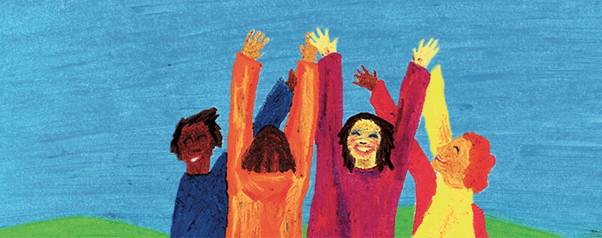
Picture above: Artwork above from the Everyday Heroes arts collaboration with students. Reproduced by permission

Ruth Friskney and Claire Houghton

Young survivors of gender-based violence are at the forefront of innovative responses to Gender Based Violence in Scotland. National young people’s participation projects like Voice Against Violence, Power Up Power Down, and Everyday Heroes have transformed Scotland’s understanding of gender based violence through young people’s perspectives. The projects’ creative, relationship-building approaches are rooted in the skills of support workers in empowering children to speak about abuse. Young survivors themselves innovate in speaking directly to people in power and reaching out to other children and young people experiencing GBV, including during Covid-19.

Voice Against Violence led this campaign, co-produced with Government, about young people’s experience of living with domestic abuse alongside their mothers.

Young survivors have worked to see children and young people recognised as victim-survivors of all forms of gender-based violence. A Voice Against Violence film was used by young survivors to critique the lack of recognition of children in legislation about domestic abuse.  A key step forward was achieved in the Domestic Abuse (Scotland) Act 2018 to finally recognise that the perpetrators’ ongoing psychological, physical, sexual and financial abuse adversely affects children as well as women.

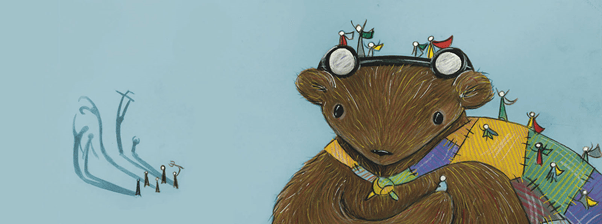
Super Listener, designed by the children involved in Power Up, Power down, to set out what children want from the adults who work with them. Now available in nine languages through Improving Justice in Child Contact. Slide the arrows left and right for English (left) and German (right).

Key messages  are consistent across projects: young people don’t know how to seek support, support is inadequate, training is needed and specialist workers are invaluable. Young survivors have taken action on this, using fabulous innovative and creative methods: websites by young sexual violence survivors for support and information, training videos and resources like Super Listener for professionals and a national online platform currently being co-developed (That’s Not OK) to take forward survivor’s recommendations to Government.

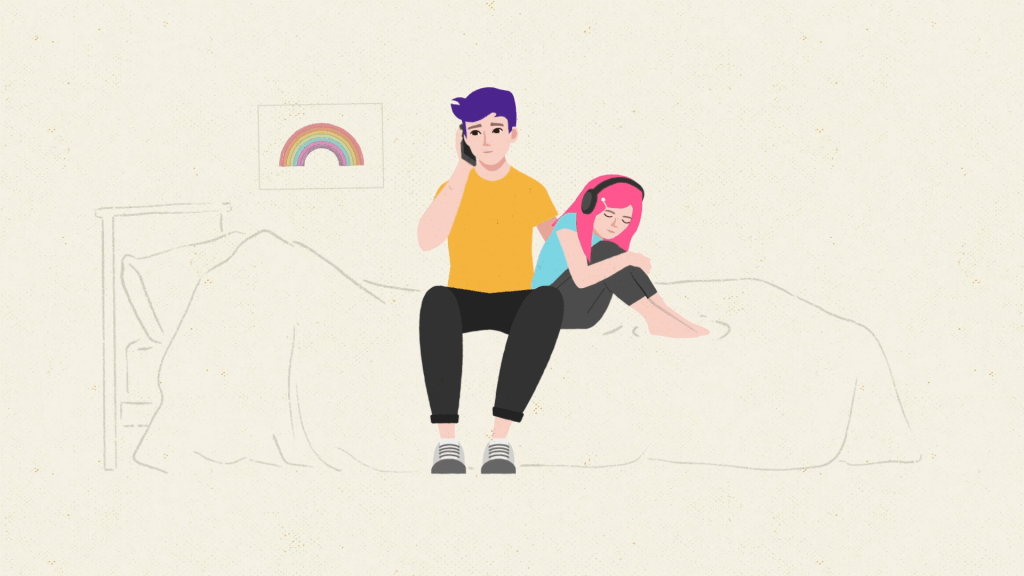
Still from You are not alone!, an animation designed by young people affected by domestic abuse for young people affected by domestic abuse. Watch different language versions from the Improving Justice in Child Contact media channel.

When COVID-19 hit, and evidence began to build about the ways in which the pandemic helped perpetrators of domestic abuse to harm women and children, Yello! a group of young advisers to Improving Justice in Child Contact (IJCC),  felt that

we had to do at least something small to help out – or at least let someone out there know that they’re not alone and what they’re going through will pass. [1]

What it was like to make the animations, from Yello’s blog: We knew we had to help

Yello! wanted to make sure that children and young people knew that there was help and how they could get to it. They worked on two animations (“You are not alone” and “If home is not safe”) and supported partners across the five countries of IJCC to tailor animations for their own languages and contexts.

Locally, young experts from AWARE, Angus Women’s Aid’s Young Expert group, created their own film about what young people affected by domestic abuse might be feeling and the questions they would be asking during COVID. The film signposts sources of help, to make sure that young people affected by domestic abuse – in their own relationships or alongside their mother – know, even in COVID, that “You are not alone”.

Artwork from the Everyday Heroes arts collaboration with students

A key message from all these projects is that the justice response to young survivors needs improvement – in particular for children and young people’s views to be given due weight and for the perpetrator, not the woman or child survivor, to be held accountable. Everyday Heroes’ call for action expressed through displays in Parliament and creative dialogue with key decision-makers resulted in a pledge for collaborative action by Ministers.

Child contact remains a key area of concern – one being considered by the Improving Justice in Child Contact project including Yello!, its young advisers. Evidence from young survivors indicates that domestic abuse continues even if a mother and child are able to separate from a perpetrator. Child[1]  contact can be defined as communication, such as phone calls or spending time, with a parent that the child does not usually live with, and its type and frequency can often be set by the Courts. Child contact is often used by perpetrators to continue to harm mothers and children. COVID-19 has provided perpetrators with additional opportunities to enhance their abuse.[2]

“Don’t dismiss us – we experienced it, and we know what we’re talking about.”

From Yello!’s evidence to the Justice Committee

In Scotland, Yello! have been instrumental in the development of the Children (Scotland) Act 2020, meeting with the Minister, submitting written evidence, and taking part in person in a session with the Justice Committee. One young woman worked with Scottish Women’s Aid to write a case study of her experience of the child contact system – with the aim of giving decision-makers a glimpse of what it is like for a young person not to be listened to, and to be told to spend time with someone she feels unsafe with.

Yello!, the young advisers to Improving Justice in Child Contact, dressed up as ghosts to meet the Scottish Minister for Community Safety in Parliament. Their key message was that young people affected by domestic abuse feel invisible in court processes that decide child contact.

Internationally, IJCC have inspired partner organisations and the young people they work with to reach out creatively to share their experiences and to meet directly with people in power. For example, young people working with the IJCC partners in Portugal have been invited to meet directly with judiciary and other key stakeholders. Maria, a young person working with the IJCC partner in Romania, has written a blog, including poetry, about her experiences:

It was only one wish I have had,

I asked not to see him again

And it is such a sombre thing

You demand that I must visit him.

I read and a tear slipped my face

Because in danger you have put me

You told me I need to stay with him

As if it was a little thing.

Note to my judge
‘Maria’, 13 years old, working with the Romanian partner in the IJCC project, writing about the experience of reading the child contact court order

Young survivors of abuse have transformed policy and practice responses in Scotland through participation – and are inspiring young people internationally with what progress is possible. Such innovation needs resources and the support of competent adults to fully harness the wonderful power, talent, expertise and passion of young survivors.

“I think projects like ours are important because not that many children and young people have a say in their lives, because people think we are too young to know better.”

Yello!, on the experience of taking part in participation work

[1] There is a large academic literature on the impact of domestic abuse on children and the particular issues around child contact such as: Katz, E. (2016). Beyond the Physical Incident Model: How Children Living with Domestic Violence are Harmed by and Resist Regimes of Coercive Control. Child Abuse Review 25(1), 46–59. Callaghan, J., Alexander J., Sixsmith, J and Fellin, L. (2018). Beyond “Witnessing”: Children’s Experiences of Coercive Control in Domestic Violence and Abuse. Journal of Interpersonal Violence, 33(10), 1551–1581 Holt, S. (2017). Domestic Violence and the Paradox of Post-Separation Mothering. British Journal of Social Work 47 (7), 2049–2067; Mackay, K. (2018). The approach in Scotland to child contact disputes involving allegations of domestic abuse. Journal of Social Welfare and Family Law 40(4), 477-495. Morrison, F, Tisdall, E.K.M., and Callaghan, J., (2020), Manipulation and Domestic Abuse in Contested Contact – Threats to Children’s Participation Rights. Family Court Review, 58 (2), 403-416.

[2] You can read Improving Justice in Child Contact’s response on COVID-19 to the UN Special Rapporteur on Violence Against Women

This blog was written by Dr Ruth Friskney and Dr Claire Houghton from the University of Edinburgh. Ruth is a Research Fellow on the Improving Justice in Child Contact project (funded through the European Union’s Rights, Equality and Citizenship Programme 2014-2020), working to improve participation in child contact processes for children affected by domestic abuse. Claire is a Lecturer in Social Policy and Qualitative Research working to improve young people’s impact on gender equality and gender-based violence policy, through Voice Against Violence (ESRC/Scottish Government funded), Everyday Heroes (Scottish Government) and the new ESRC UK project CAFADA. In writing this blog Claire and Ruth have drawn on the inspirational and creative work of the young people leading and taking part in the projects described in this blog, as well as the organisational partners: with thanks to them all.

Their twitter handle is @CYSRG1


DAY FOUR: “If I’m not in Friday, I might be dead”

This week the Femicide Census released a ground-breaking report analysing ten years of men’s fatal violence against women and girls in the UK.

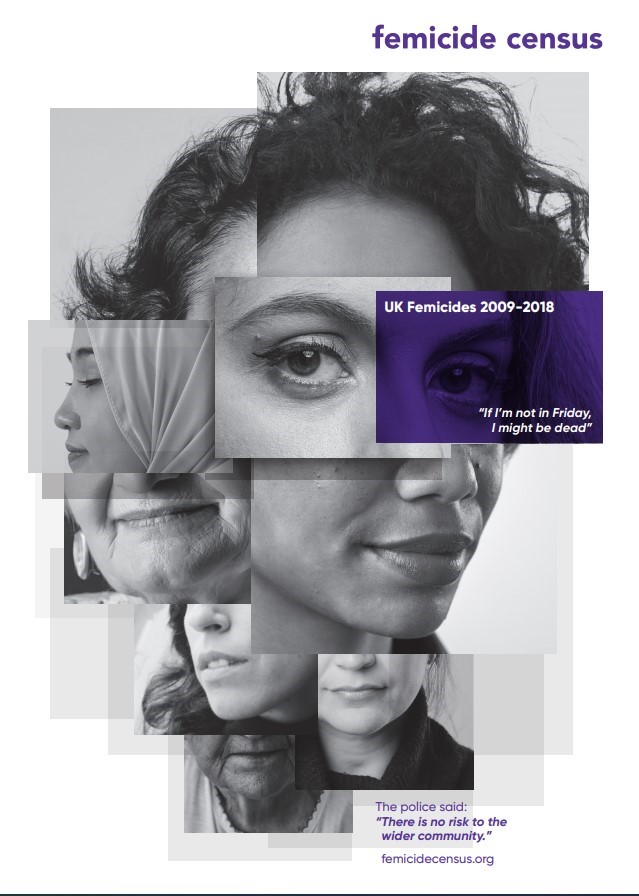
Picture above: cover of Femicide Census report of Femicides in the UK between 2009-2018. Source: femicidecensus.org

Karen Ingala Smith

This week the Femicide Census released a ground-breaking report analysing ten years of men’s fatal violence against women and girls in the UK.

The report entitled UK Femicides 2009-2018:  The police said, “there is no risk to the wider community” offers an in-depth analysis of the deaths of 1,425 women and girls aged 14 years and over killed by men and boys between 2009 and 2018.

1,425 dead women over ten years is an average of 142 a year, though in fact the range was from 124 women in 2016 to 168 women in 2010; a woman dead at the hands of a man on average every 2.5 days. The majority, 888 women (62%)’ were killed by a current or former partner, meaning that for ten years, a woman was killed by a current or former partner every 4 days. The report also addresses the suspicious deaths of another 117 women, for which, owing to various reasons addressed in the report, a suspect could not be legally held responsible. 

Femicide, the killing of women and girls because they are female, is not a specific offence in the UK.

  The specific sexed contexts of these women’s deaths were erased. Instead they were homicides (murders and manslaughters) – or where the man killed himself before he was detected, charged or convicted – unlawful killings.  But whether the law recognises it or not, there is much that is sex-specific about men’s fatal violence against women. 

The subheading of the Femicide Census is, “If I’m Not In On Friday, I Might Be Dead”. These are the words of  Judith Nibbs who said this to colleagues as she left work in April 2014. She did not go to work on the Friday in question. She was murdered by her husband.  

It’s true that there were a far greater number of men killed over those same years: 3,796[1] males aged 16 and over. But women are disproportionately victimised, comprising approximately 36% of victims but only 8% of those convicted[2] in the year ending March 2019. Between 2009 and 2018, annually between 4% and 8%[3]of men were killed by a current or former partner compared to our finding of 62% of women who were killed by men. Men are also much more likely to be killed by a same sex partner. There are sex differences in histories of abuse between couples where intimate partner homicide ends the relationship, women killed by male partners or ex-exes have almost always suffered months of years of abuse from him prior to their death, while men killed by female partners are usually those who have been inflicting abuse. There are also differences in methods of killing, sexually motivated killings and use of sexual violence, and overkilling.

Men kill women because they can and because they decide to

Men’s violence against women is often framed as a loss of control. Indeed, this is available as a partial defence to murder. But men’s fatal violence against women is much more about control, than the loss of it, particularly, but not only, when we’re looking at intimate partner femicide. Of the 62% (no. 888) of women who were killed by a partner or former partner, at least 378 (43%) were known to have separated from or to have taken steps to separate from the man who killed her. The majority of them, 89% (338) were killed in the first-year post separation and 142 (38%) in the first month. This finding ties closely with Jane Moncton Smith’s 8-stage model of domestic homicide, where four of the eight stages: coercive control, trigger, change in thinking and planning, relate to men increasing their control not losing it.  

It is not only women who are partners of abusive men who are controlled, and whose liberty is restricted by abusive men, – it is all women – in the routine choices we make, in the ways that we’re judged and whether we do or don’t comply.  

Men’s violence against women is a critical tool of patriarchy. 

Women are killed by husbands, partners, lovers, exes of all these, by men whose advances they reject, by their sons, so-called friends, neighbours, maintenance men, burglars and sexual predators as well as men who get off on women’s pain and humiliation, be they women they know or women they don’t.

Less than a month before we published the report, Peter Sutcliffe, who had killed at least 13 women and attacked at least 10 more in Yorkshire and Greater Manchester between 1975 and 1980, died in prison. His death is a timely reminder that femicide extends beyond men killing current and former partners, or other family members. Also, that the sexism and misogyny that are characteristic of systems and institutions that regulate our lives are not restricted to those that deal with the domestic. Joan Smith has argued that in the policing of West Yorkshire, men’s arrogance and misogyny meant that Sutcliffe was able to kill more women than could have been the case if survivor accounts had been taken seriously, that is, if women had been believed. Men charged with murder lie about their intent and actions even when the consequences of their crime, a woman’s dead body and the injuries that they inflicted, are plainly available as contradictory evidence.

Rape convictions have fallen to a record low, to the extent that feminist campaigners suggest that rape is as good as decriminalised. Yet stereotypes about women’s false allegations rather than men’s false protestations of innocence, and juries’ false ‘not guilty’ verdicts are those which dominate popular consciousness.

So-called ‘gender neutral’ responses to domestic and sexual violence, including prostitution, are anything but. Ignoring the sex-specific nature of women’s victimisation hides disproportionality.  The Femicide Census team are very clear that statutory services and the criminal justice system could make a difference by doing their jobs properly and implementing existing laws and policies. At the same time an inquiry into institutional sexism and the state apparatus would surely reveal a system stacked against women.

However, without a clear and ambitious strategy that addresses the individual, relational, institutional, cultural and cross-cultural factors that create a conducive context for men’s violence against women, we fear that men’s violence against women, girls and children will not be eradicated.  Approaches that see incidents of men’s fatal violence against women as isolated incidents and that do not recognise that some members of the community – women, by virtue of our sex – are at risk of victimisation by men that is disproportionate and different in nature to any violence we inflict, are doomed to reinforce the structural sex inequalities of patriarchal societies. The Femicide Census is a call to action and a commemoration of our sisters.


[1]https://www.ons.gov.uk/file?uri=/peoplepopulationandcommunity/crimeandjustice/datasets/appendixtableshomicideinenglandandwales/current/previous/v3/homicideappendixtables201718correction.xls

[2] ONS Y/E March 2019 https://www.ons.gov.uk/peoplepopulationandcommunity/crimeandjustice/articles/homicideinenglandandwales/yearendingmarch2019

[3] Ibid

Karen Ingala Smith is a co-founder and Director of the UK Femicide Census. She set up the website Counting Dead Women (CDW) in 2012, now replicated across the world. She is Chief Executive of nia, an East London charity providing services for women, girls and children who have been subjected sexual and domestic violence, including prostitution. Karen is also a doctoral candidate at the University of Durham. Karen was awarded the Positive Role Model for Gender at the 2014 National Diversity Awards.

Her social media handles are @k_ingalasmith @femicidecensus @countdeadwomen

You can find the Femicide Census report here.