Day Twelve: Gender-based Violence and our Chak De Moments

Lora Prabhu’s NGO focuses its efforts on expanding gendered participation in public spaces through sports. But before girls’ participation in sports is a systematic approach to changing surrounding environments.

Featured image source: Lora K Prabhu

Lora K Prabhu

Earlier this year, sports women in India made headlines for the wrong reasons. Women wrestlers, including Olympic medallists were protesting on the streets of Delhi, against inaction on sexual harassment charges against the Wrestling Federation president. The sordid saga of sports women being subjected to ongoing sexual harassment with impunity made it to media platforms, but the institutional response was tepid to say the least. It took five months of our star wrestlers sitting on dharna (protest), for the police to file a First Information Report (FIR) against the federation head, but with the caveat that the charges of child abuse (meaning higher punishment) were left out. There was no surprise, no public outrage and business continues as usual.

Back in 2009, my NGO CEQUIN (www.cequinindia.org) had conducted a baseline study on gender-based violence in public spaces in Delhi, with a sample size of 630 women and girls. (https://cequinindia.org/wp-content/uploads/2018/01/PerceptionandExperience.pdf) As per the findings, 96% of the respondents perceived Delhi as an unsafe place for women and 98.6% reported having faced sexual harassment in some form during their lifetime. Several other studies following this, with larger sample sizes, corroborated these findings. The Nirbhaya rape case in 2012 of a young physiotherapy student in the heart of the capital brought to the fore, the scope and impunity of gender-based violence. A lot has changed since then, in terms of an overall awareness of the issue. There are gender sensitive laws in place. Gender purportedly is being mainstreamed into planning and design, women’s cells, sexual harassment committees, etc. However, women’s workforce participation rate in Delhi remains less than 15% and India ranks 135 among 146 countries in the Global Gender Gap Index 2022.

The massive mismatch between the big increase in girls’ retention in education in the last couple of decades vis-i-vis the low and declining workforce participation rate, is I believe, the most significant indicator we need to track. While implementing the Disha project in partnership with UNDP across Haryana in 2018 (conducting career counselling and job placements for over 12,000 women college students) our critical learning was that unless we acknowledge and comprehensively address gender-based violence, we will not make any headway. Young women in higher education are the most vulnerable to sexual violence whether in their educational institutions or while navigating public spaces and even within their own homes. We are encouraging our girls to dream big, but then observing their aspirations often crushed as they step out into the ‘world’. One of the active girls from our Seemapuri project who recently dropped out of our programme due to family pressure, wistfully lamented “Would I have been better off without this self-awareness of my rights and capabilities? Maybe it would have hurt less!”  

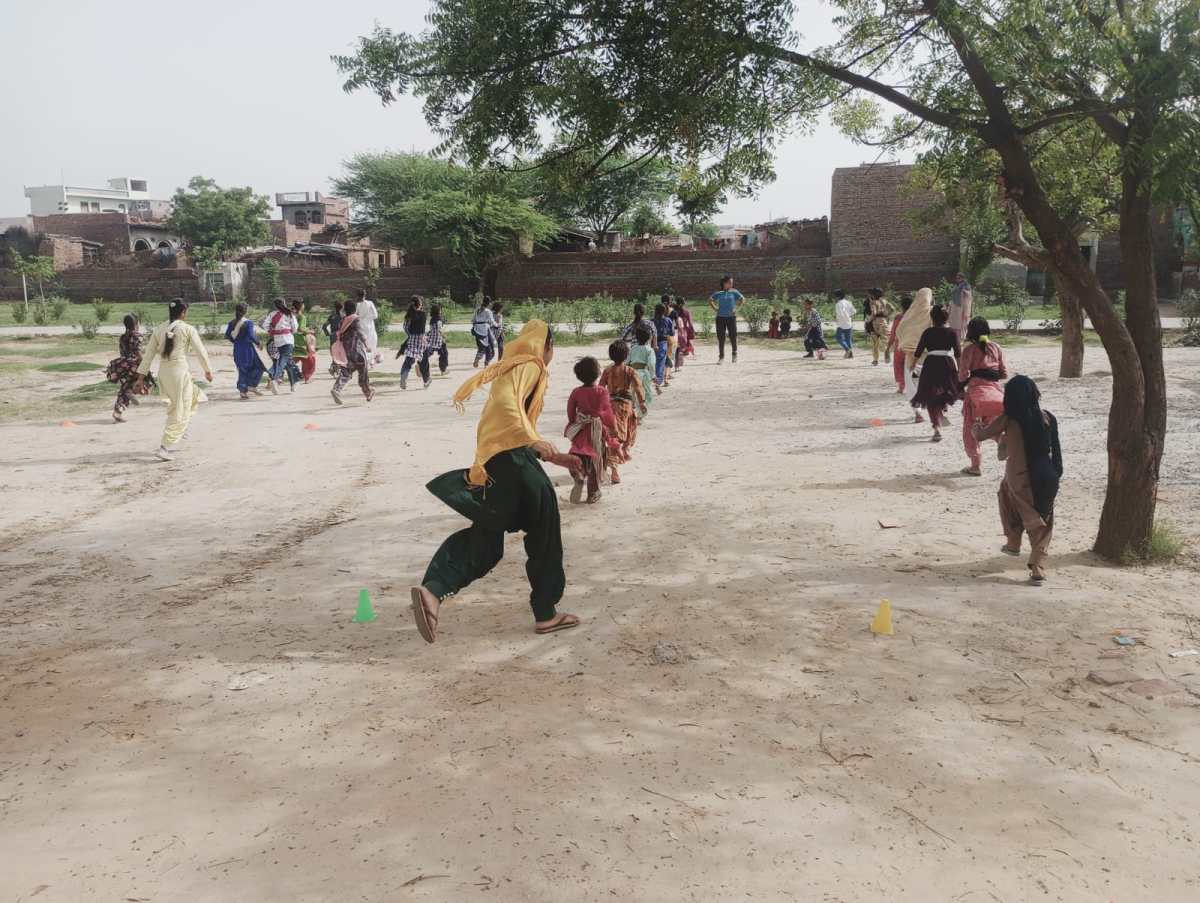
The patriarchal framing of Indian public spaces continues to present it as the male domain, and young women stepping out to join higher education and subsequently the workforce, are often treated as ‘intruders’. The ability of women and girls to navigate public space with confidence requires active challenging of gender stereotypes and consciously creating enabling environments. CEQUIN started its Kickstart Equality programme in 2010, using football as tool to challenge gender stereotypes and engender public spaces. Hundreds of girls have emerged as footballers through this programme, while learning to confidently navigate their city.        

What has it taken for these girls to be able to participate in sports in public spaces? Our programme entails creating mothers’ collectives to conduct gender audits and advocate with local stakeholders for safe and enabling environment for their daughters. We conduct a gender sensitization and leadership programme for boys, who become enablers for the girls in their peer group. We actively promote role models for girls, in the form of women football coaches, so that they have a safe and inspiring environment to blossom.

The transformation in girls participating in sports is phenomenal. From the time that they were in their hijabs or dupatta-covered heads, they now feel confident to walk through the streets in their football gear.  They regularly access public spaces; they are physically and mentally prepared to combat gendered violence; they are ambitious and driven to achieve their dreams.

While talking to some of our senior football players from Jamia University last year, they shared how street harassment has been a regular ordeal. They would travel in groups in order to feel safe. One day, frustrated by the daily onslaught, and ostensibly inspired by the film Chak De, the girls decided to thrash the boys. The boys never repeated that behaviour again. Girls playing football in public spaces is very a common sight in Jamia today. Girls claimed to feel respected while wearing their jersey, and reported feeling much safer. Counter violence on the girls’ part is not to be condoned, but the tangible increase in the girls’ physical and mental strength, definitely had a positive impact on their mobility and access.   

Earlier this year, on a field trip to our project site in rural Haryana, some of our women football coaches (who have been a part of our programme for over a decade) faced sexual harassment from middle school boys, who were not more thirteen years old. It was by far the most very unnerving experience to see how deep seated the scourge of gender-based violence is. This coincided with the street protest of our women Olympians in Delhi, driving home the fact that we have miles to go before we sleep, in the context of addressing gender-based violence.    

Author bio

Lora K Prabhu is the Executive Director and Co-Founder of the NGO CEQUIN (Centre for Equity and Inclusion). CEQUIN was set up in 2009 and has been doing pioneering work with vulnerable women and girls in urban and rural areas, focusing on gender equity and using sports for development. Prior to that, she was associated with the United Nations Development Fund for Women (UNIFEM). Ms Prabhu has 25 years of work experience, having worked as a researcher, journalist, film maker and development professional. She has a master’s degree from JNU. She has written on gender and made women centric films; worked on a voluntary basis as well as professionally with a variety of women’s organizations. She was nominated for the International Visitors Leadership Programme on Global Women’s Issues by the U.S. Government State Department in 2011. She served as member of the working group on women’s empowerment for the 12th Five Year Plan of the Government of India. She has co-edited ‘Fear that Stalks: Gender Based Violence in Public Spaces’, published by Zubaan Books 2012. Ms Prabhu served as board member of the Central Board for Film Certification (CBFC) from 2011-14. She has been a member of the Sexual Harassment Committee in public and private sector firms. She is co-convener of the National Alliance for Women’s Football in India. Her NGO CEQUIN has received several awards and was felicitated by FICCI in 2019.   
Day Twelve: Stocktaking on the functioning of The Sexual Harassment of Women at Workplace (Prevention, Prohibition and Redressal) Act, 2013 (2014-2019)

It’s been a decade since India’s premier law governing sexual harassment at work, the Sexual Harassment of Women at Workplace (Prevention, Prohibition and Redressal) Act, 2013 (PoSH-Act) came into effect. What concerns remain?

Featured image source and in-text images: Website of Partners for Law in Development

Partners for Law in Development (PLD)

It’s been a decade since India’s premier law governing sexual harassment at work, the Sexual Harassment of Women at Workplace (Prevention, Prohibition and Redressal) Act, 2013 (PoSH-Act) came into effect. Today, the law makes news mostly in the context of high-profile cases and broader social movements like the #MeToo movement. The absence of a formal monitoring and review process, and availability of public data has rarely been the focus of public attention and debate, but is of serious concern. Partners for Law in Development (PLD), a legal resource group, has systematically documented observations through its work on building capacities with government and higher education institutions. We have examined how the law functions under the PoSH-Act and outlined the protection gaps in order to contribute towards building knowledge and the discourse on the subject. Although not an exhaustive list, these are the concerns that relate to the functioning of the law that appear to cut across sectors and deserve attention.

I. Compliance largely limited to the creation of Internal Committee:

Workplaces often prioritise the formation of Internal Committees (IC) to demonstrate compliance with the law. However, it’s common to establish ICs only after a complaint of sexual harassment at the workplace. Delays in appointing ICs and long gaps between the appointments of new members have been observed within the first five years of the law’s implementation. This emphasis on IC creation may give the misleading impression that a workplace is free of sexual harassment. Unfortunately, training and orientation sessions are often neglected, held briefly, or treated as one-time events. Furthermore, government departments and agencies encounter challenges in organising meetings due to officials’ busy schedules. Many employees, including senior staff, are often unfamiliar with their workplace’s sexual harassment policies.

While many ICs exist, they may be inactive, lack functioning email addresses, or consist of unaware committee members. A similar situation is observed with Local Committees (LC), which are often unappointed or non-functional. Despite the existence of penalties for non-compliance, the lack of monitoring renders these penalties ineffective.

II. Insufficient training and sensitisation for the Committee:

Insufficient training and sensitisation result in uninformed committee members who lack the necessary skills to handle sensitive cases. Maintaining confidentiality is challenging, and committee members are often unclear about their responsibilities and the law’s requirements. Confusion often arises regarding disclosure of complaint content, regularity of IC meetings, the committee’s role in preventive work, the committee’s mandate to provide recommendations, interaction between parties involved in a complaint, and whether an unsuccessful case of sexual harassment constitutes a false claim. In some cases, external members’ roles are rendered ineffective, as they may not be included in inquiries, receive short notice, or lack impartiality.

III. Challenges in relation to new and emerging workspaces: 

The law does not provide guidelines for adapting it to new and emerging workplace types, such as shared workspaces, where individuals or groups rent communal workspace by the hour or day. Workers in the unorganised or informal sector often struggle to access the law, given the requirement to go to district headquarters to file complaints and participate in inquiries, resulting in lost wages. Unorganised sector workers and new workplace models do not align with the IC structure outlined in the law. Challenges also arise in addressing complaints against third parties in the organised sector when there is no financial contractual relationship with the organisation. Although Local Committees may be an alternative, they often do not exist or remain non-functional, creating a gap in the law. Even when they function, LCs lack the means to compel respondent participation or enforce their directions.

IV. Efficiency versus transformatory approaches:

Efficiency often takes precedence over holistic redressal, with organisations adopting approaches like the ‘zero-tolerance’ model, which results in termination for any harassment transgressions. However, this approach may lead to disproportionate punishments for minor wrongs that could be addressed through counselling, apologies, or other approaches as recommended by the law. It also avoids investing in transformation and problem-solving. Other shortcuts to inquiry include respondents resigning upon notification of a complaint, complainants facing retaliation, and workplace cultures that prioritise efficiency and profit over social responsibility.

V. Local Committee and the Informal Sector

Local Committees are intended to serve women workers in the unorganised sector, including domestic workers, cases where ICs do not exist, and cases against employers. However, LCs face delays, a lack of information, and inadequate training. Their role in relation to the unorganised sector, particularly domestic workers, is largely notional, as they can only refer matters to the police for inquiry and action. Accessing remedies is unrealistic and onerous for domestic workers in the absence of support services, workers’ unions, job security, and the need to travel long distances.

Conclusion

The above findings have emerged from extensive trainings carried out by PLD, which formed the basis for documenting the types of cases commonly reported, frequently asked questions and the gaps in statutory law. The full report of the findings can be assessed here.

Author bio

Partners for Law in Development (PLD), established in 1998 as a legal resource group works towards realising social justice and women’s rights. PLD carries out evidence based research studies, produces legal explainers on laws, posters for raising awareness on gender justice for women, and among other things engages actively with diverse stakeholders. Since the enactment of the PoSH-Act in 2013, PLD has conducted more than 160 trainings and workshops till 2019, covering more than 7300 participants from about 17 states. The findings emerging from these trainings have informed the current research paper. 

Additional Media Learning

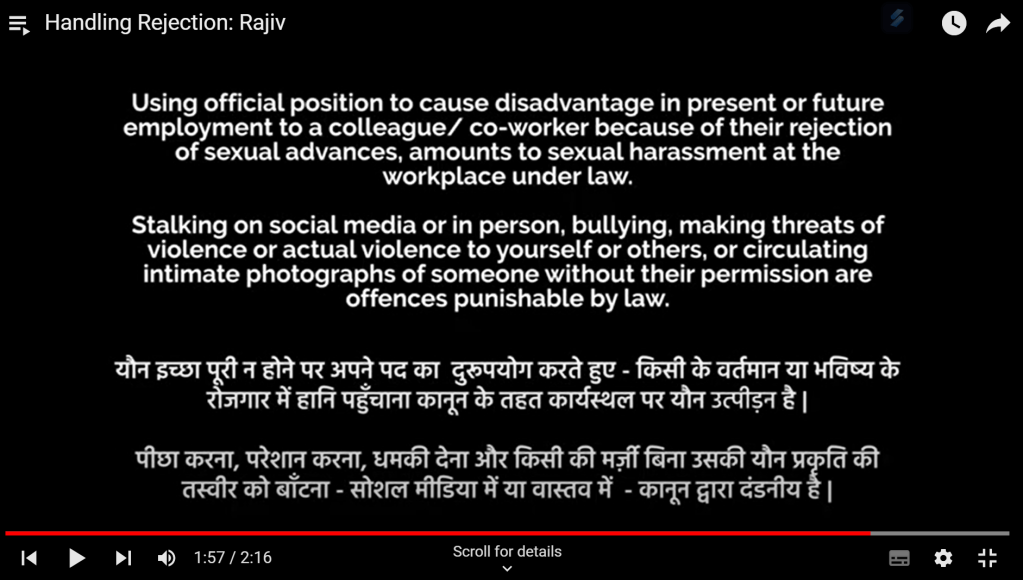
This is a series of 11 short videos on consent and rejection – conversation starters to nuance framing consent beyond binaries of victim-perpetrator, or yes-no, developed from real stories that emerged through the sexual harassment prevention work carried out by Partners for Law in Development, the video-series encourages critical, self-aware expressions of intimacy and the related grey areas of boundary setting, peer pressure, stereotyping that shape our conduct and assumptions. This series seeks to go beyond crime and punishment to explore and encourage conversations leading to transformatory approaches to popular attitudes and assumptions about sexuality.

Day Eleven: They Do What They Can – Gender Equality Officers Support Victim-Survivors of Sexual Harassment and Violence at German Universities

Who do you turn to for support at German universities as a victim-survivor of sexual harassment and violence? Often, it is hard to find any point of contact that both seems to have an official character and at the same time to be trustworthy, writes Wendy Stollberg.

Wendy Stollberg

On the lookout for support

Who do you turn to for support at German universities as a victim-survivor of sexual harassment and violence? Often, it is hard to find any point of contact that both seems to have an official character and at the same time to be trustworthy. With some patience during your internet search, you might come across the e-mail address or phone number of the gender equality officer at your department. She (mostly they are women) states that she can be approached in cases of sexual harassment and violence. What support can you expect from her?

Gender equality officers

Before answering that, let’s have a brief look at their office. Gender equality officers operate at all public German universities. This is legally enshrined in state higher education acts. Their mandate is to support and to consult the university management and the department managements in creating and maintaining equal chances for women (!) in academia. In short, their aim is reaching gender equality at their institution. Gender equality officers are elected for a 2-to-6-year term by female members of the university. They have a suspensive veto right in management decisions and – very importantly – they act independently from the instructions by others. Each university has a chief gender equality officer. Big universities additionally have departmental gender equality officers – one of them that you might have turned to as a victim-survivor. 

Striving for gender equality includes fighting sexual harassment and violence. Consequently, it is understood that gender equality officers put this topic on their agenda. Now back to the question of what kind of support a gender equality officer can give a victim-survivor.

How gender equality officers support victim-survivors

Gender equality officers provide confidential counseling. They give you a safe space to share what happened to you. They actively listen to you and verbally empower you. If you wish, the gender equality officer suggests to you further steps for redress and for your safety and well-being. She refers to other points of contact and informs about complaint procedures (if there are any). The gender equality officer offers to accompany or represent you in calls with superiors, HR and the offender. 

What you will probably not be aware of: From consultations with victim-survivors, gender equality officers gain knowledge about harmful and discriminating behavior and structures. They use it to push, develop, and organize tailored initiatives against sexual harassment and violence like, e.g., workshops, information material and codes of conduct. 

Benefits and limits of their support

Let’s sketch the most important benefits: Most of the gender equality officers are highly motivated to help victim-survivors and to fight sexual harassment and violence. Many have a background in gender studies and political activism against inequalities. Combined with the work they do as gender equality officers, they are equipped with knowledge about power abuse, dependencies and discrimination much more than other members of the university. They understand that they must handle cases of sexual harassment and violence with special care for the victim-survivors. What is more, they initiate and support awareness and prevention activities.

What are the greatest limits? Clearly, they are of a structural nature. First of all, it is difficult for gender equality officers to point out second-level support to victim-survivors: Many universities do not obtain proper procedures for handling cases of sexual harassment and violence, nor for processing complaints, nor for issuing sanctions against offenders. Second, gender equality officers are no professional counsellors and have not received training in psychology, coaching or trauma work. Third, they operate without reflection and supervision and must cope themselves with their own emotions. Fourth, they are caught in often contradicting expectations (from the institution, from victim-survivors and from themselves). They strive for structural changes and at the same time “only” help single women. Fifth, they support only women. If you are a victim-survivor of another gender, you might receive no counselling support at all within the university. Sixth, due to short office terms, gender equality officers cannot build up much trust, awareness and experience. Seventh, many of them do not have a room to conduct confidential counselling, do not have enough time available for any activities against sexual harassment and violence and often lack support within their departments. 

Helpful support? 

If you are a victim-survivor, it is only you who can judge if the support you receive by a gender equality officer is helpful to you. The truth is that by now they offer the best support you can get at most German universities. The individual gender equality officers do what they can. It is the conditions concerning the office and counseling that are not favorable. The universities must come up with more responsible and viable solutions for victim-survivors’ support.

Author Bio

Wendy Stollberg chairs the Office of the Standing Working Group for the Prevention of Sexualized Harassment, Discrimination and Violence at Freie Universität Berlin. She is the main person of contact for victim-survivors, by-standers and persons with educational, supervisory, and management responsibilities seeking advice and support.

wendy.stollberg@fu-berlin.de

Day Nine: Changing Cultures, Adapting Methods – Meeting the Challenges of Measuring Sexual Violence

Yesterday’s post was a reminder that students often feel they are talking but not being listened to. Today we hear from Professor Bill Flack about the challenges of measurement and changing sexual cultures on campus. Professor Flack was in conversation with Dr. Hemangini Gupta from GENDER.ED

Featured image source: WordPress stock photos

Hemangini Gupta and Bill Flack

  1. What is the kind of work that you’re doing around sexual harassment and sexual violence on college campuses?

I do this work in local, national, and international contexts. 

Locally, I’ve been conducting campus climate surveys focused on sexual violence victimization at my school (Bucknell University in Lewisburg, Pennsylvania, USA) since the early 2000s. I do this work with teams of undergraduate students (and occasionally master’s students), and have found their involvement to be vital in making the research relevant to their social intimacy cultures. Recently I’ve also been involved in reconstituting a local coalition against campus sexual assault consisting of faculty, student support staff, and students, to share information and resources and to work collaboratively across the various boundaries in our campus community.  

Nationally, I’ve had the good fortune to be involved in the Administrator-Researcher Campus Climate Collaborative (ARC3; https://www.arc3survey.org), a group of campus sexual assault researchers, student life deans, and Title IX coordinators (these folks are responsible for on-campus adjudication of cases that are brought to the university’s attention) that came together in 2014 and 2015 to develop a research-based campus climate survey in response to the 2014 White House Task Force (https://www.justice.gov/archives/ovw/page/file/905942/download). The ARC3 survey is currently being revised, and the 2.0 version will (hopefully) be available some time next year. I was also recently invited to be on the Advisory Committee for the Action Collaborative on Preventing Sexual Harassment in Higher Education (https://www.nationalacademies.org/our-work/action-collaborative-on-preventing-sexual-harassment-in-higher-education) at the National Academies of Sciences, Engineering, and Medicine.

Internationally, I’ve been very fortunate to have two Fulbright Scholarships focused on sexual violence in higher education, one at Ulster University in Northern Ireland (fall 2015) and the other at the University of Galway (fall 2019). One result of the Fulbrights has been the establishment of a research network that includes colleagues from throughout Ireland and the U.K. (including colleagues at the University of Edinburgh). I’m currently on the Fulbright Specialist Roster and available to help with short-term projects focused on assessing gender-based violence in higher education.

2. Was there a particular event that got you interested in this work?

Yes. Students in my first seminar on psychological trauma (I trained as a clinical psychologist, and did a post-doc at the Boston VA Medical Center) got interested in the discrepancy between prevalence rates of campus sexual assault reported in the research literature (there wasn’t as much of it at the time, back in the early 2000s, as there is now) and information on the numbers of cases reported to authorities in my university. Based on their own experiences and those of their peers, they thought that the rates on our campus were closer to those reported in the literature than those in annual campus safety reports, and so we decided to do a survey to find out. Turns out the students were right. 

3. How does this work relate to your research?

This work is my research, although I also do research on “trigger warnings,” that is the effect of telling students about potentially disturbing content in academic assignments before they’re exposed to it so that if need be they can prepare themselves for the possibility of experiencing distress. I also do some work on promoting equity and justice in college curricula. 

4. What are some of the challenges that you encounter with measuring and calibrating data related to sexual harassment and sexual violence?

Some of the major challenges in this work are trying to ask the right questions in the right ways, being as inclusive as possible with regard to those groups who are targets of harassment and violence and to the types and contexts of harassment and violence, and the lack of support for – and often backlash to – doing this work.

Regarding measurement, sexual harassment and sexual violence occur in social and intimacy cultures that are always changing, and so researchers are always catching up with those changes (this underscores the importance of involving members of the groups we’re interested in in designing the research!). My favorite example of this goes back to our first survey at Bucknell. The students insisted that we assess hooking up as a risk factor, and I had no idea what hooking up was (well, I knew a bit because I had watched ‘Sex and the City’ where they’d talked about “friends with benefits,” but that was the extent of my knowledge). Turned out that hooking up was more strongly related to sexual assault than alcohol consumption, and that it was (is) a fairly complex phenomenon (hookups vary in lots of different ways).

So we try to improve our measures as best we can. One current example is the new revision of the Sexual Experiences Survey (Koss et al., 2007), commonly considered the “gold standard” for survey-based assessment of sexual violence, due to be published very soon. It’s been changed and extended in some interesting and, hopefully, useful ways, for example replacing “consent”-based language with “permission”-based items that are designed to be closer to respondents’ experiences. 

Inclusivity is a huge challenge in this work, both in terms of how and what we ask about in survey questions and with respect to including sufficient numbers of those who’ve experienced sexual harassment and assault especially from members of groups that are typically minoritized, marginalized, and otherwise oppressed within our campus communities. Response rates vary in this kind of research, but it’s very difficult to get large percentages of the campus population to respond to research surveys about emotionally distressing experiences, and the smaller the subgroups the more challenging it is to obtain response rates sufficient to analyze statistically. 

Over-sampling of those subgroups is one way to deal with this problem. Another is to use a combination of surveys and interviews focused more on qualitative information, so called “mixed methods.” While ideal in combination, this kind of work is labor-intensive and requires substantial resources of time and funding. That’s not an excuse not to do it, of course, and there are excellent models such as the critical approach taken by Michelle Fine (https://www.gc.cuny.edu/people/michelle-fine) and colleagues.   

Finding support to do this work is also difficult. Although the situation has improved somewhat over the last few decades, it remains difficult to find grant funding for this kind of work, especially in the international context. And sometimes it’s not just lack of support, but rather denial that sexual violence is a problem and aggressive criticism aimed at stopping the work of researchers, community workers, and activists. As Susan Faludi and others have taught us, when work against oppression has an impact we can expect backlash from those with a stake in maintaining the status quo.

About Bill Flack

Professor Bill Flack trained as a clinical psychologist and has focused increasingly on critical and community psychologies. His research is aimed at understanding and eliminating sexual assault and other forms of gender-based violence in the context of higher education. His teaching and research help students to understand the shortcomings of current psychological knowledge in order to improve it toward more socially just ends.

Day Eight: Can’t or Won’t? – The difficulties of changing systems in institutions. 

Shifting lens to UK contexts today, Amy Life and Sharessa Naidoo write from their experience of #MeTooEdiUni, reflecting on what it means to feel like you are speaking without being listened to.

Featured image: via Amy Life

Amy Life & Sharessa Naidoo

As students, safety in university spaces is something we feel we should be able to take for granted. But how can students feel safe if their abusers are allowed to remain on campus? Sexual assault shouldn’t be part of the university experience. Seeing your abuser in the same spaces where you are trying to study should not be a common experience for students either. Yet, it remains the case that university establishments would rather let students off the hook for sexual assault than receive the negative press that’s attached to having known rapists on campus. Using redressal systems that are not fit for purpose, systems that were originally intended for cases of academic misconduct, is a surefire way of avoiding the issue at hand. 

#MeTooEdiUni was set up in the wake of a petition from Aarti Mukehedkar calling for the University to change the way they handle cases of sexual misconduct. Aarti’s experience of the university’s redressal system is similar to many other students with numerous reports of victim blaming, unfair hearings and lack of support following negative outcomes. Given the adverse effects on students’ mental health, the obvious miscarriage of justice and the overall disregard for student safety, we felt it was necessary to spark a movement for change. Our campaign was focused on the specific need to review the Student Code of Conduct (the document outlining the redressal process) and change a system designed for dealing with academic misconduct and make it fit for the gravity of sexual assault cases. 

Petitions, open letters and protests allowed us a seat at the table and yet, whilst we were part of the conversation, we did not feel listened to. It’s easy to fall into the trap of thinking that being in the room guarantees you a voice and perhaps we fell into this trap too. Despite our carefully outlined amendments to the code, our ideas for improving fairness, for taking into account the diverse experiences of students, for keeping people safe, we were met with only faint smiles and empty promises. It is in the interests of institutions to focus on the small minutiae of important documents, to make changes but never the ones that will equate to a real difference in the systems set out by the document. Our improvements were eventually reduced down to simple clarifications, the odd change of word order or added explanation, but nothing that would amount to a better, fairer, and safer redressal system. It was, in want of a better expression, soul destroying. There are only so many times you can sit at a table of people with more power than you and ask for victims of sexual assault to be believed before you become exhausted and simply give up. The problem is that this is exactly what the University wants, it’s how these systems remain unchanged, and it’s how miscarriages of justice go uncorrected. 

Bureaucracy is the weapon that institutions wield against change-makers and it’s certainly effective. Eventually, after months of effort and no real changes, we were told that if we wished to continue raising the issue, we must voice our concerns via the Edinburgh University Students Association. This was an easy way to silence us – we could only speak through a system, not through our own voices. In order to make change then, we must ask others to speak for us, there is no longer a seat for us at the table and nothing has really changed. We still hear about students going through the process and being left out to dry while their assailant faces no consequences for their violent actions, and we are angry. They are angry. And we are all tired. 

It’s hard to see through this mist of gloom, to see the light of change at the end of a dark, labyrinthine tunnel. But as Sharessa Naidoo, a previous president of Girl*Up and one of MeTooEdiUni’s campaigners points out, the campaign marks a significant step forward. We have heard about the experiences of students, and the issue is out in the open. The awareness that the campaign created will hopefully mean the next students to fight for changes won’t have to start from scratch – something that both Sharessa and I feel incredibly proud of. More change is needed, of course, especially with regards to tailored support for BAME survivors.

“Concrete change is still needed as university survivors require tailored support. As a brown woman, I call on the university to hire more BAME sexual assault response staff, specifically trained to help BAME survivors. My experience growing up outside the UK as a racialized minority means my experiences and feelings related to sexual assault are vastly different. If I were to undergo an assault, there would be cultural shame. My self-perception would shatter, which has forever been based on my ability and my family’s ability to protect me. Being exotified is another experience only BAME individuals have, that affects our sexual encounters. Conclusively, there are many instances where racism and a sexual assault are inseparable.”

Sharessa Naidoo

It is vital when campaigning for overhauls of sexual assault redressal systems in higher education to account for the diverse experiences of diverse student bodies and it’s concerning that university’s failures to even look at the way their redressal system causes harm will perpetuate existing inequalities. 

When it comes to the issue of sexual violence in higher education, there is an important question that we must ask: is it that these institutions can’t improve justice, implement trauma-informed processes, account for experiences of BAME and other minority students, or is it that they won’t? And if they won’t why won’t they? When student safety is at risk, are we really going to be fooled into believing that a system designed for academic misconduct can cope with cases of sexual misconduct?

Author Bios

Amy Life is a fourth year French and Philosophy student and the Undergraduate Communications Intern for GENDER.ED. She has previously been the president of Edinburgh University’s Feminist Society and is one of the founders of #MeToo Edinburgh University. 

Sharessa Naidoo graduated with a MA in Maths and Philosophy from the University of Edinburgh in 2023. She is a 4th generation South African of Indian-origin. Much of her experiences are shaped by her South African upbringing and time spent in her Johannesburg-based all girls’ high school as a South Asian. She served as Girl Up Edinburgh’s President at the university from 2021-23. Girl Up Edinburgh is a student club a part of the global Girl Up UN Foundation Movement aimed at empowering young girls and women to be community leaders. Her time at Girl Up gave her greater exposure to sexual assault on campus and the ability to talk to survivors. She is passionate about anti-racism and how structural injustices can be identified and solved most effectively.