
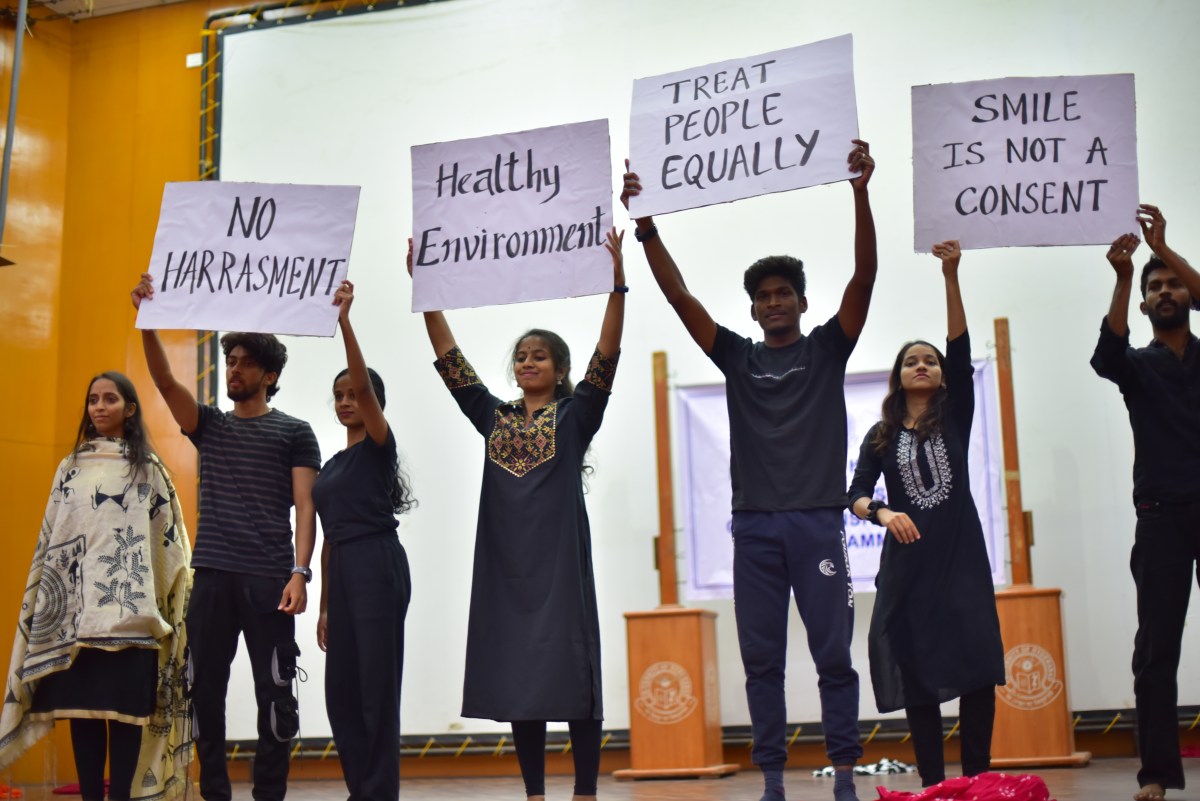
Featured image title and source: Flashdance at a Gender Sensitisation program on the Uni of Had campus recently, courtesy Aparna Rayaprol
Aparna Rayaprol
It is now more than two decades since a woman student was sexually assaulted on the campus of University of Hyderabad by some ‘outsiders’. Faculty and students protested for five days and the atmosphere was turbulent. Women students were traumatised and felt it could easily have been one of them. Issues of security were discussed and there were attempts to put the onus of responsibility on the women students, restricting their movements, supposedly for their own safety. In a cultural context where conversations on sexuality and sexual crimes are often swept under the carpet, it was almost impossible to create an open, non-sexist discussion. However, the silver lining was that the campus community came together to discuss sexual violence and how to create a safe campus for its students.
Institutional responses over time
With time, the faculty and students who were involved in gender sensitisation activities, tried to shift the focus from ‘protection’ of women students to creating a culture of trust. By 2001, the Committee against Sexual Harassment (CASH) was created and the Vishaka guidelines were being adapted to suit the needs of a central university with a diverse population. I was made a member of this Committee and we soon started to deal with a variety of cases. The Chair, a senior professor who was well-respected for her work on child rights in the country, could protect the Committee from undue influences from university authorities and political interests. We had many meetings to deliberate on a host of cases, including one of sexual harassment of a student by a professor which went on for a number of months.
Students and faculty were called to depose before the Committee. This was a new experience for members as well as the university community, and it certainly set the tone for a campus space that was not only safe, but also proactive in dealing with issues of sexual harassment. Procedures were put in place for lodging complaints and the process for examining them, and the learning was immense for all of us. The Committee had members from civil society organisations and those with legal experience, who brought in expertise from the field and the courtroom. There were cases of early stages of cybercrime, such as obscene emails, derogatory posters about women around Holi and public displays of love and proposals of marriage to women students by male students without their consent. The committee too had members who may believe in gender equality but continue to restrict the freedom of women.
Good Institutional Practices
A decade later the Committee became GSCASH as gender sensitisation became part of its proactive remit rather than just being a reactive body. Cries for the ‘freedom to wear what we please’ and candlelight marches to ‘take back the night’ were witnessed on the campus from time to time. Students became actively engaged and street plays about sexual violence and the gender spectrum evolved. Orientations for new students now have posters about ragging and sexual harassment as well as sessions to talk about these issues. Today, we have transgender students who are struggling to have gender neutral facilities and fighting toxic masculinity. A few years ago the GSCASH conducted a sensitisation session for administrative staff and security, although it is yet to become an institutionalised practice.
Student-led sensitisation on our campus has been the most successful over the years. Faculty members have helped create spaces for discussions in and outside our classrooms wherever possible. After the ‘Me too’ campaign, a number of discussions took place on issues of power and hierarchy in academic institutions. The UGC Saksham team visited the campus and conducted an audit of the policies and practices over the years. The document showed that UoH had made considerable progress in creating an environment that respected social justice more broadly. While some institutions had no committees until recently when it became mandatory under UGC mandate, at the UoH gender equality has always been on the agenda. The awareness of diversity and the intersections of gender with caste, region, religion, and class have been quite high. The student representatives on the GSCASH are elected annually as part of the Students’ Union general elections. Today there are three elected representatives from different programmes on the committee. It is now called ICC as per the UGC guidelines and that results in ambiguity among students who have little idea about the meaning of complaints.
Challenges
Every now and then, an incident of sexual violence and distrust among students makes one reflect on how new forms of patriarchy tend to replace older attitudes and behaviours, creating further fissures, especially when political groups off and on the campus seek to use gender for their own goals. There are discussions on who should not complain against whom and that other intersecting identities should be given greater precedence. The chair of committee and her ability to negotiate with the students and be firm with the administration is very crucial to the smooth functioning of the ICC. The university authorities cannot influence the proceedings or outcomes of the complaint.
Author bio
Aparna Rayaprol is a professor of Sociology at the University of Hyderabad in India. Her areas of academic interest include gender studies, diaspora, qualitative research methods and urban sociology. She is the author of Negotiating Identities: Women in the Indian Diaspora, New Delhi, Oxford University Press, 1997. Her PhD was from the University of Pittsburgh and she was at Princeton University at the Center for the Study of American Religion in 1998-99. She was a member of the GSCASH at the University of Hyderabad in its early years and continues to be actively involved in gender sensitisation programs on and off campus. She worked on gender training of school teachers in Hyderabad and co-authored a Gender Training manual for Teachers in 2022.
arayaprol@uohyd.ac.in
 16 Days Blogathon