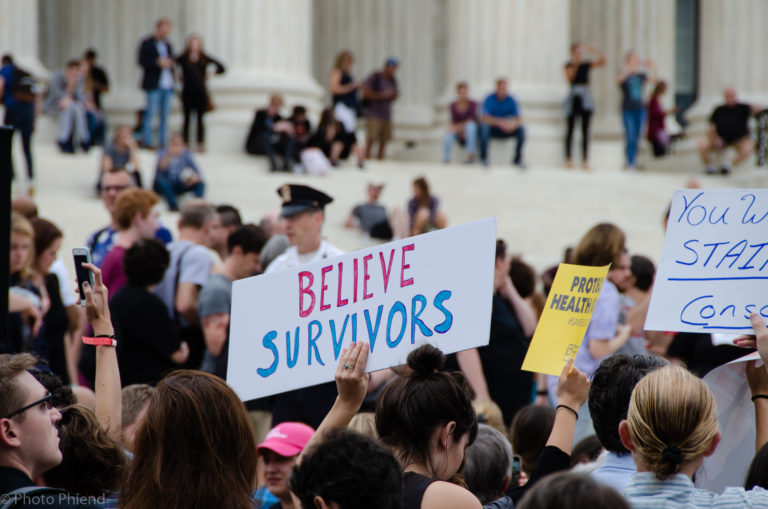
Featured image from Photo Phiend / Flickr.
Catherine Donovan
I am a feminist. These are the things I struggle with. How do we get a better understanding and response to domestic abuse in the relationships of lesbians, gay men, bisexual women and men, trans and non-binary folk?
There is a public story about domestic abuse that tells us that ‘the problem’ is that of cisgender heterosexual men being, primarily, physically (including sexually) violent towards cisgender heterosexual women.
(Donovan and Hester 2014)
We know that men are vastly more likely to be the perpetrators and women the victim/survivors. But the public story of domestic abuse has unintended consequences for members of LGBTQ+ communities who are victim/survivors of domestic abuse and seek help. Assumptions follow from this public story of domestic abuse: that men can’t be victim/survivors; women can’t be perpetrators; perpetrators are bigger and stronger than victim/survivors who are smaller and weaker/passive. The public story of domestic abuse doesn’t just describe a problem, it creates a problem with particular contours in our minds, in the minds of those who are victimised and in the minds of help-providers. It makes it difficult to tell different stories and it makes it difficult for them to be heard. How can we make it easier for victim/survivors from LGBTQ+ communities to recognise and name what is happening to them and get the help that they need?
Could we – should we? – stop talking about gender when we talk about domestic abuse and talk instead about the power seen/felt in what we call relationship rules and practices of love?
(Donovan and Hester 2014)
The first rule is that the relationship is for the abusive partner and they will make all the key decisions. The second is that the victim/survivor is responsible for everything – the abuse, the abusive partner, the relationship, the household if they share, the children if they parent. And love can somehow be a glue keeping abusive relationships together and encouraging victim/survivors to keep forgiving and remaining loyal and staying or returning to abusive relationships. Perpetrators use love and promise to change, beg forgiveness and seek understanding by explaining their abuse and their neediness.
Of course, these relationship rules and practices of love have been shaped by dominant ideas about cis heterosexuality, femininity, and masculinity with binaried and unequal gender norms at the heart of them. I don’t want to lose this analysis and the consequences of patriarchy. But I also want to make sure that anybody who is being victimised by domestic abuse can get access to help. It seems to me that unless we can unhook the perpetrator/victim binary from a heterosexual man/woman binary and their accompanying strong/weak binary and active/passive binary (Donovan and Barnes 2020) then those who are not heterosexual, those who are bigger and/or physically stronger than their abusive partner, those who are not victimised primarily with physical force including physical sexual violence, will not be seen or heard and supported.
If not, and this seems quite common, where there are two women or two men in an abusive relationship there is a tendency to assume there might be mutual abuse or, as it is sometimes called, bi-directional violence. I think this is because without the heterosexual abusive binaries outlined above it becomes difficult to ‘work out’ who is the perpetrator and who is the victim/survivor. If we could focus on how power operates through relationship rules and the practices of love we might be better able to identify whether, in fact, one partner is using physical violence or other behaviours to manage, resist, and/or defend themselves against the domestic abuse of their partner. If we can put assumptions about heteronormative, binaried gender to one side and focus on the direction of power, the relationship rules, the way that love operates in the relationship then we might better understand that rarely are any victim/survivors passive and weak. On the contrary, victim/survivors are made responsible by the perpetrator, they manage everything including their own behaviours and those of their abusive partner, attempting to pre-empt their needs and demands in order to mitigate the abuse. They also fight back, they try to (re)establish an equal relationship. It doesn’t work because perpetrators are more willing to use abusive behaviours (and use them regularly) to remind victim/survivors of the relationship rules and/or to punish them for not obeying them. But this is why domestic abuse is often so difficult to name. The imagery that reflects the public story – the man in the foreground, standing, a hand in a fist raised, larger by perspective than the woman in the background, on the floor, kneeling, sitting, smaller, at the mercy of the man. This is powerful imagery. Perhaps it has been too powerful or successful because it has unwittingly created limited ideas about what counts as domestic abuse and who counts as legitimate victim/survivors. The public story of domestic abuse is not enough to allow all of those victimised by domestic abuse to get the help they need. This what I struggle with, and I am a feminist.
REFERENCES
Donovan, C.; Hester, M. (2014) Domestic Violence and Sexuality: What’s Love Got to do with it? Policy Press: Bristol. http://www.policypress.co.uk/display.asp?ISB=9781447307433& Now out in 2015 paperback.
Donovan, C. and Barnes, R. (2020) Queering the Narratives of Domestic violence and Abuse. Palgrave: London.
AUTHOR BIO
Catherine Donovan is Professor in Sociology and Head of Department at Durham University UK. For the last 30 year she has been researching the intimate and family lives – more recently focussing on domestic and sexual abuse – of lesbians, gay men, bisexual, and, trans folk. Her work, both with Prof Marianne Hester and with Dr Rebecca Barnes, has been innovative focussing as it has first of all on comparing love and violence in same sex and heterosexual relationships and then on lesbians, gay men, bisexual and trans folk who use violence and abusive behaviours in their intimate relationships. She has also been involved with research considering perpetrators of family abuse in minoritised communities including targeting lesbians, gay men bisexual and trans folk. She is on the Drive Partnership national working group on LGBTQ+ perpetrators and is a Board member of WWiN a domestic abuse service in Sunderland, North East England.
 16 Days Blogathon