DAY ELEVEN: The Politics of Reproductive Mobility: Criminalisation of Abortion as Gender-Based Violence

Sinéad Kennedy connects the politics of mobility with the right to access abortion in this illuminating piece. She says, “Criminalising abortion did not stop Irish women from ending their pregnancies; If they were “mobile”, they travelled to Britain to access abortion. If they were “immobile” they risked a 12 year prison sentence and sought clandestine, illegal abortions even if that meant putting their lives, health and liberty at risk.”

Sinéad Kennedy

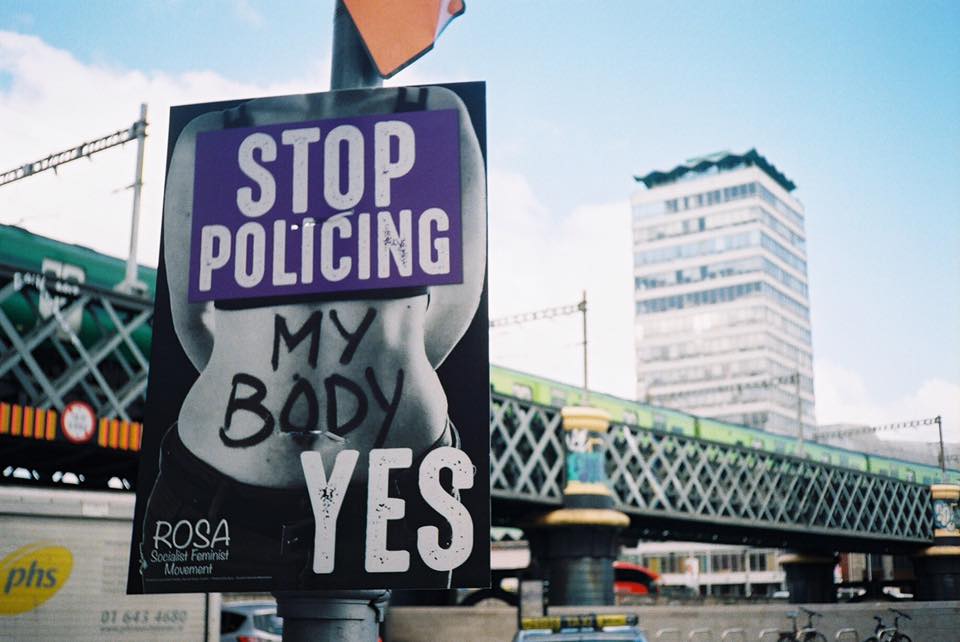
Featured image: ‘Stop Policing My Body in Dublin’, taken by Aerin Lai

In almost all European countries abortion is permitted. According to the Centre for Reproductive Rights, standard European practice is to legalise abortion on request or broad social grounds, in at least the first trimester of pregnancy. In addition, most countries also ensure that abortion is legal throughout pregnancy when necessary to protect the health or life of the woman or pregnant people. Only in a very small minority of European countries, namely Poland and Malta, does the law prohibit abortion in almost all circumstances.

Yet, abortion provision remains subject to criminal law: abortion services may largely be provided as part of maternal and reproductive health, but unlike other aspects of healthcare, abortion continues to be conceptualised within a legal framework.

So instead of the law guaranteeing the right to abortion, abortion is understood as a criminal offence – either by the person seeking the abortion and/or the medical practitioner providing the service – and therefore only permitted within a legally controlled framework.

The consequences of violating this framework include hefty prison sentences. No other form of healthcare is subject to this level of criminalisation and it creates a profound “chilling effect” on both those seeking abortion care and on healthcare providers offering legal abortion services.

Even in countries where legal restrictions may only apply to the stage at which abortion is available, criminalisation still results in a precarious social and legal situation for people in need of abortion, forcing many to travel to access the services that they need. This system of “enforced” mobility disproportionality effects those with neither the means nor the ability to be “mobile”, particularly poor women, disabled women, migrant women and pregnant people.

Abortion access, therefore, is intimately connected with questions of mobility and immobility. Mobility allows some people to move and requires other people to remain fixed in place. Thus the term “mobility” captures both movement and “stuckness,” meaning the ways in which movement occurs, and the attempts to regulate or prevent it.

Reproductive mobility is used by states to regulate and discipline the act of reproduction. Particularly as embodied in women’s fertility; it becomes a means of fixing fertility: dealing with, sorting out, and putting it right.

Reproductive mobility is a contested space; a site of conflict but also a site of potential political transformation. Indeed the issue of reproductive mobility has become a key aspect of abortion activism. For example in Ireland, where abortion was criminalised in almost all circumstances except where a woman’s life was at risk, abortion activists have long exploited the political potentialities inherent in reproductive mobility, underscoring the hypocrisies and vulnerabilities inherent in the Irish state’s regulation and control women’s fertility and mobility. During the successful 2018 “Repeal” campaign to legalise abortion, activists highlighted how Irish women have long sought to access abortion through mobility.

For decades in Ireland, abortion was shrouded in secrecy and shame. Then, in 2013, the story of the death of Savita Halappanavar because an international story that exposed the violence behind Ireland’s criminalisation of abortion. Savita, a 31 year-old Indian national living in Ireland, attended a leading Irish maternity hospital, miscarrying for 16 weeks. Doctors there felt unable to offer standard medical treatment due to the presence of a foetal heartbeat. Pleading for her life, Savita repeatedly asked for an abortion but was refused and was told “Ireland is a Catholic country”.  Five days later she died of septicaemia.

The Irish campaign to legalise abortion that exploded in months after Savita’s death saw the historic silence around abortion evaporate as thousands of women came forward to tell their abortion exile stories publicly through campaign groups like TFMR (Termination for Medical Reasons) and anonymously through the In her Shoes campaign.

These stories included the experiences of women who have been raped; women who were denied life-saving medical treatment like chemotherapy simply because they were pregnant; women with desperately wanted pregnancies, who after receiving the devastating diagnosis of a fatal-foetal anomaly were told they must continue their pregnancies to term regardless of the outcome.

Criminalising abortion did not stop Irish women from ending their pregnancies; If they were “mobile”, they travelled to Britain to access abortion. If they were “immobile” they risked a 12 year prison sentence and sought clandestine, illegal abortions even if that meant putting their lives, health and liberty at risk.

Most importantly, these abortion stories themselves also “travelled” between national contexts, becoming a key focus for activists in Malta, in Poland and in United States. These stories highlighted the enforced immobility of many women within borders, especially asylum seekers who remain “stuck” and unable to access abortion because they lack mobility. This political form of storytelling not only humanises women and pregnant experiences, but also exposes how a state’s control and criminalisation of reproductive healthcare amounts to nothing less than state-sanctioned gender-based violence.

Author’s Bio

Sinéad Kennedy teaches in the Department of English at Maynooth University, Ireland. She was a founding member of Together for Yes, the 2018 campaign to remove Ireland’s constitution ban on abortion and continues to campaign for reproductive justice in Ireland through Action for Choice.

DAY ELEVEN: Anti-Abortion Ideology on the Move: Examining Mobile Crisis Pregnancy Centers

You likely wouldn’t think of volunteers at crisis pregnancy centers—unregulated anti-abortion non-profit organizations that masquerade as health clinics—as the backbone of the anti-abortion movement. But this industry has become a primary mechanism through which the anti-abortion movement spreads its ideology writes Carly Thomsen. 

Carly Thomsen

Featured image: “Devil Bus” by Rayn Bumstead, graduate of Middlebury College, where she was co-organizer of the Queer Artists’ Collective. “Devil Bus” highlights the dangers of mobile CPCs and counters the happy, rosy, and warm aesthetics that mobile CPCs use to downplay their political agendas. 

When you think of who makes up the anti-abortion movement, you might imagine activists protesting in the streets. Or political lobbyists working with conservative lawmakers to enshrine their beliefs into law. Or religious leaders condemning abortion. You likely wouldn’t think of volunteers at crisis pregnancy centers—unregulated anti-abortion non-profit organizations that masquerade as health clinics—as the movement’s backbone.

But the crisis pregnancy center (CPC) industry has become the primary mechanism through which the anti-abortion movement spreads anti-abortion ideology. Indeed, the anti-abortion movement invests more time and resources into CPCs than any other aspect of their work. Such funneling of resources reflects the anti-abortion movement’s belief that CPCs are a useful site from which they can make mobile anti-abortion sentiment and enact what we ought to consider gender-based violence under the guise of care and concern.

Deception is central to this work. Scholars, reporters, and activists have illustrated what CPCs’ deceptive practices look like: disguising their political and religious motivations; implying that they offer abortions when they do not; opening near abortion clinics with the intention of confusing and thus hijacking those en route to the clinic; and peddling false information regarding abortion.

Scholars found, for example, that 80% of crisis pregnancy center websites listed in state resource directories for pregnant women include false or misleading medical information, including that abortion leads to breast cancer, infertility, and mental health issues, among other claims that have been repeatedly proven false.

Such inaccurate information is given credence by the aesthetic decisions of CPCs, which suggest that they are medical clinics when they are not. For instance, some CPC volunteers wear white lab coats and some CPC websites include medical imagery. Perhaps more worrisome, CPCs also increasingly offer free ultrasounds, although they do not make clear to clients that these ultrasounds are meant to be “non-diagnostic,” and therefore are not medical in nature.

Recently, the CPC industry has started to take their anti-sex, anti-abortion messages on the road, using mobile on-the-go buses and vans to extend their geographic and political reach. Mobile CPCs use many of the same strategies that brick-and-mortar CPCs use; however, their geographic slipperiness raises additional concerns beyond those associated with stationary CPCs.

First, mobile CPCs are able to park immediately outside of abortion clinics, allowing them to get closer to abortion seekers than brick-and-mortar CPCs can. Second, their mobility allows them to travel along routes that can constantly shift; this unpredictability and nimbleness makes more difficult possibilities for anti-CPC resistance. Third, mobile CPCs spread anti-abortion messages while in transit, quite literally moving around anti-abortion sentiment in ways that brick-and-mortar CPCs simply cannot. Fourth, if we listen to what the CPC industry tells us, mobile units are allowing the anti-abortion movement to more effectively target low-income women, women of color, and women in rural areas. Lastly, mobile CPCs will be even more difficult to regulate than brick-and-mortar CPCs.

If a city or state were to pass laws restricting the activities of CPCs in their jurisdiction—as most states and the federal government have done regarding abortion—mobile crisis pregnancy centers could simply drive to a neighboring area without these same laws in place, a problem that would remain even if passing legislation to regulate brick-and-mortar CPCs became common.

Despite these problems, there are no state or federal laws regulating mobile CPCs and there are no large-scale feminist campaigns directed specifically at mobile CPCs. In fact, we don’t even know exactly how many mobile CPCs exist. In the U.S., where the anti-abortion movement has utilized mobile CPCs more than in any other country, estimates of the numbers of mobile CPCs in circulation range from 170 to 260. (For context, there are approximately 2600 brick-and-mortar CPCs in the U.S. and just 700 abortion clinics.) While the U.S. is the epicenter of the CPC industry, CPCs exist in more than 100 countries. They are clearly a global problem. According to a Heartbeat International database, there are, for instance, 249 CPCs in the United Kingdom. And there are eight mobile CPCs outside of the U.S.

Regardless of the scale at which mobile crisis pregnancy centers operate, they raise concerns worthy of consideration by scholars, policy makers, and activists—especially because the anti-abortion movement is increasingly using mobile units to spread Evangelicalism, medical misinformation, and anti-abortion ideology. In so doing, mobile CPCs, like brick-and-mortar CPCs, raise serious public health and data privacy concerns.

Mobile CPCs, therefore, should encourage those of us on the political left to re-think the positive affects that tend to stick to mobility and movement. Mobile crisis pregnancy centers use their mobility to reproduce dominant power relations, further entrenching the sexism, racism, and classism of the status quo through remaking the spatiality of reproductive politics.

In short, mobile CPCs demonstrate that movement and mobility can thwart people’s opportunities to develop liberatory imaginaries, desires, and futures. While CPCs’ mobility has created new possibilities for the anti-abortion movement to capitalize on people’s marginalization and enact the kinds of gendered violence inherent within anti-abortion activism, it also could inspire new forms of abortion justice and anti-gendered violence activism. We might just have to hit the road to do it. 

Author’s Bio

Carly Thomsen is assistant professor of gender, sexuality, and feminist studies at Middlebury College. She is the author of Visibility Interrupted: Rural Queer Life and the Politics of Unbecoming from the University of Minnesota Press (2021) and directed and produced In Plain Sight, a documentary short that extends the arguments of this book. For more information about the film, visit http://www.inplainsightdocumentary.com. She’s currently completing a book about queer reproductive politics. Learn more about Thomsen’s research and teaching at www.carlythomsen.com.