DAY TWELVE: I Never Ask For It: Building Testimonials to Gender-Based Violence

Over nearly twenty years, Blank Noise has worked with citizens and communities across India and beyond to build testimonials of gender-based violence. Blank Noise rests on the power of feminist collaborations and building feminist solidarities, writes its Founder-Director Jasmeen Patheja in today’s blog.

Jasmeen Patheja

Featured Image: Clothes from the I Never Ask For It campaign. Image credit: Jasmeen Patheja.

An idea has no significance or meaning unless someone makes it their own.

Blank Noise is a growing community of Action Sheroes/ Theyroes/ Heroes: citizens and persons taking the agency to end gender-based violence. Blank Noise was initiated in 2003 in response to the silence surrounding street harassment in India and globally. While for the first decade, Blank Noise worked to bring attention to street harassment, its next phase was an inquiry into the nature of victim blaming. Blame permeates spaces of violence. If blame has been used to justify violence against all identities and spaces, how can we be Action Sheroes everywhere? Not just on the streets, but in our power at home, on campus, at our workplace, on the internet.

In 2003- 2004, since the start of Blank Noise,  I reached out to women around me, to speak with me about their experiences of street harassment. Responses ranged from “it doesn’t happen to me”, “how can you ask me this question – I am not that type of a woman”, to “it happened to me, I was wearing my school uniform and it still happened.”  

The dominant climate back then was ‘good girls’ don’t experience it, don’t name it, and if you do experience it, you ‘asked for it’. Fear and the threat of street harassment was a given and normalised. 

The more I listened, I paid attention to the fact that garments were being recalled and named in testimonials. I recognised that there was a pattern here in the way we narrated. The noticing became an inquiry. 

Nearly 20 years later, no matter where I go (urban, rural or internationally), I still ask the question “Do you remember what you wore when you experienced gender based violence? Is there an unnamed, yet unforgotten memory of discomfort where you remember the clothes? What makes so many of us, across identities and geographies, remember?”

The first 8-10 years of I Never Ask For It was about making the garment a ‘truth’ visible to ourselves and the public we engaged with through the press and media. We were recognising that women in all clothes, women across identities, age, religion or faith experienced it. We learnt to say #INeverAskForIt. 

Participants build the I Never Ask For It project at public sites. Image credit: Jasmeen Patheja.

I Never Ask For It has grown from an idea and campaign to a mission. The 2004 version of I Never Ask For It issued the first call to action inviting survivors of violence to bring or ‘discard’ the clothes they were wearing when they experienced violence.  We moved from the idea of inviting and encouraging survivors to speak to the campaign’s current phase emphasising, “speak if it serves you.”  

I Never Ask For It is a place for memory – to keep our memories safe. It works towards building ten thousand garment testimonials and bringing them to unite at sites of public significance. We share this number because we are motivated by what it would take to build this – the healing it could offer, the feminist solidarities it could initiate.

I Never Ask For It has been built slowly, iteratively, through the years. It has been co-created with feminist alliances and through listening. We ask ‘who is yet to be heard,’ and that drives how we design its path ahead. The practice at Blank Noise is located within socially engaged art practice and movement building.

I Never Ask For It behind the scenes includes workshops, campaigns, research projects, public actions such as ‘Walk Towards Healing’, Listening Circles, public talks and more. It has moved away from its early ‘myth breaking’ and making this truth visible approach to now claiming, “We are done defending. I Never Ask For It”. The garment is merely a witness. It bears memory. It was present at that moment. We believe there is power in bringing the garments together, standing united in solidarity; power in speaking if it serves the speaker. 

We are building testimonials, but who has the capacity to listen? I Never Ask For It is about learning to be a listener. It is an injustice to ask survivors to speak if we do not have the capacity to listen.  I Never Ask For It rests on building our collective capacity to listen. The burden of memory is not mine, or ours alone.

Over the years, I Never Ask For It has been shared at multiple sites including Ars Electronica – Austria (2005), Kitab Mahal (2006), Abrons Art Center (2017) , Ford Foundation Gallery (2018), and is now also at Khoj International Artists Association through their ongoing show called Threading the Horizon.

Watch this powerful video of their work here.

Author’s Bio

Jasmeen Patheja is an artist in public service mobilising towards the right to be defenceless. Patheja has worked to end gender based violence and victim blame for nearly two decades. She founded Blank Noise in 2003, in response to the silence surrounding street harassment. She mobilises citizens and individuals to take agency in ending sexual and gender-based violence. Patheja designs methodologies (tareeka) to confront fear, fear politics, warnings, and victim blame surrounding sexual assault. Patheja works towards building the capacity to listen to survivors of sexual assault and the capacity to care.

Jasmeen works with multiple forms of media. She is also a photographer. She is a TED and Ashoka Fellow.

DAY TWELVE: Care, fear and mothering in the British asylum accommodation system

“Writing about motherhood in the asylum system, I’ve come to realize, requires thinking about forms of life that survive, resist, and often also thrive in vulnerablizing and harmful spaces; and about the care practices that enable them to do so, even amidst fear” says Júlia Fernandez in this illuminating piece.

Júlia Fernandez

Featured image: Rayan’s accommodation, a small studio flat where she lives with her two children since they were moved to a very isolated area in the outskirts of the city. Rayan is one of Júlia’s participants in this project and the photo was taken by her.

I press Ctrl+F on my keyboard and search for the word ‘care’ throughout the document where I type all my fieldwork notes. The search function returns 120 results, of which more than 50, I quickly realize, belong to the word ‘scared’. Such an altering presence of two additional letters prompts relevant questions when writing about motherhood in the British asylum system. In what ways are ideas and experiences of ‘care’ and being ‘scared’ woven into the same everyday life stories of mothers living in asylum accommodation, and what does it mean to mother along the divides between care and fear?

Eleven months of (still ongoing) ethnographic research on the reproductive experiences of asylum-seeking women residing in temporary accommodation in London have invited me to wonder how ‘care’ and ‘fear’ mobilise different yet interconnected practices and discourses that shape lives -and life-making- in the asylum system. The authors of ‘Revolutionary Mothering’ beautifully capture the care work of mothers as ‘making a hostile world an affirming space for another person’ (2016: 116). 

Writing about motherhood in the asylum system, I’ve come to realize, requires thinking about forms of life that survive, resist, and often also thrive in vulnerablizing and harmful spaces; and about the care practices that enable them to do so, even amidst fear.

What is it like for mothers to care when caring takes place in sites defined by ‘habits opposite to love’ (Gumbs, A, 2016: 12)? How do mothers nurture the life of others in sites that facilitate their very own suffering? And how is gender central to the understanding of how forms of violence fold into the everyday practices of care?

I follow Victoria Canning’s criticism of the structural violence of the British asylum system (2018) and approach asylum accommodation as hostile spaces structured by gendered and racialized forms of control, where the perpetuation of violence, trauma and fear is woven into the ordinary lives of unwanted populations. Canning’s work evidences the further gendered harms inflicted by the structures that contain and control migrants on women who have survived persecution. I try to extend her line of analysis to explore the impacts on mothers who care for their children and others in the precarious and uncertain circumstances of temporary asylum accommodation.

Mothers are moved through or stuck in the asylum accommodation system on a no-choice basis, subjected to forms of surveillance and control, and to the enforcement of material and legal precarity. Thereby, they experience minimized autonomy and safety, and higher levels of dependency and vulnerability that extend gendered and intersectional forms of violence into their everyday lives.

As houses witness processes of feeding, nurturance, love, and the continuous remaking of social relations, they also carry wider political significance. Thus, I argue, as extensions of patriarchal control, asylum accommodation structures and the gendered systems of violence that underpin them act as particular terrains for the emergence of specific forms of relatedness and practices of everyday care and support with which mothers, often as lone parents or as primary caregivers, respond to the violence and brutal care deficit of the system and the fears that this engenders.

María breastfeeding her newborn baby right before they were moved to another room. Her partner was carrying downstairs everything they had. Image credits: Júlia Fernandez

For the mothers I have met through my fieldwork, fear lives in the subtle, lingering agony of protracted waiting times and in the sudden accelerations of forced mobilities. The persistent threat of destitution silences dissent and complaint among mothers, whose phone calls to the charity Migrant Help are imbued with the fear of being dismissed or of being punished for the insolence of being ungrateful. Fear soaks through that meal illicitly cooked in a hotel room with improper appliances and pervades the air like the smoke that activates the alarms. Fear inhabits unopened envelopes containing unintelligible Home Office correspondence, empty Aspen cards at the end of the week, the return of a husband from an unlawful work day that raises public suspicions about illegal employment. Mothers fear raising a baby on their own in a hotel room and being sexually harassed on their way to the communal toilet. They fear unfavourable forced mobilities and disrupted childhoods that unfold through the course of fragmented memories of temporary housing.

For almost a year, I have observed the day-to-day strategies mothers utilise as they figure out how to mother despite being scared of the various deliberate forms of harm that permeate the British asylum system.

Mothers answer the gendered impacts of structural violence that further marginalise, impoverish, and exclude them with mundane, sketchy, creative, improvised acts of making life possible – often imbued with a sense of not-enoughness. Women respond to poor housing conditions by bathing small children and warming up milk bottles in the sink; composing ingenious sleeping arrangements in a limited living space; cooking chicken soup inside a kettle and warming up pizza slices in a secretly sneaked-in-toaster. They respond to the marginalising and individualising mechanisms of the accommodation system by waiting for the staff shift to bring friends and relatives to stay overnight and by participating in forms of relatedness across sites of temporary accommodation that support them and allow them to care for others. Their acts of care include boundless hugs and kisses to their children and other mother’s children; donating second hand clothes, buggies, and cots to their neighbours; doing hospital visits and helping with childcare; building a den with blankets and pillows and baking a birthday cake for their friend’s child.

The circumstances in which these acts of care take place bestow their mundanity with an extraordinary character that pushes back against gendered systems of violence and nurture the life of others beyond the limits of their fears.
References

Canning, V. (2017): Gendered Harm and Structural Violence in the British Asylum System.  Routledge Studies in Criminal Justice, Borders and Citizenship. London: Routledge.

Gumbs, A., Martens, C. and Williams, M. (2016): Revolutionary Mothering: Love on the Front Lines. PM Press.

Author’s Bio

Júlia Fernandez is a PhD candidate in Social Anthropology at the University of Edinburgh, currently conducting ethnographic research on reproductive experiences among asylum seeking women in London. Her research aims to capture the complex everyday experiences of mothers within the British immigration and asylum system, seeking to understand how the conditions of transiency, insecurity and temporality result not only in particular modalities of mobility but also articulate specific reproductive experiences and subjectivities “on the move’’. Júlia also volunteers as a doula supporting asylum seeking women during pregnancy and childbirth and has social care background working with migrant women experiencing gender-based violence.

DAY ELEVEN: The Politics of Reproductive Mobility: Criminalisation of Abortion as Gender-Based Violence

Sinéad Kennedy connects the politics of mobility with the right to access abortion in this illuminating piece. She says, “Criminalising abortion did not stop Irish women from ending their pregnancies; If they were “mobile”, they travelled to Britain to access abortion. If they were “immobile” they risked a 12 year prison sentence and sought clandestine, illegal abortions even if that meant putting their lives, health and liberty at risk.”

Sinéad Kennedy

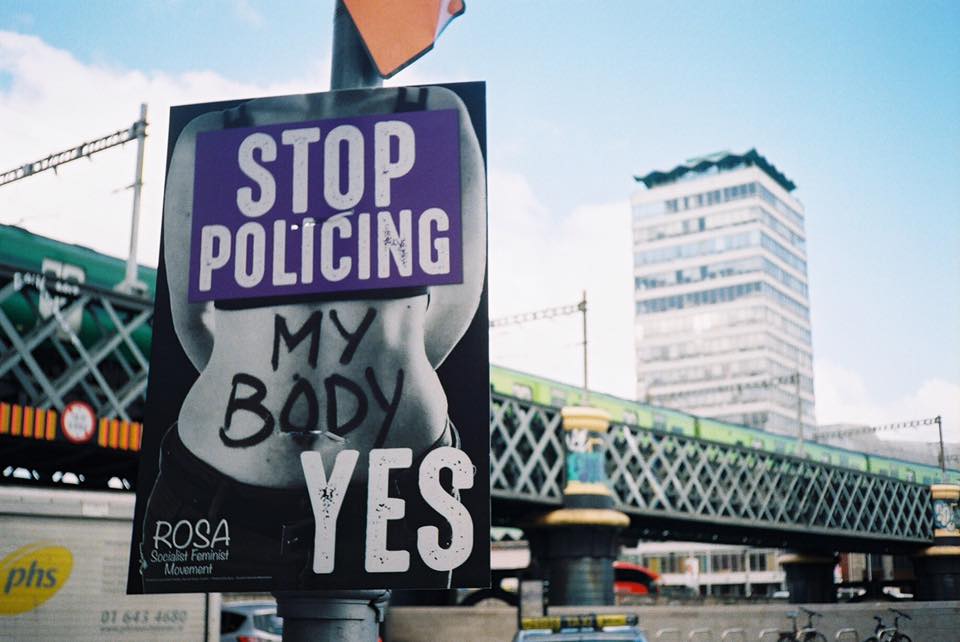
Featured image: ‘Stop Policing My Body in Dublin’, taken by Aerin Lai

In almost all European countries abortion is permitted. According to the Centre for Reproductive Rights, standard European practice is to legalise abortion on request or broad social grounds, in at least the first trimester of pregnancy. In addition, most countries also ensure that abortion is legal throughout pregnancy when necessary to protect the health or life of the woman or pregnant people. Only in a very small minority of European countries, namely Poland and Malta, does the law prohibit abortion in almost all circumstances.

Yet, abortion provision remains subject to criminal law: abortion services may largely be provided as part of maternal and reproductive health, but unlike other aspects of healthcare, abortion continues to be conceptualised within a legal framework.

So instead of the law guaranteeing the right to abortion, abortion is understood as a criminal offence – either by the person seeking the abortion and/or the medical practitioner providing the service – and therefore only permitted within a legally controlled framework.

The consequences of violating this framework include hefty prison sentences. No other form of healthcare is subject to this level of criminalisation and it creates a profound “chilling effect” on both those seeking abortion care and on healthcare providers offering legal abortion services.

Even in countries where legal restrictions may only apply to the stage at which abortion is available, criminalisation still results in a precarious social and legal situation for people in need of abortion, forcing many to travel to access the services that they need. This system of “enforced” mobility disproportionality effects those with neither the means nor the ability to be “mobile”, particularly poor women, disabled women, migrant women and pregnant people.

Abortion access, therefore, is intimately connected with questions of mobility and immobility. Mobility allows some people to move and requires other people to remain fixed in place. Thus the term “mobility” captures both movement and “stuckness,” meaning the ways in which movement occurs, and the attempts to regulate or prevent it.

Reproductive mobility is used by states to regulate and discipline the act of reproduction. Particularly as embodied in women’s fertility; it becomes a means of fixing fertility: dealing with, sorting out, and putting it right.

Reproductive mobility is a contested space; a site of conflict but also a site of potential political transformation. Indeed the issue of reproductive mobility has become a key aspect of abortion activism. For example in Ireland, where abortion was criminalised in almost all circumstances except where a woman’s life was at risk, abortion activists have long exploited the political potentialities inherent in reproductive mobility, underscoring the hypocrisies and vulnerabilities inherent in the Irish state’s regulation and control women’s fertility and mobility. During the successful 2018 “Repeal” campaign to legalise abortion, activists highlighted how Irish women have long sought to access abortion through mobility.

For decades in Ireland, abortion was shrouded in secrecy and shame. Then, in 2013, the story of the death of Savita Halappanavar because an international story that exposed the violence behind Ireland’s criminalisation of abortion. Savita, a 31 year-old Indian national living in Ireland, attended a leading Irish maternity hospital, miscarrying for 16 weeks. Doctors there felt unable to offer standard medical treatment due to the presence of a foetal heartbeat. Pleading for her life, Savita repeatedly asked for an abortion but was refused and was told “Ireland is a Catholic country”.  Five days later she died of septicaemia.

The Irish campaign to legalise abortion that exploded in months after Savita’s death saw the historic silence around abortion evaporate as thousands of women came forward to tell their abortion exile stories publicly through campaign groups like TFMR (Termination for Medical Reasons) and anonymously through the In her Shoes campaign.

These stories included the experiences of women who have been raped; women who were denied life-saving medical treatment like chemotherapy simply because they were pregnant; women with desperately wanted pregnancies, who after receiving the devastating diagnosis of a fatal-foetal anomaly were told they must continue their pregnancies to term regardless of the outcome.

Criminalising abortion did not stop Irish women from ending their pregnancies; If they were “mobile”, they travelled to Britain to access abortion. If they were “immobile” they risked a 12 year prison sentence and sought clandestine, illegal abortions even if that meant putting their lives, health and liberty at risk.

Most importantly, these abortion stories themselves also “travelled” between national contexts, becoming a key focus for activists in Malta, in Poland and in United States. These stories highlighted the enforced immobility of many women within borders, especially asylum seekers who remain “stuck” and unable to access abortion because they lack mobility. This political form of storytelling not only humanises women and pregnant experiences, but also exposes how a state’s control and criminalisation of reproductive healthcare amounts to nothing less than state-sanctioned gender-based violence.

Author’s Bio

Sinéad Kennedy teaches in the Department of English at Maynooth University, Ireland. She was a founding member of Together for Yes, the 2018 campaign to remove Ireland’s constitution ban on abortion and continues to campaign for reproductive justice in Ireland through Action for Choice.

DAY ELEVEN: Anti-Abortion Ideology on the Move: Examining Mobile Crisis Pregnancy Centers

You likely wouldn’t think of volunteers at crisis pregnancy centers—unregulated anti-abortion non-profit organizations that masquerade as health clinics—as the backbone of the anti-abortion movement. But this industry has become a primary mechanism through which the anti-abortion movement spreads its ideology writes Carly Thomsen. 

Carly Thomsen

Featured image: “Devil Bus” by Rayn Bumstead, graduate of Middlebury College, where she was co-organizer of the Queer Artists’ Collective. “Devil Bus” highlights the dangers of mobile CPCs and counters the happy, rosy, and warm aesthetics that mobile CPCs use to downplay their political agendas. 

When you think of who makes up the anti-abortion movement, you might imagine activists protesting in the streets. Or political lobbyists working with conservative lawmakers to enshrine their beliefs into law. Or religious leaders condemning abortion. You likely wouldn’t think of volunteers at crisis pregnancy centers—unregulated anti-abortion non-profit organizations that masquerade as health clinics—as the movement’s backbone.

But the crisis pregnancy center (CPC) industry has become the primary mechanism through which the anti-abortion movement spreads anti-abortion ideology. Indeed, the anti-abortion movement invests more time and resources into CPCs than any other aspect of their work. Such funneling of resources reflects the anti-abortion movement’s belief that CPCs are a useful site from which they can make mobile anti-abortion sentiment and enact what we ought to consider gender-based violence under the guise of care and concern.

Deception is central to this work. Scholars, reporters, and activists have illustrated what CPCs’ deceptive practices look like: disguising their political and religious motivations; implying that they offer abortions when they do not; opening near abortion clinics with the intention of confusing and thus hijacking those en route to the clinic; and peddling false information regarding abortion.

Scholars found, for example, that 80% of crisis pregnancy center websites listed in state resource directories for pregnant women include false or misleading medical information, including that abortion leads to breast cancer, infertility, and mental health issues, among other claims that have been repeatedly proven false.

Such inaccurate information is given credence by the aesthetic decisions of CPCs, which suggest that they are medical clinics when they are not. For instance, some CPC volunteers wear white lab coats and some CPC websites include medical imagery. Perhaps more worrisome, CPCs also increasingly offer free ultrasounds, although they do not make clear to clients that these ultrasounds are meant to be “non-diagnostic,” and therefore are not medical in nature.

Recently, the CPC industry has started to take their anti-sex, anti-abortion messages on the road, using mobile on-the-go buses and vans to extend their geographic and political reach. Mobile CPCs use many of the same strategies that brick-and-mortar CPCs use; however, their geographic slipperiness raises additional concerns beyond those associated with stationary CPCs.

First, mobile CPCs are able to park immediately outside of abortion clinics, allowing them to get closer to abortion seekers than brick-and-mortar CPCs can. Second, their mobility allows them to travel along routes that can constantly shift; this unpredictability and nimbleness makes more difficult possibilities for anti-CPC resistance. Third, mobile CPCs spread anti-abortion messages while in transit, quite literally moving around anti-abortion sentiment in ways that brick-and-mortar CPCs simply cannot. Fourth, if we listen to what the CPC industry tells us, mobile units are allowing the anti-abortion movement to more effectively target low-income women, women of color, and women in rural areas. Lastly, mobile CPCs will be even more difficult to regulate than brick-and-mortar CPCs.

If a city or state were to pass laws restricting the activities of CPCs in their jurisdiction—as most states and the federal government have done regarding abortion—mobile crisis pregnancy centers could simply drive to a neighboring area without these same laws in place, a problem that would remain even if passing legislation to regulate brick-and-mortar CPCs became common.

Despite these problems, there are no state or federal laws regulating mobile CPCs and there are no large-scale feminist campaigns directed specifically at mobile CPCs. In fact, we don’t even know exactly how many mobile CPCs exist. In the U.S., where the anti-abortion movement has utilized mobile CPCs more than in any other country, estimates of the numbers of mobile CPCs in circulation range from 170 to 260. (For context, there are approximately 2600 brick-and-mortar CPCs in the U.S. and just 700 abortion clinics.) While the U.S. is the epicenter of the CPC industry, CPCs exist in more than 100 countries. They are clearly a global problem. According to a Heartbeat International database, there are, for instance, 249 CPCs in the United Kingdom. And there are eight mobile CPCs outside of the U.S.

Regardless of the scale at which mobile crisis pregnancy centers operate, they raise concerns worthy of consideration by scholars, policy makers, and activists—especially because the anti-abortion movement is increasingly using mobile units to spread Evangelicalism, medical misinformation, and anti-abortion ideology. In so doing, mobile CPCs, like brick-and-mortar CPCs, raise serious public health and data privacy concerns.

Mobile CPCs, therefore, should encourage those of us on the political left to re-think the positive affects that tend to stick to mobility and movement. Mobile crisis pregnancy centers use their mobility to reproduce dominant power relations, further entrenching the sexism, racism, and classism of the status quo through remaking the spatiality of reproductive politics.

In short, mobile CPCs demonstrate that movement and mobility can thwart people’s opportunities to develop liberatory imaginaries, desires, and futures. While CPCs’ mobility has created new possibilities for the anti-abortion movement to capitalize on people’s marginalization and enact the kinds of gendered violence inherent within anti-abortion activism, it also could inspire new forms of abortion justice and anti-gendered violence activism. We might just have to hit the road to do it. 

Author’s Bio

Carly Thomsen is assistant professor of gender, sexuality, and feminist studies at Middlebury College. She is the author of Visibility Interrupted: Rural Queer Life and the Politics of Unbecoming from the University of Minnesota Press (2021) and directed and produced In Plain Sight, a documentary short that extends the arguments of this book. For more information about the film, visit http://www.inplainsightdocumentary.com. She’s currently completing a book about queer reproductive politics. Learn more about Thomsen’s research and teaching at www.carlythomsen.com.

DAY TEN: Dowry abuse and exit trafficking in the transnational context  

Sara Singh sits down with Prof Manjula O’Connor, psychiatrist, researcher and advocate, to talk about the issue of dowry abuse in the transnational context and the use of exit trafficking by perpetrators to abandon victim-survivors overseas.

Sara Singh and Manjula O’Connor

Featured image: Couple crossing last fingers, reproduced from Shutterstock.

Sara Singh sits down with psychiatrist, researcher and advocate Professor Manjula O’Connor to talk about dowry abuse in the transnational context and the use of exit trafficking by perpetrators to abandon victim-survivors overseas.

In recent years, there has been growing awareness amongst policymakers, service providers and community members in Australia of the issue of dowry abuse. Defined as the use of ‘coercion, violence or harassment associated with the giving or receiving of dowry at any time before, during or after marriage’, dowry abuse is a form of domestic and family violence (DFV) that disproportionately affects women, girls and their families.

Whilst historically the practice of dowry in Indian societies was intended as a means of empowering women and providing them with a measure of economic and financial security as they began a new chapter in their lives as married women, in modern times the practice has been exploited by many individuals who utilise it as a tool for obtaining and/or accumulating wealth and money.

Research has highlighted how men and their families may make excessive demands for dowry and perpetrate various forms of abuse against women and their families to coerce them to accede to their dowry demands. At the same time, perpetrators may abuse women in retaliation for providing what they perceive to be ‘inadequate’ or ‘insufficient’ dowry.

“If the groom or his family believe that the amount of dowry given was not sufficient, then that starts to give rise to all kinds of abuse, including demands and extortion”, says O’Connor, who has spent more than a decade supporting women who have experienced dowry abuse in Australia.

According to O’Connor, one of the main factors facilitating the perpetration of dowry abuse is the power imbalance that often exists between perpetrators and victim-survivors. In transnational marriages, this power imbalance is often heightened, creating further opportunities for abuse. Research has highlighted how globalisation and international migration have generated and reinforced inequalities in power, status and socioeconomic opportunities between countries and regions. These inequalities can have implications for marriage and dowry negotiations.

O’Connor highlights how non-resident Indian (NRI; i.e., an individual with Indian citizenship who has migrated to a foreign country) men living in Australia may be perceived by residents in their country of origin as highly attractive candidates for marriage due to their NRI status and the potential social and economic opportunities that their residency in Australia provides. In these circumstances, NRI men may leverage their Australian residency status to demand greater dowry from women and their families. “The marriage prospect of an Australian resident back in South Asia…for example in India, they are very good…” says O’Connor. “They are seen to be far superior as compared to the local grooms and that increases the value of the groom in terms of the dowry amount.”

In many cases of dowry abuse in transnational contexts, the victim-survivor may also be reliant on the perpetrator for visa sponsorship into the country the perpetrator is residing in. This dynamic contributes to the power imbalance between the perpetrator and the victim-survivor, creating further avenues for abuse. 

O’Connor notes how perpetrators, for there may be multiple, may exploit their position as the victim-survivor’s visa sponsor to demand additional dowry. These demands may be reinforced by threats by the perpetrator to withdraw their sponsorship of the victim-survivor’s visa if the victim-survivor does not accede to the perpetrator’s demands. In this way, perpetrators coerce and control victim-survivors, and instil a sense of fear in them.

O’Connor also highlights cases where the perpetrator has, after receiving large amounts of dowry from the victim-survivor and her family, tricked or coerced the victim-survivor to return to her country of origin, and then abandoned her there and withdrawn sponsorship of her visa, leaving her unable to re-enter Australia. “What I have seen is that there are some grooms who are able to fraudulently send their wife back home under false pretense, and when she’s there, have removed their sponsorship and cut off all connections with her and confiscated the dowry given”, says O’Connor.

This tactic of deceiving or coercing victim-survivors to return to their country of origin, and subsequently abandoning them there, is termed ‘exit trafficking’. Defined as the use of coercion, threat or deception to make an individual leave the country, exit trafficking is a criminal offence in Australia (see s 271.2(1A), Sch 1, Criminal Code Act 1995 (Cth)), with offenders liable to a maximum sentence of 12 years imprisonment if found guilty of the offence.

Despite the criminalisation of exit trafficking in Australia, however, community awareness around the issue remains low. Victim-survivors of exit trafficking are often unaware that the perpetrator’s conduct amounts to a criminal offence and that they can be supported to legally re-enter Australia.

“Most women do not know that they are able to return back to Australia under this particular law which says that exit trafficking is illegal and a criminal offence”, states O’Connor.

Currently, multiple services in Australia assist victim-survivors of exit trafficking. The Australian Federal Police (AFP), for example, investigates cases of exit trafficking, supports victim-survivors, and offers referrals to other relevant support services. One such support service is the Australian Red Cross, which is funded by the Department of Social Services to run a support program for individuals who have experienced trafficking. The ultimate decision around whether a victim-survivor of exit trafficking can stay in Australia rests with the Department of Home Affairs.

As O’Connor notes, more work needs to be done to develop community awareness around the issue of exit trafficking in the context of dowry abuse, so that victim-survivors are aware of their legal rights under Australian law and can access appropriate services for support and assistance. “I think that the most important thing is education of the community and women”, says O’Connor. “It’s very important that [victim-survivors] are given the information that in the case of domestic violence or any threats of trafficking that they should connect with the police and relevant services straightaway”.

Authors’ bios 

Manjula O’Connor is a Psychiatrist with four decades of experience. She is also an applied researcher and a published author. Her primary area of interest for past 10 years has been family violence and mental health in immigrant communities. She chairs the Royal Australian NZ College of Psychiatrists Family Violence Psychiatry Network and is an Honorary Associate Professor at the Department of Psychiatry, University of Melbourne, as well as an Adjunct Professor at the UNSW School of Social Sciences. Manjula co-founded the Australasian Centre for Human Rights and Health in 2012 and advocates against family violence in immigrant communities. Manjula led the public dowry abuse campaign in Australia that led to the inclusion of laws against dowry abuse in the Victorian Family Violence Protection Act and triggered the Federal Senate Enquiry into dowry abuse. She is a member of South Asian Community Ministerial Advisory Council, and aa White Ribbon Advocate. Manjula’s work has been cited in the Victorian Parliament and the Federal Australian Parliament several times. Manjula was a member of the steering group that organised the Second National Dowry Abuse Summit.  

Sara Singh is a Research Assistant at the Gendered Violence Research Network (GVRN), UNSW Sydney. She has a Bachelor of Laws (LLB) and a Bachelor of Criminology and Criminal Justice from UNSW and has worked across various research projects in the fields of criminology and social work. She is interested in research aimed at informing policy development and best practice responses to individuals and communities impacted by gendered violence and has undertaken research in areas such as domestic and family violence, and economic and financial abuse. In 2020, Sara was awarded a UNSW Scientia PhD scholarship. Her PhD research explores perceptions and experiences of dowry and dowry abuse of women from Indian communities in Australia.